DECOLONIAL ARENAS 2026 KICKS OFF

At the end of October 2025, we coordinated the visit of a delegation of women activists from Tunisia and Libya to Italy, to bring the voice of women fighting for their rights in the Mediterranean.
Within the framework of the project "Nisaa' Lil Salam - Women for Peace", promoted by Un Ponte Per and financed by the Eight per Thousand funds of the Waldensian Church, and of the project "Kutub Hurra", financed by the Haiku Lugano Foundation, between 22 and 30 October 2025, a Libyan delegation representing the Libyan Legal Aid Organisation (LLAO) and a Tunisian one representing theLina Ben Mhenni Association (ALBM), took part in a series of events and meetings to compare and exchange views with Italian civil society in Palermo, Rome and Padua. The Tunisian delegation, however, did not receive the necessary visas to enter our country and had to resort to remote connections to take part in the meetings.
IN PALERMO, FOR THE SABIR FESTIVAL
The first appointment was on 23 October, when the delegations took part in the 'Women on the Move' event as part of the Sabir Festival in Palermo. During the meeting, the Libyan representatives brought a valuable and complex testimony on the condition of women and migrants in their country, explaining how the rate of female emigration remains very low in Libya, even after the fall of the Gaddafi regime, when a significant number of women were forced to flee the violence of militias and armed groups. Migrants, Libyan and sub-Saharan, often do not find better conditions in the destination countries and, once rejected, suffer abuse and violence in detention centres and militia-controlled locations. In the absence of official data on female migration, the Libyan Legal Aid Organisation continues to fight for the approval of a law protecting all women, Libyan and foreign, from violence.

Also at the Sabir Festival, together with Un Ponte Per and ARCI, the Libyan delegation also participated in the event 'Colonial Traces: Deportations. A confrontation with the uncomfortable memory', a meeting and presentation of the photographic exhibition 'I relegati libici a Ustica dal 1911 al 1934', which related contemporary migratory and social dynamics to colonial history, in particular the Italian colonisation of Libya and the deportation of Libyan activists to the island of Ustica. The Festival was also an opportunity for Tunisian activists to present the valuable work of the Lina Ben Mhenni Association, and in particular the Feminist School created by the prematurely deceased Tunisian activist - which culminates each year in the 20/27 Festival with workshops and activities such as the Lina Clubs, dedicated to art, creative writing, theatre and cinema - and the distribution campaigns of Arabic-language books in Tunisian and Italian prisons.
On this occasion, the women activists of the Libyan delegation discussed their legal and advocacy work, at national and international level, to implement draft laws against violence against women, irregular migration and human trafficking. They also talked about providing legal assistance to victims of violence and holding training sessions for female citizens and recent law graduates.
IN ROME, BRIDGES OF FEMINIST RESISTANCE
A few days later, in Rome, the association Casa delle Donne Lucha y Siesta, with the participation of a councillor from the metropolitan city of Rome and local activists, organised the meeting 'Bridges of Feminist Resistance'. On this occasion, the Tunisian delegation illustrated several initiatives promoted by activist Lina Ben Mhenni, such as the book distribution campaigns for detainees in Tunisia, the provision of medicines and support for patients suffering from rare diseases, as well as the documentation of the violations against protesters during the 2011 revolution.

The Libyan delegation focused on the condition of women in Libya and the challenges they face due to the legislative vacuum with respect to protection against gender-based violence, the prevalence of institutional violence and militias against women, and the dominance of a still strongly patriarchal mentality in society. The participants discussed the difficulties and threats they face in trying to promote new laws to protect women through advocacy campaigns and legislative proposals to supplement legislation that is outdated and no longer conforms to international human rights standards.
IN PADUA, WITHOUT BEING ABLE TO ENTER PRISON
Finally, a final meeting was held in Padua on 30 October, moderated by the local Guarantor of the Rights of Persons Deprived of their Liberty, which was also attended by institutional figures and representatives of civil society. Once again, Tunisian and Libyan activists illustrated their work, insisting on the importance of strengthening the role of women in reconciliation and peace-building processes in Libya and Tunisia.

Despite the request for permission submitted at the beginning of October to allow the activists to visit the Rome Juvenile Prison, the prison administration did not issue the necessary permits in time. Unlike in Rome, the Padua prison administration had issued the visit permits for 30 October. However, following the issuing of a new directive by the Central Prison Administration on 21 October, both the visit and the related activity planned with our partners in the 'Kutub Hurra' project were cancelled.
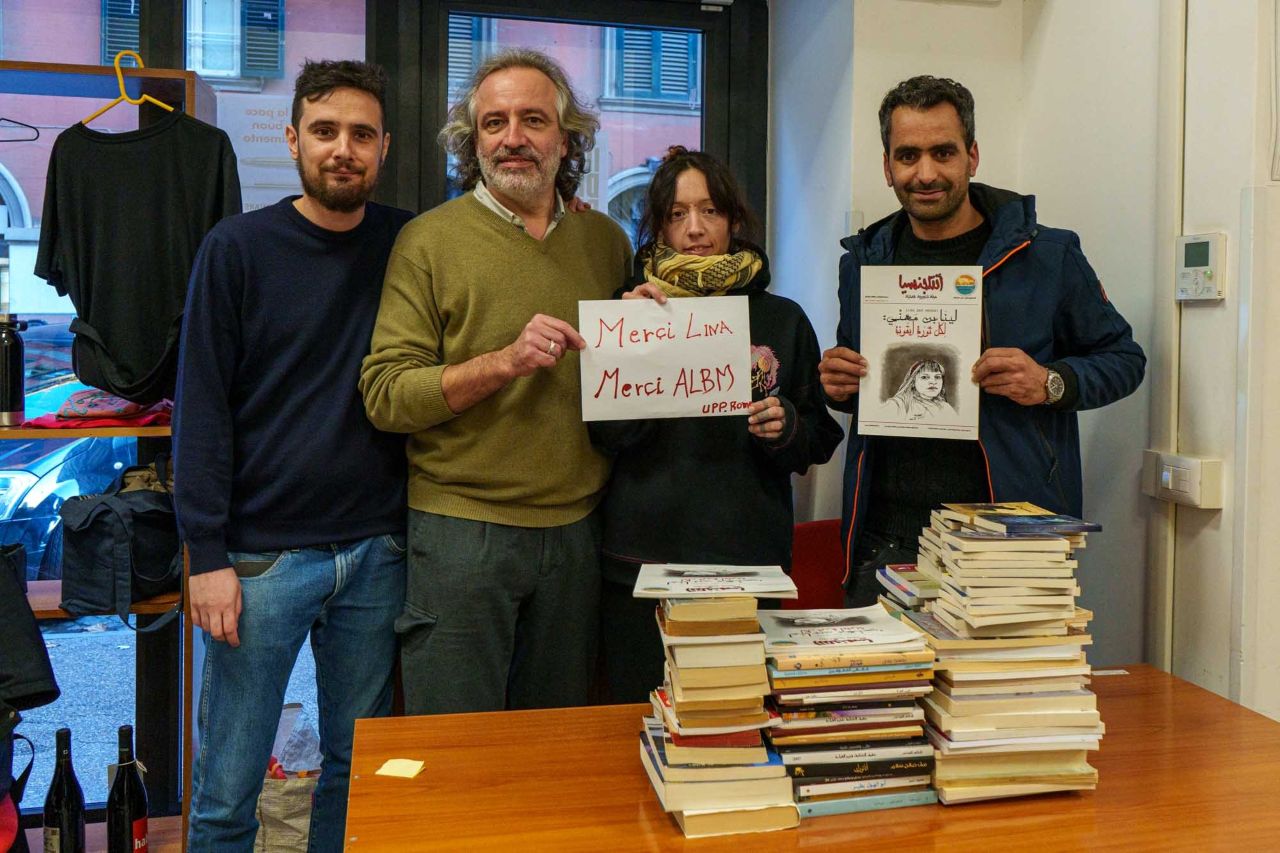
The directive revoked the authority of local prison administrations to approve activities and their permits, transferring this competence to the DAP. Although the activity was already planned and approved, the prison administration immediately implemented the new directive and suspended the previously approved planning and permits. A Ponte Per was informed of this decision less than 24 hours before the planned event. Consequently, we proceeded with a symbolic delivery of 100 books during the meeting held on 30 October at the City Hall.

Mohamed Ed-Daoudy - Contact person for the 'Kutub Hurra' programme of Un Ponte Per