DECOLONIAL ARENAS 2026 KICKS OFF

We wanted to share iftar together on the first day of Ramadan, but she refused completely, all because of that black mask on her face. It wasn’t illness that made her refuse, but something deeper than exhaustion, harsher than hunger.
The story begins with Hamdi’s family, which consisted of nine people including him. Before the war, he was a successful trader in the markets. Money was never a worry — he owned property and several businesses that allowed him and his family to live comfortably.
But when the genocide began, day by day, life started changing for Hamdi and his family. Things that were once easy to get became almost impossible. On the first day of May 2024, Hamdi received news that his property and everything he owned had been destroyed by occupation missiles. He couldn’t bear it, and in that moment, his heart stopped, leaving behind a whole family struggling to provide the basics of life on their own. They lived in southern Gaza, in Rafah.
A week later, news came of the invasion of Rafah. More than a million people, including the displaced from Rafah, were forced to flee into the unknown. I was Hamdi’s neighbor. That day, during the displacement, Um Youssef — Hamdi’s wife — didn’t know how to leave the house or what to do. I managed to contact a transport vehicle to take her few belongings. She planned to go temporarily to her sister’s house in central Gaza.
After that day, I didn’t see Um Youssef and her family until November,2025 almost two years into the genocide, after the fragile ceasefire. My mother got a call saying that Um Youssef was looking for a place to set up her tent because she couldn’t find anywhere. We tried to find her a small space on our land, enough for her, her two young children, and her daughters.
A few hours later, Um Youssef and her family arrived. I could barely recognize them except through one of her daughters, who was my age and whom I knew from before. Their faces had changed so much. They came with a small cart carrying their belongings, including a little child who seemed older than his years, having seen too much in life. Youssef, who was nine, tried to carry and unload the items by himself.
Um Youssef wore a mask, at first, I thought it was because of the flu or something like that.
I helped them arrange their belongings, set up the only tent they had, built a temporary bathroom, and organized everything. It was mid-winter, and every day a new storm arrived. The storm wasn’t just weather; it was another test of whether the fragile tent could withstand a world collapsing over it.
Through all this, I watched little Nour Al-Din, her shy child who kept looking away from me. When he laughed for the first time, his innocent smile, when I played with him, I would say, “Kiss me, and I’ll buy you a biscuit?” And that was the end of that day.
A week later, I was sitting with my mother and asked her about Um Youssef. Why, in the cold winter, did she live in a tent? She told me, tears welling in her eyes, that Um Youssef had been living in a tent for over a year, after the area where her sister lived in central Gaza was threatened. She found a place in a shelter center.
Then she moved to southern Gaza called Asdaa to set her tent. She lived there alone with her family in a displacement camp. Her sister’s house had been partially destroyed, making it impossible for her to return, experiencing multiple displacements herself and with her family.
My mother told me that in mid-2025, the Israeli occupation suddenly entered the area where they lived, forcing most families to leave without any belongings. When Um Youssef returned, many of her few possessions had been destroyed. She endured some of the hardest days of hunger, sometimes surviving on just one meal every two days.
During that period, aid entered sporadically and didn’t reach everyone. Prices in small markets doubled every week. A bag of flour became a dream, and a can of sardines had to be divided among several children. The question was no longer, “What will we eat?” but, “Will we eat today?”
I couldn’t stop thinking about this. Even in my own family, with my father and my brother Mohammad, we barely managed to get by. How did others manage? How did they cope with the struggle for the simplest foods, the basics of life, sometimes almost impossible to obtain?
I remembered seeing little Youssef on the first day he arrived. His sharp expression made sense, he carried worries beyond his age, having seen so much despite being only ten. And the mask Um Youssef always wore, what was its story? Why did she wear it all the time?
I asked because in December and January 2026, I went to check on them during harsh winds and heavy reins. I tried to help them tie down anything the wind tore or dig channels in the sand so water wouldn’t flood their tent. Even in those conditions, she kept her mask on.
My mother told me the reason. Before the war, when life was good, Um Youssef jokingly told my mother she wanted a gold tooth. Today, she wears the mask because of her circumstances — she has been robbed of the ability to smile, even at a young age.
I didn’t understand at first. I asked my mother what she meant. She explained: due to hunger, stress, headaches, and the pressures of life, she lost many essential vitamins, and her upper teeth fell out. She tried visiting several dentists to fix them, but the cost — about $4,000 — was impossible. She had to accept reality and wear the mask indefinitely.
The mask didn’t just cover her mouth.
It hid the effects of hunger on her body and her embarrassment in a world that didn’t even leave her the right to smile.
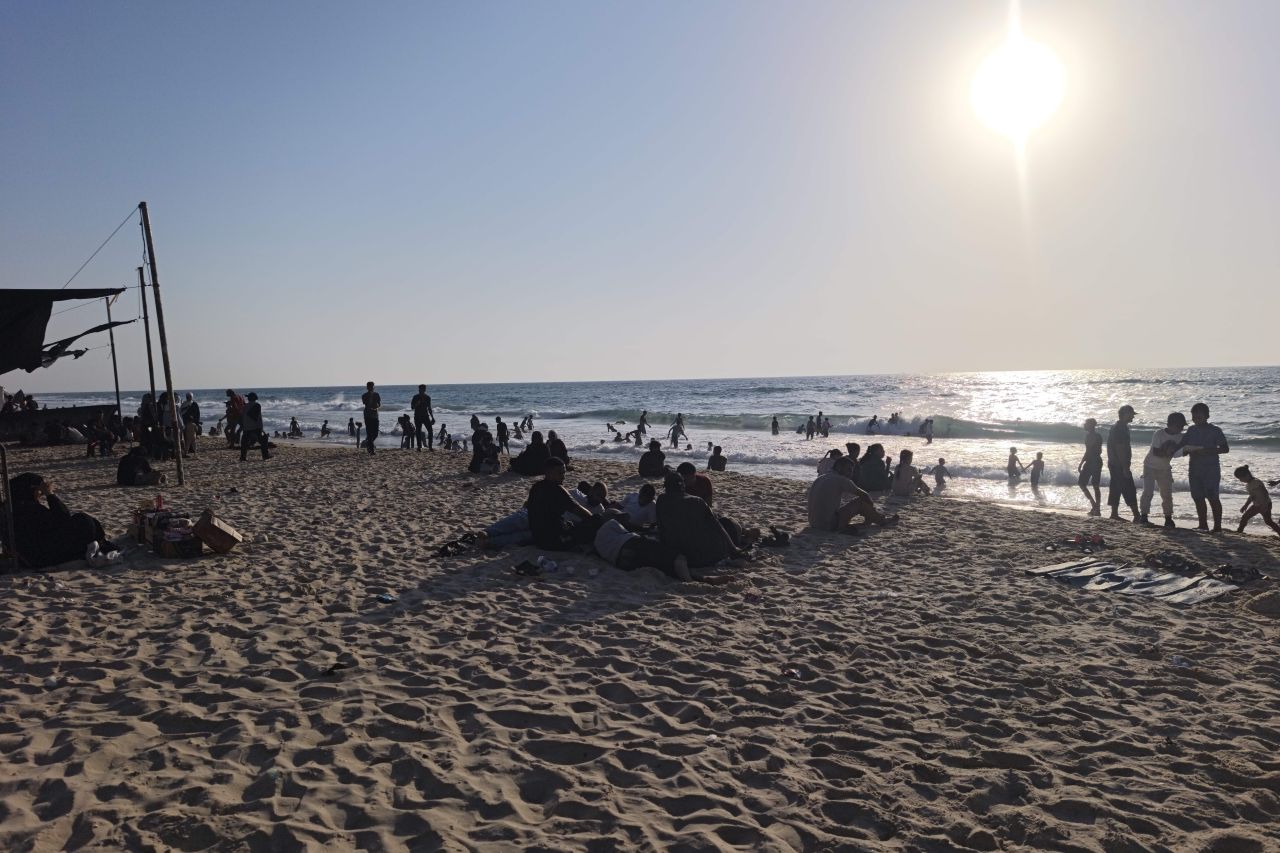
I couldn’t stand that moment. I remembered Hamdi Abu Youssef, always praised for his generosity. I once asked him for a ring as a child, and he brought it the next day. Now, I write for more than ten international platforms, translated into seven languages, and yet I couldn’t help her. I felt helpless, frustrated, and heartbroken. I went to the sea for fresh air, but even that day, the breeze that usually calmed me had no effect.
Ramadan began on February 18. A day before, I wanted to bring them some joy. I tried inviting them to share iftar with us. They refused at first, saying she was sick. In truth, she couldn’t remove her mask to eat in front of anyone.
In Ramadan, families gather around food. She feared the eyes watching her instead.
I saved some money from my writing to provide them with Ramadan necessities, to share small moments of happiness and let them know we were thinking of them. This Ramadan, though lacking its usual signs and traditions, we try to make it through, carrying memories with us every day.
When I look at Um Youssef, I don’t see her alone. I see all of Gaza, trying to hide its cracks beneath a thin layer of patience.
Her story is not unique. There are 57, 000 stories like hers, reflecting the harsh reality of life in Gaza today, under a fragile ceasefire and empty peace slogans that mean nothing.

Hassan Herzallah - Correspondent from Gaza