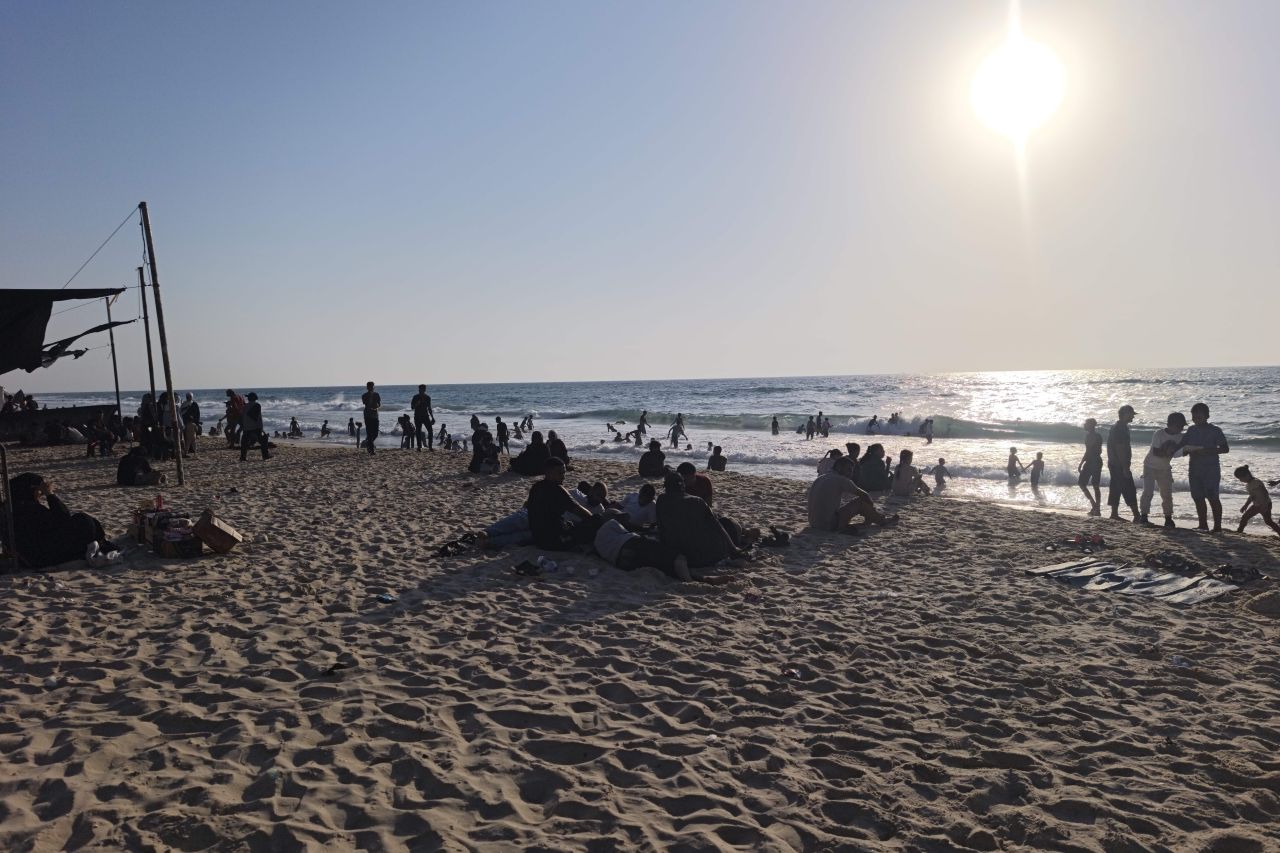
WAITING FOR THE SUN. A THOUSAND DAYS OF GENOCIDE

"Together with my brother, we grew 8,000 trees: we had olive, lemon and vine trees. We lost 3,000 of them to Daesh (ISIS), because of the constant fighting. But little did we know that the worst was yet to come: this year we lost another 3,000 due to lack of water."
This was Ahmad's account to Daniela Sala, collected in a beautiful reportage published in the Guardian in 2021. Unfortunately, not much has changed since then, and northern Syria continues to suffer from a severe water shortage. The causes can be found in climate change, but also (and perhaps above all) in the dams upstream of the Euphrates river - in Turkey - which mercilessly cut off the flow of water reaching Syria. Another huge problem is that of waste; more than a decade of war has not only left wounds in people's bodies. The entire landscape is still largely reduced to rubble and the amount of debris everywhere is appalling.
"During sandstorms in the most desert areas, one can see real clouds of rubbish floating in midair".
Our co-chair Angelica Romano, who recently returned from a trip to the country with Alfio Nicotra, also co-chair of Un Ponte Per, told us.
After years of rebuilding hospitals and health facilities, as well as opening clinics in refugee camps, since 2019 we have been working on the recycling and proper disposal of medical waste, supporting over 36 health facilities in the governorates of Hasakeh, Raqqa and Aleppo. Environmental and ecological protection is one of the main axes of commitment for the Autonomous Municipalities of North-East Syria(NES). Last year here, together with our partner Kurdish Red Crescent (KRC), the local authorities and thanks to the support of the Area Metropolitana de Barcelona (AMB) and the Prosolidar Foundation, we laid the foundations for the first pilot project of waste separation and recycling at municipal level in the NES. Not only medical waste, but also common waste, produced by households. Below is the video story of Angelica and Alfio.
In the Municipality of Hasake, we have found particularly fertile ground for these first projects, in which the collaboration between local authorities and citizens is crucial to their success. Obviously, awareness-raising activities were carried out 'house by house', to prepare the population for a new way of collecting waste. Today, we can say that the waste collection system set up is working, also involving some local cooperatives in door-to-door waste collection.
"The waste is collected from the houses, and then taken to a place for sorting and recycling," says Rovand Abdo, co-chairwoman of the Environment Department of the Municipality of Hasake, a really smart woman who confirms the very important link between female leadership and the environment. A pairing that we strongly support, and which is often encapsulated today by the term 'eco-feminism'. Let us remember that Syria is still one of the areas in the world with the highest rates of gender-based violence and a very limited supply of protection services. This is whyRovand's example is even more revolutionary. We can listen to her in the video below, in which she shows the results of the Zero Waste project we are running alongside her.
As you can see in the video, mainly in these early stages of the project, the separate collection and recycling of plastic/metals, paper and organic waste was started. With the organic waste, fertilisers and manure are produced. "Great for the soil," Rovand adds, proudly showing the agricultural fields where it is used to increase the city's green spaces.
"In the next phase of the project, we will try to expand to other neighbourhoods, so that other people can benefit from this programme because it has beneficial effects on the environment, agriculture, hygiene, human health and in general on reducing waste."
concludes co-chair Rovand Abdo with great determination, and we hope with all our hearts that it will happen. Maybe it is just a drop in the bucket, as our co-chair Alfio Nicotra says, or maybe it is the prelude to a bigger change towards a highly sustainable circular economy.
Un Ponte Per has been present in north-eastern Syria since 2015, initially sending humanitarian shipments destined for the Kurdish Red Crescent, and then structuring its intervention since 2016, when several projects were launched to rebuild the area's health system and offer support to the population fleeing Daesh.