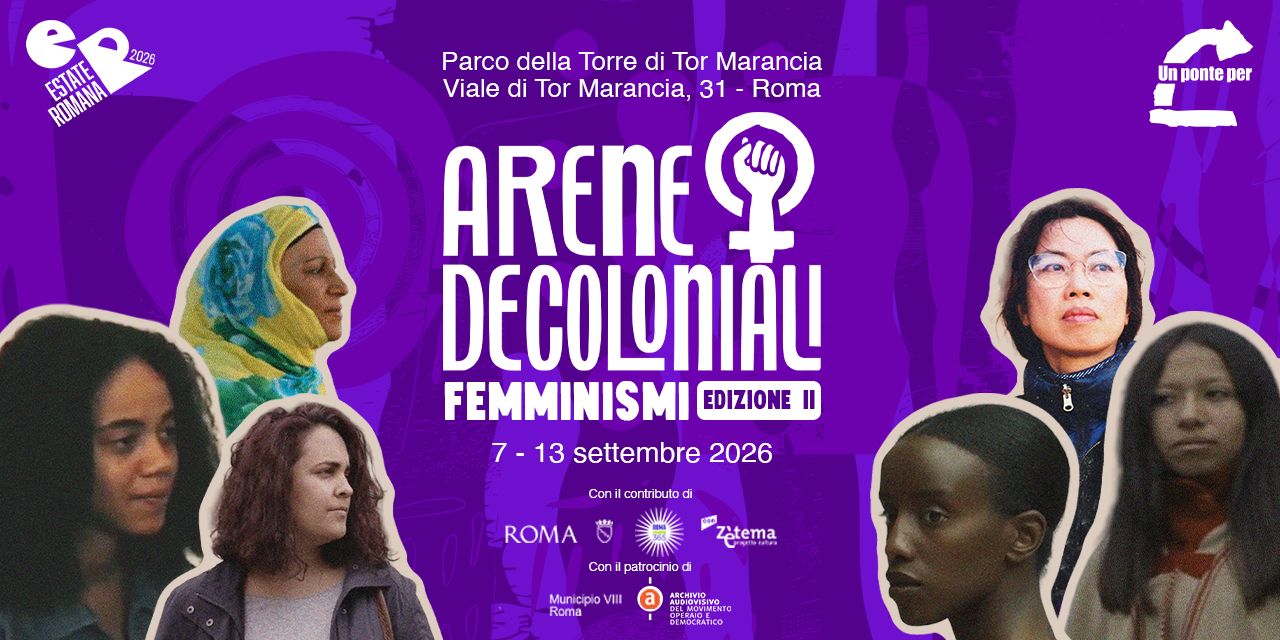
DECOLONIAL ARENAS 2026 KICKS OFF
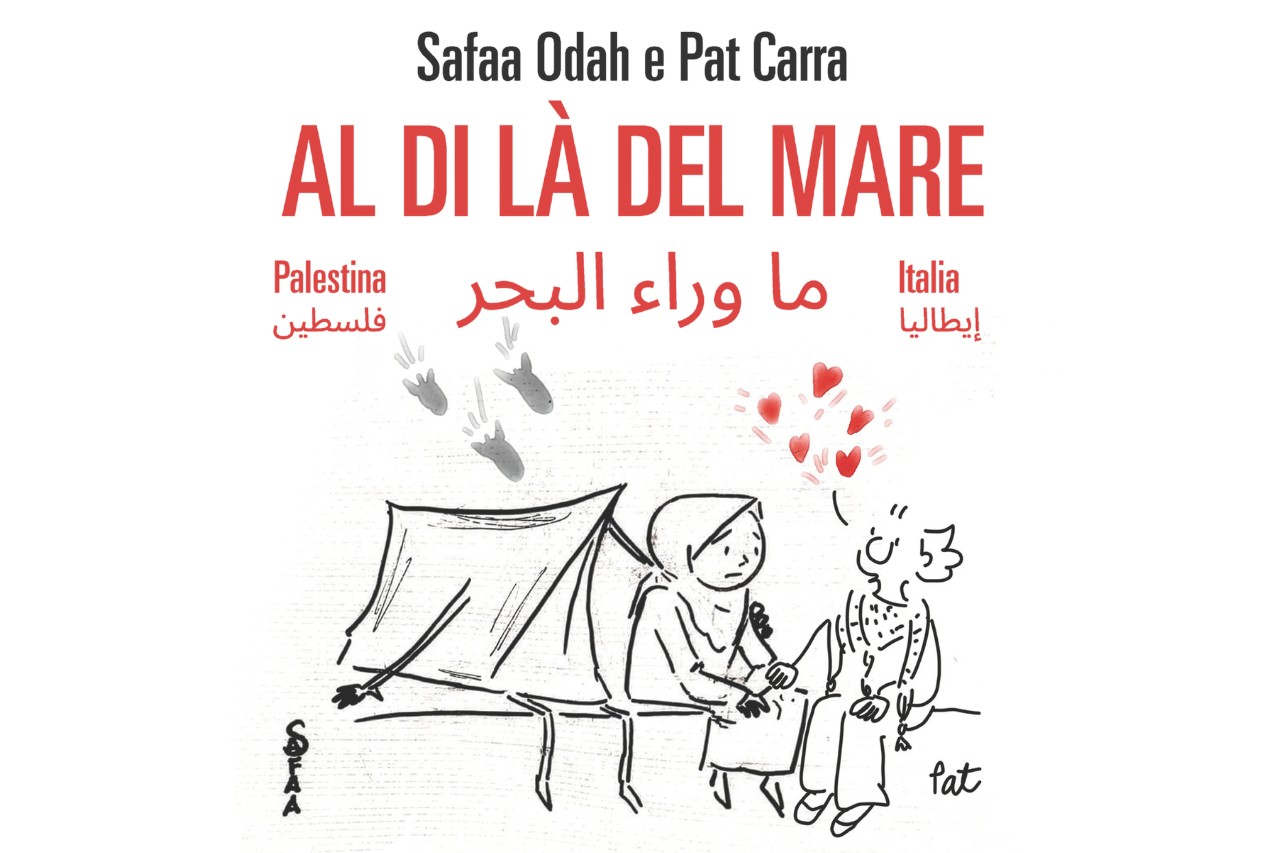
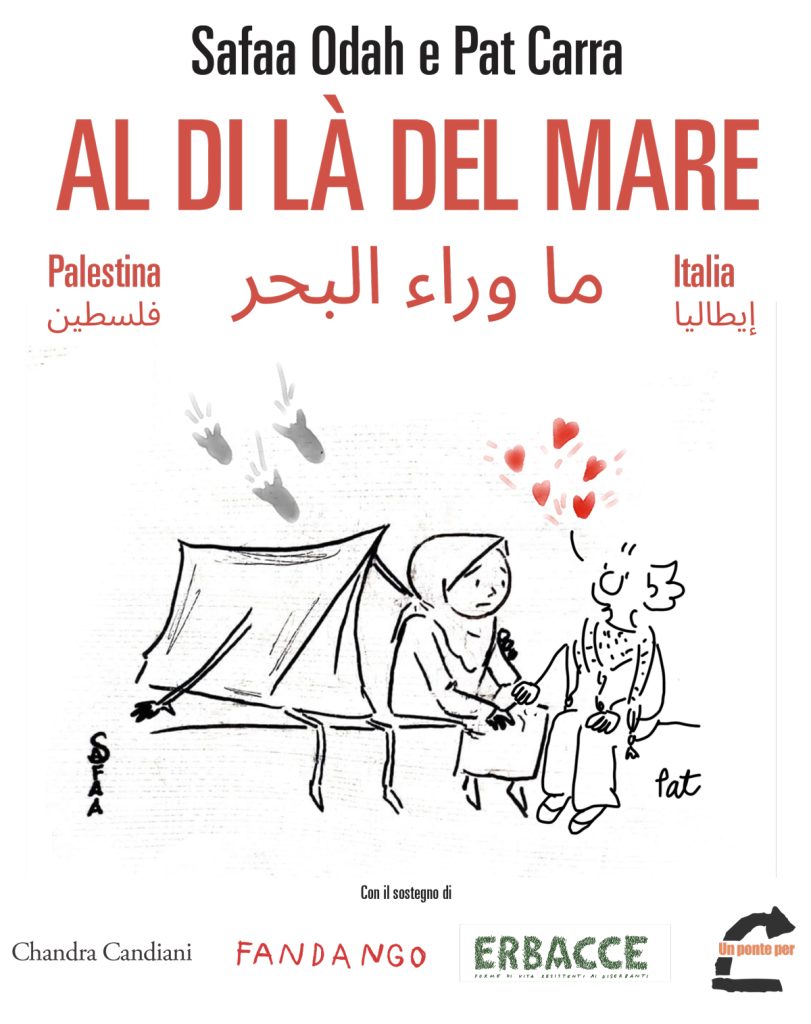
A bond of friendship, solidarity and feminism: this is what unites the cartoonists Pat Carra and Safaa Odah, across the divide between Italy and Gaza. From their meeting in 2024 – whilst Safaa continued to draw and bear witness from the tent where she lives as a displaced person in the Strip – a shared artistic and human journey emerged, which today takes shape in the book Safaa and the Tent. Diary of a Cartoonist from Gaza (Fandango, 2026) and in the travelling exhibition Beyond the Sea. Palestine Italy.
The exhibition, which opens in Lecce on 11 June before moving on to Rome and Modena, brings together illustrations, comics and works created by the two artists, including a number of collaborative pieces that defy the distance imposed by borders, sieges and wars. A project that tells the story of Palestine today through art, humour as a form of resistance and a deeply feminist perspective. Also supported by Un Ponte Per, in collaboration with Chanda Candiani, Fandango and Erbacce, Al di là del mare stems from the book’s publication and the desire to transform a relationship forged between Milan and Gaza into a shared space for encounter, memory and imagination.
We interviewed Pat Carra and Safaa Odah together to talk about comics, friendship, resilience, and the power of images to cross the sea even in the most difficult of times.
How did you meet, and how did your relationship begin?
Pat Carra – I met Safaa in 2024 on social media. I fell in love with her comics; that’s how it all began. I asked her to contribute to *Erbacce*, the feminist humour magazine I’m part of, and we dedicated the column *A Tent in Palestine* to her. An increasingly engaging correspondence developed between us. Fate assigned me the challenge of creating the practical conditions for a joint project, first her book and then our exhibition. In “Safaa and the Tent: Diary of a Cartoonist from Gaza”, there is also a second protagonist: our relationship. We are two cartoonists and share a feminist perspective; Safaa is 30 years younger than me, she is energetic and courageous, and her faith makes her strong. At a painful time for me, she was very close to me. It was a paradox to receive support from Gaza, where genocide is taking place and everything is in short supply. We found ourselves laughing.
Safaa Odah – We met during extraordinary times. Those were extremely difficult times and I was in a very fragile state of mind. As you know, we were going through a genocide. At that time, drawing was a way for me to resist and stay strong. We met on social media and I realised straight away that Pat is not just an artist, but a person. I’ve met many colleagues and artists, but she was the only one to stay, and there was something different about her. Over time, our relationship went beyond the boundaries of collaboration. In this encounter, I found a space where I could be sincere. Through her, I discovered a world of wonderful friendships, including the poet Chandra Livia Candiani. Pat played a very important role in getting my drawings published in the magazine Erbacce, and it was through her that the book with Fandango came about. We connected through our thoughts even before our drawings, and through our feelings even before our words.
What role does drawing play in representing the world around you?
PC – Comics and humour have always been a form of resistance for me. When I draw cartoons about male violence or war, I’m following a path that has its roots in my childhood. Like Safaa, I am self-taught in drawing; she studied psychology, I studied philosophy, yet we both ended up choosing this language, which is simple but not simplistic. It is an art that brings things back to a human scale, revealing the truth beyond the fiction, like the child who says ‘the emperor has no clothes’. Transforming anger, hatred and anguish into a moment of liberation is the essence of the craft. In 2004 I created ‘Cassandra Laughing’, a character who chronicles the Western wars following 9/11. Safaa bears witness to the post-7 October genocide by stripping the oppressor of his supposed omnipotence: Israeli soldiers are unbearable in her cartoons, just as the rats she depicts in front of sacks of flour are.
SO - For me, drawing isn’t just a means of expression, but a way of understanding what’s happening around me. Very often, words are not enough. I draw to document what I experience and what I see – not just events, but also emotions and everyday details that others might not notice. Sometimes I feel I am a witness, and that it is my duty to convey this reality as it is, with sincerity, even if it is very painful. Moreover, drawing is a space through which I can confront this reality, not flee from it. It is my means of staying grounded and of transforming this pain. It is not just art: it is a responsibility. To recount what is happening from my perspective and to leave a real impact on the viewer.
What have these years of genocide been like, as seen from Gaza and Italy?
PC – I march in the squares, attend meetings and follow the news, but my true guide on Palestine is Safaa. We share a common language, that kind of comic: socio-political, feminist, with a touch of humour even when the subject matter is tragic. Italy is a country sold out to the United States and Israel; Milan is a city twinned with Tel Aviv. Safaa is the only cartoonist who continues to draw from Gaza. My commitment from Italy has been to nurture our friendship, recognise her leading role, amplify her voice and join her in chorus. Safaa is a great cartoonist; her work is destined to become a classic, and to feel her trust is an honour. Her struggle is mine: we survive in a capitalism that cannot be defined in human terms.
SO – It’s been a difficult two years, and it’s not over yet. The war has never stopped; we live in constant fear of loss. This takes a very heavy emotional toll. In Gaza, there is no longer any separation between life and death: they are intertwined. For us now, living is simply about trying to survive. Over the years, Pat has always sent me photos and images of solidarity demonstrations from Italy, with truly extraordinary participation. This has been very important to me: it made me feel that our people are not alone, that there are so many people supporting us. I have always known that Italy stands in solidarity with Palestine, but during the war this was even more evident. Through social media I could see just how much solidarity there was, and the support was truly exceptional.
What does it mean to you to see a book and an exhibition resulting from your collaboration today? How did this idea come about?
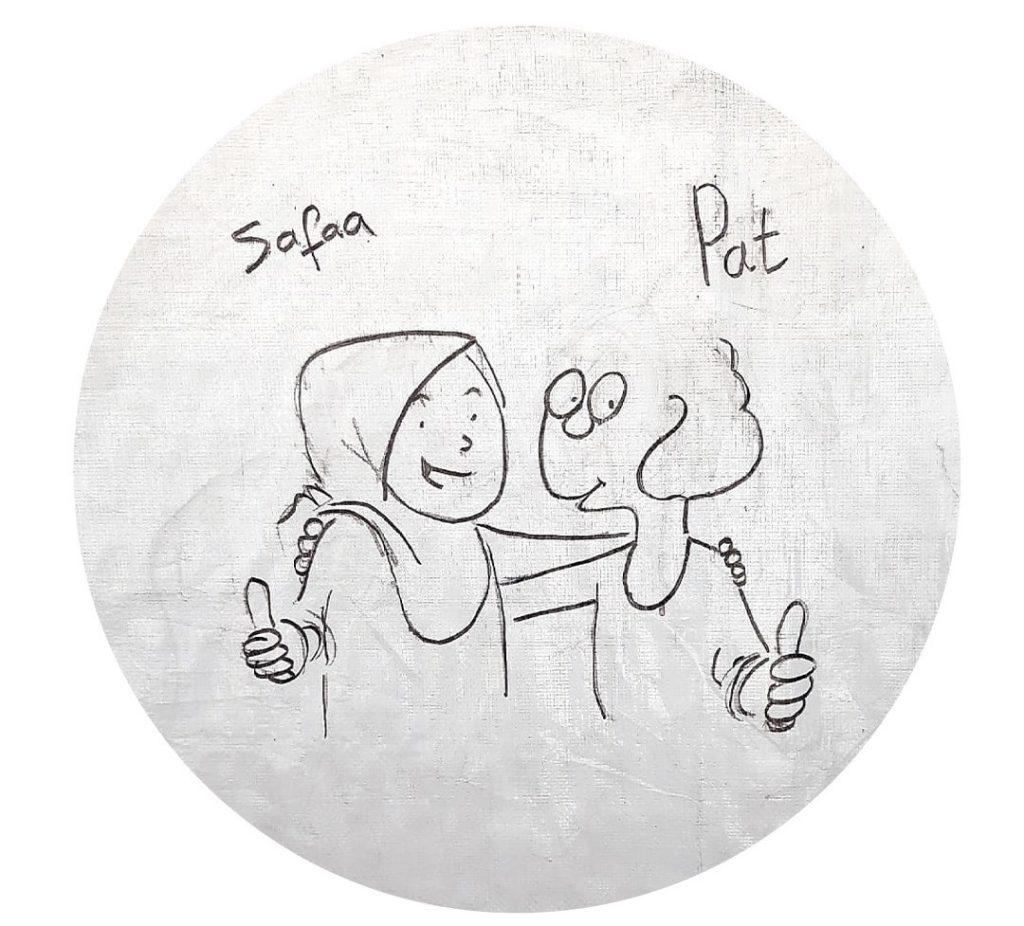
PC – Driven by a desire to put our relationship at the heart of the project, two female comic artists from two different countries. Whilst I was editing Safaa’s book, the practical conditions for working together simply weren’t there. We had to create a narrative thread, make choices and take risks. She would write to me, “keep going”. I wanted to get as close as possible, so that I could carry on. One day in 2025, I had run out of words to encourage Safaa. I chose one of her comics and drew myself next to her: this collaborative drawing became the exhibition’s central image. Others followed, forming the heart of “Beyond the Sea”: we meet in the comic, quite literally. The poet Chandra Candiani, who is with us here through her text “Indomitable Trust”, describes it in this passage:
“And there is the loving bridge between Safaa and Pat, their meeting echoing from one side of the sea to the other. A number of collaborative comics have emerged, like nocturnal sonatas and dialogues in the dark between frightened little girls who reassure one another thus within the evil of the world, without leaving it, with their fragile yet incorruptible instruments of salvation. Through their testimony. Through their working together.”
SO – Seeing my book and exhibition come to life from this collaboration stirs up mixed feelings in me. On the one hand, there is immense joy; I never expected to achieve this. I am grateful and happy for all of this. But I would have loved so much to be there with you. For us, every drawing has a story; every detail is linked to a moment, and it seems to prove that something can continue to exist and grow despite everything.
Venues for the exhibition "Beyond the Sea" (updated)