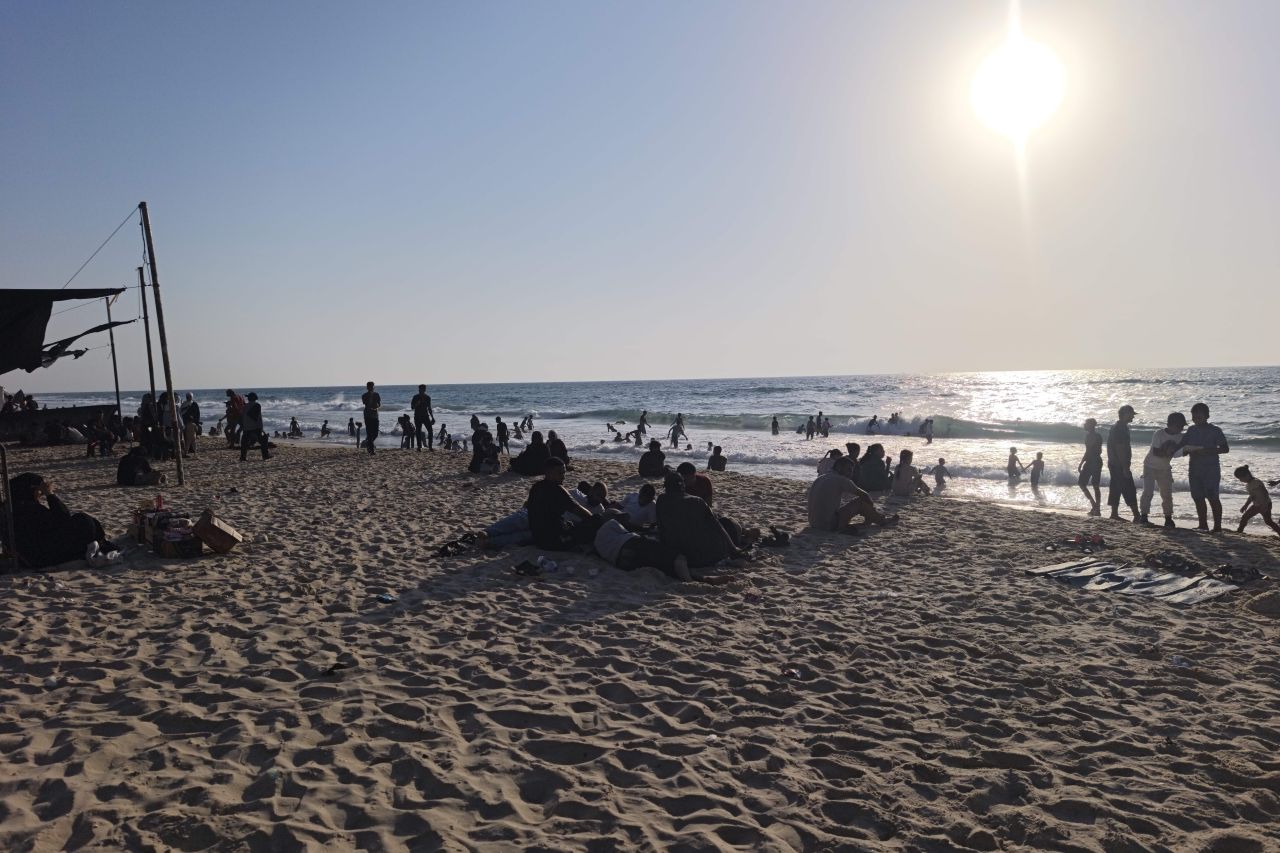
WAITING FOR THE SUN. A THOUSAND DAYS OF GENOCIDE

Peace has never been just a word, but the very condition for life to endure and cultures to flourish. Without peace, there is no civilisation, no art, no science. Iraq, the cradle of civilisations for millennia, today offers the world a new testimony: countries scarred by war can rise from the ashes and rewrite their destiny in the language of hope.
Situated at the crossroads of geographies, Iraq lies between East and West, between the Gulf and the Mediterranean. This location was never just a matter of borders: it was (and is) a living bridge, a place where cultures intertwined and human histories converged. Here the first cities of Sumer arose, here the laws of justice were engraved in Babylon, and Nineveh flourished as a capital of art and intellect. Today, after decades of upheaval, Iraq re-emerges not as a battlefield, but as a beacon that declares to the world that hope can shine brighter than devastation.

Iraq is an open-air museum. From the Ziggurat of Ur to the walls of Babylon, from the ruins of Nineveh to the cities of the south, each stone tells a story of human resilience, creation and the eternal connection between peace and prosperity. These are not silent remains: they are living messages that whisper to every visitor: 'History began here, and here humanity can rediscover itself'. Today, Iraq opens its doors to travellers, scholars and lovers of beauty, inviting them to see how past and present meet on its land in one wonderful fresco.
Yet Iraq's greatest treasure is not its monuments, but its people, its youth. Emerging from the rubble of war, they carry out cultural, artistic and educational projects that replace the language of violence with that of creativity, transforming memories of pain into energy for renewal. These Iraqi youth are not simply the face of a new generation: they are custodians of hope, guardians of the future. They are the ones who are redefining the image of their country before the world: Iraq, a land of peace, not war.
For too long, the international media has reduced Iraq to images of conflict and division. But local stories are shattering this narrative. Youth initiatives, art movements and cultural events have crossed national borders, reaching global forums and demonstrating that Iraq cannot be encapsulated in images of destruction: it must also be read as a narrative of resilience, reinvention and rebirth.
Iraq is more than a geographical space; it is a philosophical question about the very meaning of humanity. From its ancient civilisations we learn that creativity only springs from the womb of peace. From its modern history we learn that war leaves nothing but ashes. And today, walking the streets of Baghdad or in front of the Ziggurat of Ur, the earth itself asks a timeless question: "What will we leave to future generations?"
From the land that once taught mankind the alphabet comes a new lesson: hope is invincible, and Iraq, with all its wounds and memory, is also a land of great dreams.

CHALLENGES AND WORK FOR CHANGE
It would be dishonest to talk about Iraq without acknowledging the difficulties it has gone through. Decades of conflict have left scars on its infrastructure, society and collective memory. Many people abroad continue to see it only through stereotypes of destruction and despair. However, today's reality is much richer and full of hope. The Iraqi people - especially the youth and civil society - are dismantling those images and building a new model of coexistence, creativity and peace.
And the younger generation has been at the forefront of this transformation. Through cultural initiatives, art projects, educational programmes and volunteer work, they are proving that Iraq is not a battlefield, but a fertile ground for creativity and human endeavour. They are writing a new chapter in Iraqi history, based on dialogue, mutual respect and the replacement of violence with art and development.
Civil society played a key role. Organisations like Un Ponte Per have worked for years with local communities to empower young people, promote dialogue, overcome social divisions and strengthen reconciliation. They have supported women's initiatives, promoted cohesion and trained a new generation of leaders convinced that transformation starts with small gestures that can generate big changes. Our projects have united formerly divided neighbourhoods, revitalised cultural spaces and offered children the chance to dream of a brighter tomorrow.
These efforts have not gone unnoticed. Beyond Iraq's borders, the world has begun to see that its story cannot be reduced to a war narrative. Youth initiatives and civil society projects have reached international audiences, inspiring others and demonstrating that change is possible when we unite with courage and vision.
From Iraq - the land where the first laws were written and the first letters carved in clay - I would like to speak to the global community. It is time to end the arms trade, to stop the arms race that drains the planet's resources and fuels endless conflicts. It is time for humanity to rethink its priorities, investing not in war machines, but in bridges of peace: in education, in art, in health, and in the future of generations to come.
People who have endured war and poverty deserve peace: not as a privilege, but as a basic human right. Peace is not secondary; it is essential to life itself.
Those who hold the power to shape the destiny of the world have a responsibility not to accumulate influence or wealth at the expense of other peoples, but to be custodians of peace, guardians of humanity's future and not of its conflicts.
Let Iraq bear witness that civilisations are only born in the womb of peace, and that our common future can only be built on love, understanding and coexistence. Every human being deserves to live a life of dignity, free from violence.

Jameel Al-Jameel - Communication Coordinator of Un Ponte Per in Iraq