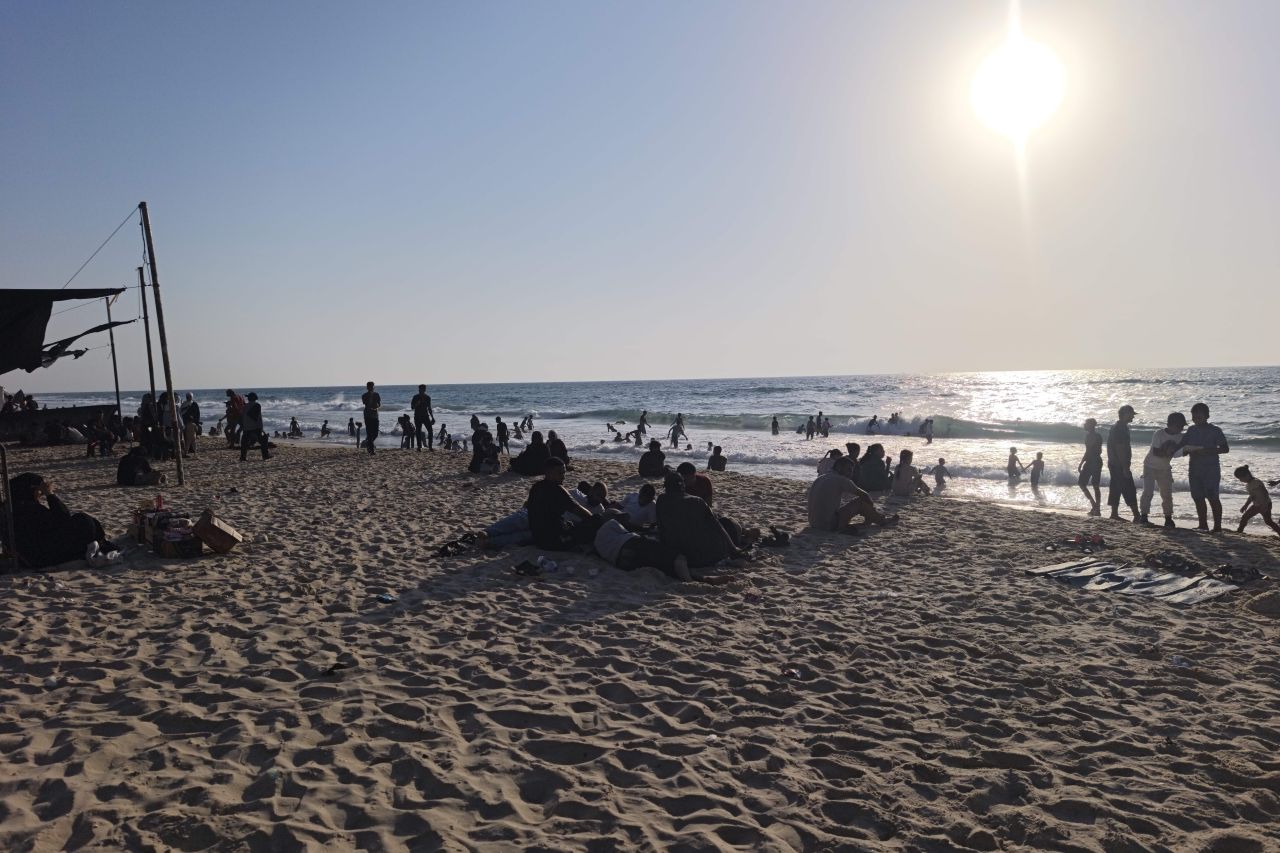
WAITING FOR THE SUN. A THOUSAND DAYS OF GENOCIDE

It was 2012 when we at Un Ponte Per, who had already been working in Iraq for years, began our journey alongside the thousands of people crossing the border into Syria at the time, fleeing a war that no one could imagine would last so long.
At the time we were among the few NGOs in the country, and we responded to that emergency by going to the border and directing the arriving people to the humanitarian assistance services that the Kurdish government in the north of the country was already setting up. Soon thereafter, 10 camps would be opened to receive refugees, in which we would immediately start work. First by trying to understand the needs of the people who had arrived from Syria. Then, choosing to work with them to provide psychological support to those who were carrying the trauma of the conflict: inAugust 2013, there were already 220,000 Syrians in Iraq, 90% of whom were refugees in Iraqi Kurdistan. Right from the start we realised that psychological assistance was not considered a priority, although it was a central need.
Lia Pastorelli, Program Desk of Un Ponte Per, who has followed the programme for many years, tells us this long story.
"At the end of 2012, we obtained funding from UNHCR to intervene in this area, and immediately started working with the Directorate of Health in Dohuk and Erbil, in Iraqi Kurdistan, to provide training for local staff, distribution of medicines, individual and group counselling, and psychological assistance for children and girls," he tells us.
"We do this thanks to the supervision of our psychiatrist, Paolo Feo, who builds specific training to offer support especially to minors. The staff working with us is mostly Syrian: many people who arrived from Syria had a background in psychology, but their qualifications were not recognised by the local authorities. However, by putting themselves at the service of their communities with the desire to help them, they have contributed in a fundamental way to the work we have carried out over the past 10 years.We also realised that the general approach was very much focused on medicalisation: the Syrian staff was instrumental in encouraging a different therapy, more based on dialogue, which only resorted to medicines when strictly necessary,' Lia explains.
"There has been a great focus on children and adolescents, through the technical supervision of specialised personnel and following programmes structured by UNHCR.This has allowed us to base our work on scientific evidence and to appreciate important changes thanks to very precise evaluation and monitoring systems,' he emphasises.
Lia remembers well that most of the problems concerned cases of depression, anxiety, post-traumatic stress.For the children, on the other hand, there was nocturnal enuresis, aggression, difficulty in concentrating. "All this was mitigated through resilience groups, play therapy, leisure activities designed for them," he says. "We also worked a lot on training the teachers within the camps, so that they would recognise the children who needed more structured support," she explains.
Today, there are over 260,000 refugees from Syria in Iraq. 90% of them live in Iraqi Kurdistan: 40% are still in camps, the others have moved to urban areas. "We have also worked in the cities to accompany their integration into the social fabric and to guarantee access to care and psychological support, a right that many of them did not even know they had," Lia recounts.
The best thing about these years of work has been to see the positive impact. "Seventy per cent of the people who have benefited from our support have been women. Over time we saw them and the refugee community change: they realised that mental health is a right, that this support was not something to be ashamed of.And we received consistently very positive evaluations of our intervention," she explains.
In fact, over 90% of the people we have accompanied over the years have said they have experienced relief of their symptoms. Levels of anxiety and stress have decreased, interactions between the children and their families have improved, aggression has decreased. "There remains of course the challenge of being a refugee, of not feeling they belong to the host community, the lack of access to economic opportunities, which continue to have a major impact and remains a heavy legacy of any conflict," Lia acknowledges.
But the most important achievement, probably, 'was that we managed to work for so many years with Syrian staff who never changed, without wasting the skills we had acquired and relying on their expertise.I think of our colleague Rashad, a psychology graduate from Damascus who fled the war and wanted to help his community in every way,' Lia recalls. "His degree, however, was not recognised in Kurdistan. He worked with us as a counsellor for years, and we finally managed to get his degree recognised by UNHCR.It was a wonderful achievement for him, but also for us.
In 2023, then, our work came to an end. In 10 years, we managed to support 250,000 people and provide psychological support to another 23,000.
Together with UNHCR, we chose to transfer all the intervention to our colleagues from 'Wchan - Organisation for victims of human rights violations', a local Kurdish-Iraqi NGO, which now carries on the support for refugees. "The work continues, but our support is no longer needed," Lia says with satisfaction.