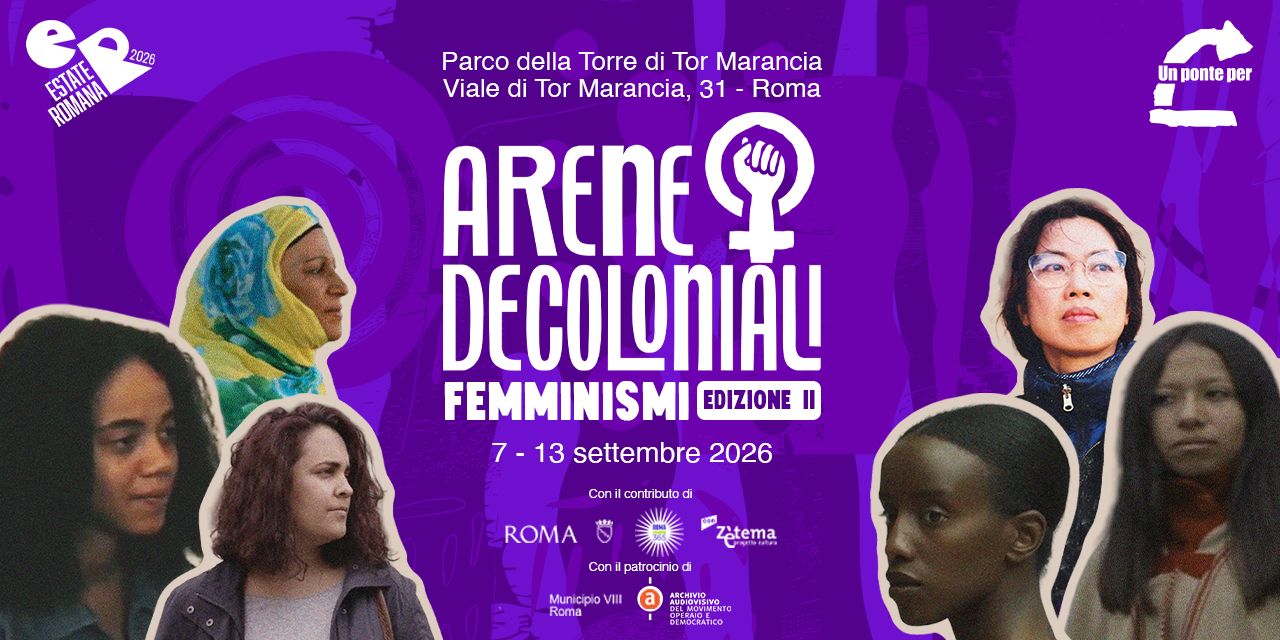
DECOLONIAL ARENAS 2026 KICKS OFF

Last weekend, the Austrian capital hosted the International Summit for Peace in Ukraine. A meeting promoted by international civil society to define a 'bottom-up' contribution to peace building paths, starting with a strong call for a 'ceasefire' that would lead to concrete and shared negotiations. Among the promoters of the Vienna Summit was also the Italian coalition "Europe For Peace", of which Un Ponte Per is a member together with the Italian Peace Disarmament Network. Fabio Alberti, founder of Un Ponte Per, participated on our behalf, recounting the two days of meetings in the article published on Michele Santoro's Servizio Pubblico. Here is the text:
"Cease fire immediately, without ifs and buts, save lives and start negotiating". This appeal emerges unanimously from Vienna, even in the difference of points of view that exist in a movement as broad and plural as the peace movement. Together, a commitment was made to continue the mobilisation in all countries, more than 40 of them represented here, until a week of global mobilisation from 30 September to 8 October.
These are the results of two very intense days of work in which 400 delegates from all continents were engaged in the summit promoted by two of the oldest peace organisations, theInternational Peace Bureau, founded in 1891 and Nobel Peace Prize winner in 1910, and the Woman International League for Peace and Freedom, which in 1915 took up the call against the useless slaughter of the Great War by dozens of women's organisations. Also promoting the summit was the Italian network Europe for Peace, repeatedly cited as an example of its capacity for unity and present with a sizeable delegation that included the Peace and Disarmament Network, CGIL, Sant'Egidio, Le Acli, the Nonviolent Movement, Un Ponte Per, Pope John XXIII, and the #StopTheWarNow caravan. Also numerous was the US participation, which since the Vietnam War has been constantly striving to curb their country's militarism.
At the centre of the debate were first and foremost the victims, hundreds of thousands of both Ukrainian and Russian, as witnessed by the Ukrainian representatives whose descriptions of the suffering of the populations moved the room, and received the solidarity of the Russian and Belarusian participants who are fighting the war at great personal risk. The president of the Ukrainian Pacifist Movement, Yuri Sheliashenko, said that war is 'first and foremost the mass killing of human beings' and is never inescapable but 'always a choice'. The choice to kill other human beings that conscientious objector Vitaly Alekseenko - whose message came at the conference - rejected by paying with the prison sentence from which he was recently released also thanks to international pressure. A solidarity confirmed together with the will to further tighten cooperation with Ukrainian, Russian and Belarusian civil society.
No doubt about the condemnation of the Russian invasion, reiterated in the final communiqué. "No error on the part of the West, no threat from NATO, no geopolitical calculation can ever justify the decision to invade a country and bomb its population," said a Ukrainian representative, receiving thunderous applause from the hall even as she implored "stop fighting now" then there will be time to discuss, but in the meantime stop killing. Negotiations take a long time and - as former US Army Colonel Ann Wright reminded us - can take a very long time, like those after the Korean War, for example, but in the meantime it is necessary that the killing does not continue. An immediate and unconditional cease-fire is the central and unifying point of the global movement, which 'does not mean recognising any territorial rights to Russia, but only stopping the killing and giving peace a chance', as the convening document puts it.
The West has made many'mistakes', starting with its failure to propose a system of shared security to Russia at the end of bipolarity, its enlargement of an alliance that, having exhausted the role for which it was created , should have been dissolved, and its failure to do anything to prevent the outbreak of war by boycotting even the first negotiations, as reconstructed in detail by Professor Jeffrey Sachs, former advisor to President Gorbachev. A Western responsibility too, therefore, is evident, but it does not justify it. Indeed, it is one thing to explain, on the basis of the laws of geopolitics, the dynamics that lead to the outbreak of a war, and quite another to use this to justify the decision to invade a country.
The peace movement is convinced, as polls show, that it represents the vast majority of public opinion, in the West, but particularly in the Global South. On this important were the testimonies of the delegates from the countries of the Global South, numerous from all continents. Most of the countries of the world, representing 75 per cent of the world's population, did not join the economic sanctions, while condemning the Russian invasion because, said Indian professor Anurada Chenoy, "they do not trust the West" based on the experience of 500 years of colonisation and fear that a consolidation of a position of Western global dominance will emerge from this war. This position, he added, is shared by democratic and non-democratic countries alike and explains the emergence of numerous peace initiatives from the southern hemisphere. 'The South proposes cooperation and the West responds competition, the South proposes multipolarism and the West responds unipolarism'. This is the evocative summary proposed by Prof. Chenoy, a concept echoed in a highly applauded speech by Colombian Vice-President Davis Choquehuanca. 'We must put an end to the politics of division proposed by the West,' he said, adding the need for a global policy inspired by unity, harmony and cooperation not only between nations but also with mother earth.
There was much interest, therefore, in the proposals that go in the direction of negotiation, after that of China, the Brazilian initiative, the African Heads of State, the Indonesian proposal, adding to the Turkish attempt at mediation, which failed, or was made to fail, in March 2022, and the Vatican proposal, which, it was learnt during the conference, is about to be launched together with dozens of Nobel Peace Prize winners.
These are all peace initiatives that the conference does not judge on their merits, but which it actively supports and will support as a whole. This is another commitment indicated in the final communiqué, because, it was said, it is necessary for the international community starting with the United Nations - much criticised for inaction - to act actively also because the war affects everyone. The war does not only make victims in Ukraine or Russia, but has made victims, particularly in Africa, because of rising food prices, it has increased energy costs all over the world creating millions of poor, it is causing a restriction of democratic space in all countries and, as no speaker failed to mention, it can lead tonuclear holocaust.
Article by Fabio Alberti, published on 11/06/2023 in serviziopubblico.it
Below is the text of the 'Vienna Declaration for Peace' drawn up by the participating organisations - downloadable here in PDF format.
We, the organisers of the International Summit for Peace in Ukraine, call on the leaders of all countries to act in support of an immediate ceasefire and negotiations to end the war in Ukraine.
We are a broad and politically diverse coalition representing peace movements and civil society, including believers, in many countries. We are firmly united in our conviction that war is a crime against humanity and that there is no military solution to the current crisis.
We are deeply alarmed and saddened by the war. Hundreds of thousands of people have been killed and injured, and millions are displaced and traumatised. Towns and villages throughout Ukraine, as well as the natural environment, have been destroyed.
Far greater death and suffering could still occur if the conflict escalates to the use of nuclear weapons, a risk that is higher today than at any time since the Cuban Missile Crisis.
We condemn Russia's illegal invasion of Ukraine. The institutions created to ensure Peace and Security in Europe have failed, and the failure of diplomacy has led to war. Diplomacy is now urgently needed to end the armed conflict before it destroys Ukraine and endangers humanity.
The path to Peace must be based on the principles of common security, international respect for human rights and self-determination of all communities.
We support all negotiations that can strengthen the logic of Peace instead of the illogic of war.
We affirm our support for Ukrainian civil society defending its rights. We pledge to strengthen dialogue with those in Russia and Belarus who put their lives at risk to oppose the war and protect democracy.
We call on civil society in all countries to join us in a week of global mobilisation (Saturday 30 September to Sunday 8 October 2023) for an immediate ceasefire and for Peace negotiations to end this war.
Vienna, 11 June 2023
"We must all do our part, to live up to the task of Peace" (Albert Einstein).