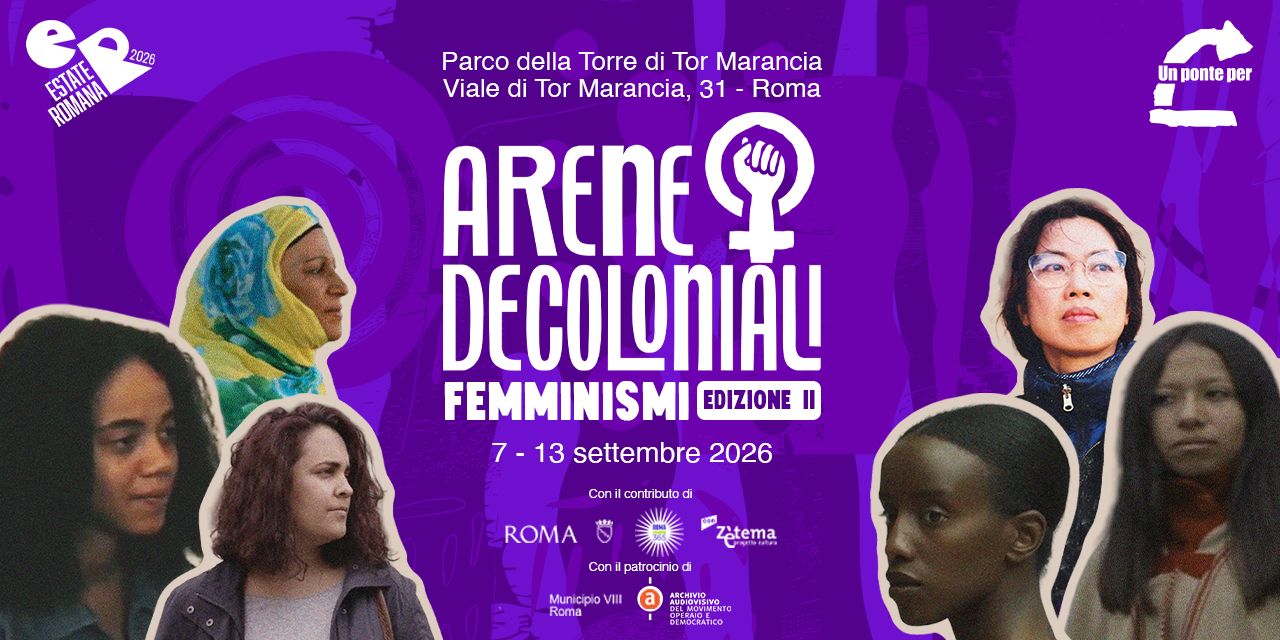
DECOLONIAL ARENAS 2026 KICKS OFF

A solidarity caravan has reached the Rafah crossing point, while the Strip sinks amid bombs, hunger and isolation. In these lines, we report the account of those who were there: voices and stories from the border of the siege. Interview with Giulia Torrini, co-president of Un Ponte Per.
In Gaza, people are dying of hunger, thirst, bombs and silence.
In the days from 17 to 19 May, while the international community stammered and the Western chancelleries divided themselves between timid warnings and diplomatic complicity, an Italian delegation decided to break the deafening immobility. Sixty members of parliament, MEPs, reporters and activists reached the Rafah crossing point to denounce the Israeli siege and the systematic use of hunger as a weapon of war.
The Gaza Strip has sunk into an abyss of inhumanity. Since 2 March 2025, no humanitarian convoys have crossed the borders: water, food and medicines remain blocked at the borders under Israeli control. The United Nations is sounding the alarm: over 14,000 children risk death from hunger and dehydration in the next 48 hours. UNRWA denounces the impossibility of distributing the remaining aid due to the continuous restrictions imposed by Tel Aviv.
In the almost choral silence of the international community, the figures become an epitaph: more than 53,000 Palestinians have been killed since the beginning of the Israeli military operation in October 2023. Entire families wiped out, health infrastructures reduced to rubble, schools turned into targets.
Confirming the systematic brutality of this offensive, on 19 May, the day the Italian delegation was still at the Rafah crossing, Israel ordered the immediate evacuation of Khan Younis and launched an unprecedented air attack on the town. Within an hour, hospitals, homes and civilian infrastructure were hit: at least 135 were killed, hundreds injured. Thousands of people, many already displaced, were forced to flee once again, without destination or protection. The war against the civilian population continues unabated; meanwhile, humanitarian aid remains blocked at the borders.
In an interview, Giulia Torrini - president of the Un Ponte Per organisation and member of the Italian delegation present at Rafah - recounts the moments she experienced near the crossing: 'During our stay at the Rafah crossing, explosions followed one another at regular intervals, every eight or ten minutes. The roar was sharp, penetrating, impossible to ignore'.
While the Netanyahu government declares the objective of 'total control' over Gaza in the name of the fight against Hamas, another truth takes shape on the ground: that of a strategy that many voices, without hesitation, define as ethnic cleansing masquerading as a war against terrorism. The rhetoric of security is thus being bent to justify a war of annihilation, which mainly affects unarmed civilians.

CAIRO: THE VOICES OF THE SURVIVORS
The recent initiative of the Italian delegation, promoted by AOI, ARCI and Assopace Palestine, took on a significance that goes far beyond symbolic solidarity. It was an explicitly political initiative, conceived as an act of rupture against the silent complicity of European institutions and the West's hesitant diplomacy. The presence at the Rafah crossing was not only intended to urge the entry of humanitarian aid, but to openly denounce the international legitimisation of a regime that, with its siege of Gaza, is waging a systematic war against the civilian population.
Torrini recalls the meetings with the Palestinian community in exile that took place in the days leading up to the arrival at the crossing: 'In Cairo, we met what we could call the "survivors": journalists, aid workers, activists who were refugees in Egypt, mostly women. They did not just share their stories: they confronted us with our responsibility, laid us bare, without discounts.
The testimonies, particularly during the confrontations with the political component of the delegation, were direct and incisive. Some activists bitterly expressed their conviction that not enough is being done, pointing out that for months images of violence have been observed and shared without this leading to concrete change. One young woman also raised the question of the use of those images, believing that their dissemination could take away the dignity of the victims, turning them into a spectacle for a now insensitive world. According to her, if even the sight of those bodies cannot shake consciences, perhaps it would be better not to show them at all'.
A provocation, certainly, but also a deeply true statement. A denunciation of Western voyeurism, of our progressive moral anaesthesia.
During these meetings, journalists such as Abdel Nasser, aid workers and activists from the Union of Agricultural Work Committees (UAWC) spoke about the destruction of 90 per cent of the agricultural land in the Gaza Strip: 'A direct attack on food self-sufficiency, part of a strategy that uses hunger as a weapon of war,' reports Torrini. "A worker from the association Vento di Terra told of being evacuated nine times before managing to find refuge in Egypt, exhausted by an existence always under threat. However, he recalled that even there, life for a Palestinian refugee remains extremely difficult. One is not free to work, study, move around. It is the systemic condition of the Palestinian diasporas, from Lebanon to Syria'.
Torrini also recounted another significant moment of the day: an in-depth meeting with an expert on international relations.
Several key elements emerged during the discussion: the declining support of Hamas among the Palestinian population, the growing detachment between the leadership and civil society, but also the maintenance of a certain influence of the movement abroad. The ambiguous role of the Gulf countries, the progressive marginalisation of the Palestinian cause in the Arab agenda, and the total absence of political will on the part of the Israeli leadership to embark on a diplomatic path were all mentioned. According to the shared analysis, Tel Aviv's strategy would not be limited to a containment of the conflict: rather, it would aim at the definitive elimination of the Gaza Strip. Not crisis management, but a systematic project of annihilation.

RAFAH: A POLITICAL GESTURE ACROSS THE BORDER
"The Egyptian soldiers guarded the pass motionless, engines switched off, weapons in their arms: a mute and absent presence. And there we were, in silence broken only by the explosions, punctual every eight minutes. A surreal silence, barely cut by the chirping of birds - you can hear it in the background in all our telephone audio as well. And in the midst of all this, shouting 'Free Palestine', 'Stop the Genocide', 'Stop Illegal Occupation', in English, to break that silence - even though we knew very well that no one was really listening to us - was an act of breaking, a political cry.
The gesture of leaving soft toys and toys on the Egyptian border, unable to cross the border like the girls and boys for whom they were intended, has become the emblem of a powerful protest. Fragile, childish, helpless objects: symbols of a torn childhood. A cry addressed to Europe to stop covering with the language of diplomacy what, in fact, is an ongoing violation of international law.
"To be there, with almost 20 parliamentarians and MEPs in the front line, displaying placards with the faces of European leaders - the same ones who continue to deny the reality of an ongoing genocide or remain inert in the face of the blocking of humanitarian aid - was very strong. And then those puppets, those little clothes scattered on the ground, accompanied by the chalk mark normally drawn around corpses at crime scenes... it was a visual denunciation. In that desolate, empty square, where trucks laden with aid once thronged, today nothing passes by any more'.
With this action, the delegation restored dignity to the word 'presence', transforming it into active witness and direct denunciation. No more generic appeals, but a precise question: where does European policy stand when borders become barriers to life?
GAZA: REPORTERS UNDER THE BOMBS
In a context where the truth is often reduced to the silence of rubble, even the word of reporters becomes a target. At the Rafah crossing, 14 female journalists launched an appeal with a clear and inescapable tone: 'Stop shooting at journalists'. A cry born of the urgency to denounce what is taking place in the shadows. Since 2023, more than 220 Palestinian reporters have been killed under Israeli shelling; dozens are detained and held in prisons, their families persecuted. In the absence of the international press, kept out of Gaza for over 19 months, it is they - exposed and isolated - who are the only eyes left to tell the story. Some, in order to stand out, wear improvised vests with the inscription 'PRESS', which protect them from nothing but invisibility. 'The press is not a witness to the conflict: it is a target', they write. And this is perhaps the most dramatic detail of a conflict that those who document fear. The appeal of the women journalists from the Rafah crossing is addressed to Europe and the world: they ask for the protection of Palestinian reporters and access to the Strip for the international press to be guaranteed.
"A Palestinian journalist," Torrini continues, "explained to us that local reporters now move around inside their homes without wearing the bulletproof vests marked 'PRESS'. Those same vests, which should provide some semblance of protection, are now no longer provided. Nothing comes any more: neither helmets, nor protectors, nor any kind of safety material. Therefore, many journalists make do with makeshift means: they stuff their vests with sponges, recreating a kind of symbolic uniform. It is no longer a means of protection, but a gesture of dignity, almost a form of resistance, a way of saying 'we are there', even though they know perfectly well that those handmade paddings will never save them from a bullet, let alone a bomb'.

EUROPE MOVES, BUT TOO SLOWLY
Under increasing pressure from public opinion and some member states, the European Union announced the revision of the association agreement with Israel, invoking the human rights clause. The UK also suspended trade negotiations with Tel Aviv, while France and Canada threatened sanctions. However, these measures appear belated and insufficient in the face of what many are calling an unprecedented humanitarian catastrophe. Meanwhile, the Israeli army insists on civilian targets: emblematic is the attack against a diplomatic delegation visiting Jenin, in the West Bank, which triggered condemnatory reactions from several European governments.
'Arriving at the Rafah crossing had a strong echo in the Arab world,' Torrini comments. 'We ended up on Al Jazeera, on I Am Palestine, on various Middle Eastern media. It served to tell, to circulate another narrative. Perhaps it is no coincidence that, immediately after our return, some European leaders started to raise their voices. Three MEPs were with us in Rafah. A few days later, the President of the European Commission called for a review of the EU-Israel Association Agreement. Italy and Germany opposed it, predictably, but something moved. The rest of Europe began to react.
As Italian activists, we know that we are in a delicate historical moment. Our government, like previous ones, continues to boast of its 'friendship with Israel'. But this rhetoric is beginning to show cracks, especially compared to other European countries that - albeit slowly and not out of sudden moral conscience - appear to be struggling in the face of growing public pressure'.
Today, international civil society has a margin for action, albeit limited, to denounce the inaction of its governments. In this context, the direct confrontation between the solidarity caravan and local realities has led to the drafting of an official document, addressed to the Prime Minister, with the request for a clear and unequivocal stance against the war.
The symbolic and political significance of this initiative will depend on the ability of the oppositions to remain cohesive and recognise the centrality of the Palestinian issue. The testimonies heard on the ground, the numbers of civilians killed are evidence that can no longer be ignored.
"The Palestinian issue today is much more than a local conflict: it is a reflection of a new global paradigm. On the one hand, a colonial power that uses apartheid as an instrument of conquest and territorial control; on the other hand, an international humanitarian system that, born after the Second World War to protect peoples affected by conflict, is today degenerating into a commercial, even profitable mechanism. Humanitarian aid has become a political lever and its operators are now declared targets. Some fear that we are moving towards a model in which assistance is entrusted to private foundations or pro-Western organisations, supported by Israel and the United States, emptying the very concept of international aid of meaning and legitimacy. In this context, the US decision to cut USAID funds and dismantle the cooperation agency is a clear signal'.
Palestine, in this framework, becomes a laboratory. An experiment. What happens there prefigures models destined to be replicated everywhere: in any context of occupation, siege or colonisation.
'This is why politics must act,' Torrini concludes. "If degradation consolidates in Palestine, it risks spreading everywhere. And this is where political as well as moral lucidity is needed. During the delegation's stay, with jurists and academics, we discussed at length not only the legitimacy of the term genocide, but also the solid international legal framework that already exists: from the rulings of the International Court of Justice and the International Criminal Court, to the legal instruments available to European governments to impose sanctions. The instruments, therefore, are there. What is lacking is the political will. This is demonstrated by the fact that the motion tabled by the opposition to suspend sending arms to Israel was rejected. On the other hand, the majority's motion to make further military purchases from Israel passed. Yet a responsible government should neither sell nor buy weapons from a state that is, in fact, massacring a civilian population as such. In theory, everything is clear, but in practice, the actions continue to fall short'.
Interview by Daniela Galiè published in Dinamopress on 23 May 2025. Photos by Daniele Napolitano.