Decoloniality. The opposite of coloniality. An active way of life and community practice that aims to dismantle the lingering effects of colonial domination, power relations, cultural racism and discrimination.
Decoloniality is opposition to all forms of imperialism, just as feminisms are forms of opposition to patriarchy. Since women’s bodies have been, and unfortunately still can be, territories of conquest, decolonial thought and various forms of feminism converge precisely in their efforts to dismantle the power structures and cultural hierarchies that restrict and prevent the plurality of histories and narratives from circulating freely.
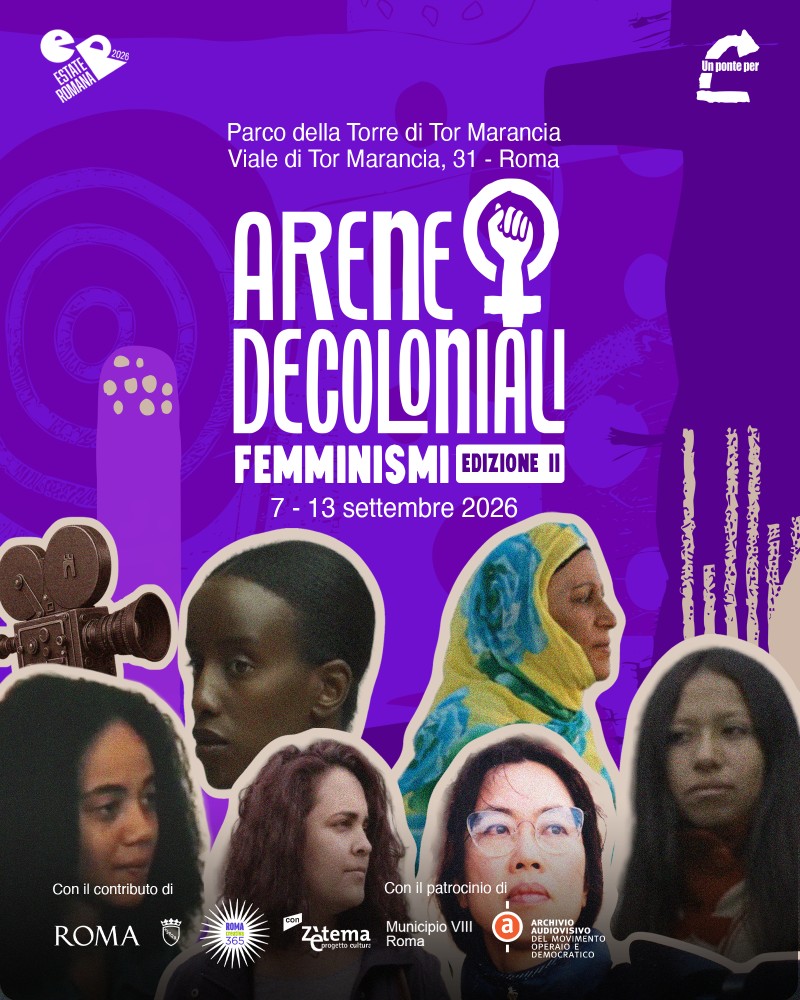
We are delighted to present the second edition of Arene Decoloniali, dedicated to feminisms in colonial and post-colonial contexts.
Organised by Un Ponte Per at Tor Marancia Park in Rome from 7 to 13 September 2026, Arene Decoloniali reaffirms its mission to be a place for people to come together and share experiences, with a vision deeply rooted in civic and cultural engagement, offering opportunities for reflection on the present, spaces for resistance, and workshops to explore new ways of being in the world.
We have a week ahead of us packed with events and gatherings where we can share experiences, reflections and knowledge, and where we can encounter diverse perspectives – those that emerge from the margins (as bell hooks has taught us) – bringing images, sounds and culture from the ‘Global South’, in the spirit of the struggle against all injustice and oppression.
Visitors will be able to take part freely in meetings, workshops and informal discussions, and attend screenings of 20 films, which will present stories that span time (from the liberation struggles of the 1960s to the present day) and space (in the desert with the Sahrawi people, in Ethiopia, Vietnam, Angola and Palestine, right through to Latin America).
In this second edition, ‘Decolonial Arenas’ will once again be an open space for listening and reflection, where communities united by a vision of a fairer and more harmonious world can come together.
Daniela Ricci, Micaela Veronesi
Artistic Direction
When we founded Un Ponte Per in 1991 (it was then called Un Ponte per Baghdad), we included an unusual clause in the first set of articles of association: after ten years, the organisation was to be dissolved, unless the members explicitly decided to continue its activities. This was not a mere whim, but a political choice. We believed that a solidarity organisation should not exist merely to perpetuate itself. It should be a means, not an end. If the reasons that had justified its creation were no longer valid, it would be right to wind it up. Every ten years, that deadline forced us to question the meaning of our existence. For practical and legal reasons, that provision was subsequently removed from the constitution, but that spirit has never disappeared.
Today, thirty-five years after the founding of Un Ponte Per, that question resurfaces. Not because conflicts and inequalities have diminished, but because the world has changed profoundly. When we began working in Iraq and then in other countries of South-West Asia, independent civil society was often fragile or non-existent. Today, despite wars and authoritarian regimes, there are networks, associations, movements, feminist organisations, trade unions and youth groups equipped with expertise, project management skills and a fully independent political vision.
The question then inevitably arises: does it still make sense for a European NGO to continue making decisions on their behalf? It would be considered unusual if a Lebanese NGO were to open and run a women’s shelter in Rome. Why, then, should it be considered normal for an Italian NGO to do so in Beirut?
The National Assembly of Un Ponte Per, which met in Salerno on June 27th-28th, answered ‘no’. It unanimously approved a resolution setting in motion a process of gradually transferring decision-making power to local offices, with the aim of building, over time, their full political, organisational and economic autonomy. This is a necessarily gradual process, developed in collaboration with the organisations involved and without jeopardising either ongoing activities or the work of local staff.
The key word is power. For years, the debate on the localisation of cooperation has centred on the transfer of resources and expertise. We believe that the crucial issue is another one: who sets the priorities? Who decides how to use the resources? Who governs the organisations?
The conviction that has taken shape over recent years is a simple one. Local organisations no longer need to be led by European NGOs. They need alliances, international relations, peer-to-peer exchanges and political support.
This also means rethinking the role of Un Ponte Per: moving away from being an organisation that directly manages services in the ‘Global South’ and increasingly becoming a bridge between civil societies, capable of forging connections, promoting joint campaigns and fostering alliances for change, rather than partnerships aimed at implementing projects.
This organisational decision also stems from a broader reflection. The assembly recognised that the current system of cooperation and development aid, taken as a whole, is a mechanism that perpetuates dependecy relationships and neo-colonial control, supplanting the necessary debate on reparations and the inequalities arising from the economic system and colonial history.
This is not about denying the value of the work carried out by thousands of aid workers, including our own. It means questioning the power structures within which even the best of intentions end up operating. And it implies the imperative to get involved in the struggles to change international relations of domination and to question the possibility of using aid for decolonisation rather than control.
We will also change the vocabulary. No longer ‘donors’ and ‘beneficiaries’, but funders and recipients. The resources allocated to development cooperation are not acts of generosity: they are a compensation – albeit still insufficient – of the wealth and opportunities taken away through centuries of colonialism.
We do not yet know where this journey will take us. We do know, however, that it is worth giving it a go. And we want to discuss this with those, in the Global North and South, who are asking themselves the same questions, starting with the seminar ‘Decolonising Cooperation’ that we will be organising in Cotonou, Benin, as part of the upcoming World Social Forum.
Fabio Alberti – Honorary President of Un Ponte Per
Article published on Vita.it
The military escalation of these hours between Iran, Israel and the United States reopens a wound we know all too well. The parallel with 2003 and the invasion of Iraq is not just rhetoric. Once again there is talk of a 'pre-emptive strike', once again regime change is evoked - more or less explicitly - as a solution. And once again a spiral is set in motion that threatens to ignite an entire region.
Regional war is not a fatality, it is a political choice. A choice rooted in a vision of power and domination that, in the name of security (whose?) produces permanent instability. We have already seen this in Iraq, Syria, Libya, Afghanistan. External interventions that have destroyed entire countries and populations, weakened civil processes, and stifled transformations from below.
Today we are witnessing dramatic contradictions: in Iran and in the diasporas, there are those who rejoice at the death of the Supreme Guide, those who mourn her, and those who are astonished. But eliminating leading figures does not mean dismantling a pervasive political system that has lasted almost 50 years. It means exposing millions of people to unforeseeable suffering as well as completely denying their self-determination.
As an organisation that has been working in the region for over 30 years, we strongly condemn this new military adventure promoted by the US-Israel axis. It is a choice that dramatically weakens the paths of emancipation and change from below, the same ones that in 2011 and 2019 had animated the Arab springs against authoritarianism and injustice. Rights are not exported by bombing. Democracies are not born from rubble.
At the same time, we stigmatise the dominant media narrative, which uncritically repeats the formula of the 'preventive attack' and struggles to pronounce simple and necessary words: girls, civilians, families. In these hours, there is general talk of 'victims' in a girls' school hit in Iran, but the terrible toll tells of over one hundred girls killed. Words count.
We also denounce Italy's political irrelevance in this scenario, reduced to a logistical tool of a war that has not been publicly discussed or deliberated. Bases on Italian territory, such as Sigonella, cannot and must not be used to fuel regional conflict.
Our concern is greatest for the countries in which we operate and with which we work every day: in addition to Iran and the Gulf monarchies, the crisis is already affecting Lebanon and Iraq. And while international attention is focused on this new front, violence by Israeli settlers and military operations are intensifying in Gaza and the West Bank. The risk is that one war will overshadow the other, multiplying impunity.
We share some testimonies collected in these hours.
IRAN. VOICE FROM THE DIASPORA
One of our Iranian diaspora activists, who has always been critical of the regime in Tehran, tells us about the complexity of these hours
"I am experiencing mixed feelings. Iranian society is much more complex than how it is described in the West. There are those who celebrate, those who mourn, those who are afraid. But it is not by 'eliminating' senior religious and military officials that one dismantles a system rooted in 50 years. The risk is to plunge into a scenario of endless instability, as in Iraq or Syria. And in the meantime, the victims are civilians. There are already so many. They are children."
IRAQ. 'WE DO NOT WANT ANOTHER WAR'.
One of our Iraqi colleagues recounts:
"I was sitting in a bar when two rockets went over our heads. Everyone panicked. My wife called me, terrified. The war will only bring death and collapse. We absolutely do not want another conflict in Iraq. What is happening is a violation of international law: destruction of infrastructure, intimidation of civilians. To all parties involved: stop the bombing immediately. We must learn from the wars we have already endured. Iraq and its people deserve peace."
LEBANON. ESCAPE IN THE NIGHT
Dramatic news comes to us from Lebanon. After rockets were launched from the south towards Israel, the Israeli army's response hit the south of the country and the southern districts of Beirut. Dozens of civilians were killed along with Hezbollah exponents.
The highways were immediately stormed by fleeing families. Our colleague Zaynab, who lives in the south, fled in the night in shock, taking hours to reach a safer area in Mount Lebanon. Local partners, such as the organisation Amel, have some staff stranded in the south awaiting evacuation. An Israeli communiqué called for the total evacuation of 53 villages (!) in the south, while the shelling continues. Shelters have been reopened in Beirut and other areas of the country to accommodate displaced families. The scenario evokes that of 2024, with the fear of an Israeli ground operation. One of the schools supported by our Qalam project has been declared a shelter for displaced people. We are conducting rapid assessments to respond to the emergency.
Un Ponte Per strongly condemns the ongoing military escalation and any war strategy aimed at redrawing political balances by force.
We also condemn the total disregard for international law, now reduced to waste paper. We had built the legal instruments to avoid the omnipotence of the law of the strongest and today these instruments are trampled underfoot.
We demand an end to the instrumental use of territories and populations as theatres of war for imperialist and colonial interests. The people we work with - activists, teachers, health workers, local communities - ask for one simple thing: to live in peace, without being pawns in conflicts they did not choose.
We have already seen where this road leads. We cannot accept history repeating itself, yet again.
Raqqa is a territory marked by deep and layered fragility. In recent years, the political and social context has been shaken by continuous shocks: internal instability, the cut in funding for humanitarian aid. All this in a region already affected by thirteen years of war, a severe economic crisis, international sanctions and the heavy consequences of the Daesh (ISIS) occupation.
The result is an enormous need for essential services, particularly in education and protection.
In December 2024, with the arrival of new waves of displaced people from the rural areas of Aleppo and Afrin, all schools in Raqqa were closed to accommodate families in buildings turned into collective centres. Even when the situation partially stabilised, 38 out of 51 schools remained closed, compromising the education of an entire generation and, along with it, their future opportunities.
The consequences of past conflicts are still evident: many schools are unusable or severely damaged by bombing, leaving entire communities without safe spaces for children and adolescents to learn.
The absence of functioning schools not only deprives people of the right to education, but also takes away a protected place, increasing the risks of exploitation, child labour and early marriage.
At the same time, this context has had a very serious impact on protection services for women, girls and children. There is an increase in child labour, early marriage, domestic violence, psychological stress and social isolation. Strong discrimination against displaced families and those returning from camps, such as Al-Hol, also persists.
Opportunities for reintegration and access to work remain extremely limited, especially for women, in host communities already facing profound economic and social difficulties.
In this scenario, it is evident how much non-formal education and protection are deeply intertwined needs: learning cannot be ensured without a safe environment, just as protection cannot be ensured if children and caregivers do not have access to structured, stable educational spaces where they can find normality and future perspectives.
This is all the more true in a context like Raqqa, where the presence of recently displaced persons and returning families makes it urgent to create places that foster not only access to services, but also coexistence, social cohesion and integration between groups experiencing tension, stigma and mutual marginalisation.


THE 'BUILDING FUTURES' PROJECT
The Building Futures project was created precisely to strengthen the Safe Spaces of Un Ponte Per for children and women and girls, and to rebuild what was destroyed: skills, educational paths, community networks.
Thanks to the support of theItalian Buddhist Institute Soka Gakkai and in collaboration with local partner DOZ, Un Ponte Per worked in an integrated manner on protection, education and social cohesion.
In 13 months of the project, 40,850 people were reached in Raqqa, helping to reduce the educational and protection barriers affecting children, adolescents and women in contexts marked by vulnerability and insecurity.


A STORY THAT TELLS THE VALUE OF THESE SPACES
N. is 18 years old and came to our Women and Girls Safe Space in Raqqa after years of family violence. She was frightened, withdrawn, without any faith in the future.
Through the one-to-one interviews with the counter gender violence programme workers and the psychosocial support sessions, she found for the first time a space where she could feel safe to speak out, understand her rights and begin to rebuild her self-esteem.
By participating in the literacy group, she acquired new skills and made connections that helped her come out of isolation. Today she looks to the future with greater serenity and wishes to support other girls in her community.
Stories like hers are frequent. Facilitators tell how these paths transform not only the lives of women and children, but also their own:
"When we see the children regain confidence and the mothers - often heads of families - feel less alone in coping with parenthood and economic difficulties, we realise that our work is really changing something".
In a fragile context like Raqqa, these spaces are much more than a service: they are places to start again.
A JOURNEY THAT COMES FROM AFAR
Un Ponte Per has been working in the protection sector in Syria since 2017, initially integrating this work into health programmes and, since 2020, inaugurating the first Safe Spaces. Over the years we have contributed to UN strategy documents, data analysis from the field and capacity building of local organisations and institutions.
Despite the chronic uncertainty of funding - which often jeopardises the continuity of activities - we have chosen not to abandon communities, but rather to reach out to the most isolated ones.
For us, supporting local communities is not a single project, but a mission.
And non-formal education, as well as health and protection, is an integral part of this mission: a bridge between the present and the future, between the crisis and the possibility of building a different society, by Syrian people for Syrian people.
Every time a centre threatens to close due to lack of funding, we know that dozens of women will lose a safe space and hundreds of children the only place to study and regain a sense of normality.
That is why we continue, even when it is difficult.
Continuing on this path means offering Raqqa - and everywhere else for that matter - the chance to shape a generation that is not defined solely by the experience of conflict. Today, non-formal education is the only channel of access to learning for thousands of children and must remain closely integrated with protection activities.
Safe Spaces are among the few places where children and women can learn, talk, feel protected, receive guidance and support. They are spaces that belong to communities and that, together with communities, must be allowed to grow.
At a time of political and social transition, Syria needs, more than ever, citizens who are educated, informed, and able to participate in rebuilding its future.
Ambra Malandrin
Protection & Education Coordinator
Between September and October 2025, thanks to the extraordinary solidarity of those who chose to stand with Un Ponte Per through the 'Water for Gaza' campaign , our Palestinian partner UAWC was able to bring an additional 1,000 parcels of fresh vegetables to displaced families and vulnerable communities in the areas of Khan Younis, Northern Gaza and Gaza City. A concrete gesture of closeness, born out of a desire to be there for the Palestinian population.
More than 5,000 people were able to receive local food - cucumbers, chillies, avocados, garlic, molokhia and onions - in a context marked by constant insecurity, evacuations, destroyed infrastructure and increasingly difficult access. A small sign of normality and dignity in the midst of chaos.
These products are not just food: they symbolise a deep bond between the indigenous people and their land, even in the midst of genocide.
All this was possible thanks to the tireless work of the local committees and representatives of the displaced communities, who, while living first-hand amidst displacement, hunger and family losses, with courage and dedication coordinated every stage of the distribution, to ensure dignity for their people, right where they are most needed.
"The most exciting thing for us is knowing that the donations you are collecting with Acqua per Gaza come directly from people for people. When we do aid distributions we explain this to the families: this is all made possible by fundraising on the street in Italy, where each person donates what they can. And people understand this very well" (from the UAWC team present in Gaza).

OUR ANSWER: WATER FOR GAZA
Two years ago we launched our 'Water for Gaza' fundraising campaign to do our part in supporting the Palestinian population.
Thanks to donations received, we have reached 50,000 people with clean water, food baskets and hygiene kits, mobile toilets to meet urgent hygiene needs and limit the spread of disease, and water tanks to provide lasting support to communities forced to be displaced by Israeli military order. With the arrival of winter, we were able to secure tents built from makeshift materials with water-repellent sheets to withstand the weather. In addition, we distributed new fishing nets to allow people to return to the sea.
A CONFIRMED FOOD CRISIS
Over the last few months, the population of Gaza has been facing a full-blown famine: more than 500,000 people were already in a catastrophic state of hunger at the end of August, rising to around 640,000 by the end of September. Dramatic numbers, which tell of the failure of the international community and the denial of a basic human right: access to food.


FOOD AS A WEAPON OF WAR
People, particularly children, suffer from malnutrition due to food shortages, out-of-reach prices and risky access to scarce supplies.
Over 2,500 aid seekers have been killed, and many more injured. Food aid has been turned into a weapon and militarised, with the blessing of the West.
In spite of everything, community kitchens have tried to fight back, serving over 650,000 meals a day. But in many areas of Gaza, they failed to reach those in greatest need.
Cultivated fields deliberately destroyed, supply routes disrupted, economic activities cancelled: hunger has become a direct consequence of the war and the restrictions imposed on humanitarian aid.

HELP US DO MORE. DONATE NOW
Now is not the time to stop. We continue to stand by the Palestinian people in the face of the systematic design of erasure. We continue to denounce with all our energy the responsibility of those who are carrying it out, and the complicity of those who remain silent.
You can support our intervention by donating now to the Water for Gaza campaign.
Now is the time to multiply solidarity efforts to build a different future. Basic necessities continue to be lacking and sanitary conditions remain extremely critical.
Un Ponte Per works with local communities and facilities in the field to bring food, clean water and shelter for the winter thanks to your donation.
Two years after the devastating 2023 earthquake that struck Türkiye and northern Syria, forcing thousands of Syrian families to flee their homes, many people are still living in dire conditions of displacement in the now overcrowded collective centers of northeast Syria.
Many of these came from the areas of Aleppo, Shahba, Til Rifaat and Manbij, carrying with them little more than the trauma of loss and the urgent need for basic necessities.
Further worsening the situation came a second wave of displacements, which began in December 2024, when with the fall of the regime, the security situation further deteriorated due to the reignition of internal armed conflict.
With the arrival of summer, the crisis became even more serious: the chronic shortage of basic services was compounded by a growing shortage of clean water, making immediate action necessary. The precarious conditions in the collective centres continued to increase health and hygiene risks, especially for the most vulnerable segments of the population, such as children and the elderly.
In response to this crisis, Un Ponte Per launched 'Ready to Respond', a key emergency intervention implemented together with the Kurdish Red Crescent (KRC), thanks to the support of Fondation de France (FdF) and Fons Català de Cooperació al Desenvolupament (FCCD). Our aim, to protect the health of displaced families by preventing the spread of water-related diseases through better access to hygiene products, providing emergency WASH (Water, Sanitation and Hygiene) kits in temporary shelters.

Delivering a Hope Through Hygiene items
Between 4 August and 14 September 2025, we distributed 4,090 emergency WASH kits to displaced families living in the 100 collective centres spread across Raqqa, Hasakeh, Qamishli and Derek. Each kit contained essential hygiene items tailored to the needs of women, men, children and the elderly, ensuring an inclusive response that respects the dignity of all.
The project was built step by step, starting with a careful identification of needs and the registration of displaced families, in cooperation with the IDP Committees, the Hassakeh Civil Council and the humanitarian coordination authorities. The distribution of the kits took place with great care: each package was delivered directly to the heads of the families, both men and women. In order to ensure that no were left out and to act with maximum transparency, we conducted post-distribution evaluations on the impact of the intervention.
“We evacuated from Manbij after the earthquake in 2023. I lost my brother when the roof collapsed on him. Years later, these kits mean a lot to all of us . Big thank to you." Khaled, displaced from Manbij.
Khaled's story is just one of many that testifies how for families still displaced today, with their burden of grief from the bereavements they have experienced, these kits were not just aid: they represented a message of solidarity, proof that they were not forgotten.

GIVING PEOPLE BACK THE CHANCE TO TAKE CARE OF THEMSELVES
In emergency settings, access to clean water and hygiene products can make the difference between health and illness. The risk of spreading disease outbreaks - such as cholera and dysentery - increases exponentially in overcrowded shelters, especially when access to safe water sources and adequate sanitation is limited.
It is not just about reducing the risk of disease, but about restoring a sense of dignity and normality to people who have lost everything.
By prioritising women's needs and ensuring equitable and inclusive access, this intervention has been a community-led and people-centred response, strengthening the capacity of affected populations to recover.
LOOKING TO THE FUTURE
Today, as Syria goes through a delicate phase after years of regime, conflict and natural disasters, Un Ponte Per continues to stand by the most vulnerable communities to support local organisations in responding to emergencies and in the work of reconstruction and recovery. Our work is driven by a belief in solidarity, dignity, and the right of all people to rebuild their lives in safety.

Gulistan Issa - UPP Campaigner and Project Manager
Hospitals without drugs for life-saving operations. Clinics in camps for displaced people without medical staff. Ambulances at a standstill for lack of fuel. This is the devastating reality we began telling you about six months ago, when we saw with our own eyes the effects of the Trump administration's suspension of USAID funding last March.
These have been terrible months, in which we have witnessed day after day the deteriorating health conditions of thousands of people. Since the early months of the year, many organisations have suspended or stopped their operations in the region altogether, and camps for displaced people have been hardest hit. Essential services such as food and water distribution, health care, nutrition and protection have failed, making life even more difficult for those already living in precarious conditions.
In camps like Abo Khashab and Serekaniye, we at Un Ponte Per, together with our partner KRC, have remained the only ones to guarantee health services, albeit with enormous difficulties, forced to drastically reduce the activities of our clinics, limiting them to emergencies and transfers to hospitals.
But hospitals were also gradually losing their ability to provide free care to the population: by the end of April, only one out of sixteen public hospitals remained fully functional throughout north-east Syria. This meant that pregnant women, children and people with chronic or life-threatening illnesses no longer had access to essential and often vital care. Paying the highest price, once again, were displaced people living in camps.
In the meantime, another important change has transformed the Syrian scenario: the reduction of services in the camps, combined with the new political situation following the fall of the regime, has pushed many families to return to their areas of origin. Today we are witnessing a gradual emptying of the camps and the repopulation of areas like Deir ez-Zor, which had remained inaccessible for years. But the return takes place in devastated contexts: there is a lack of water, energy, livelihoods, health services and basic infrastructure.
To helplessly witness the difficulties these people were experiencing, to see the crisis in a health system that we have been supporting for fifteen years to make it solid and free, and to have to suspend the contracts of Syrian colleagues with whom we had shared a long journey, were very hard tests. But it was our sense of responsibility towards them and the local communities that pushed us forward.
Crucial at this time was the support of our donor community, which responded to our appeals to cover basic health needs and gave us the strength to continue to seek new funding and to denounce the injustice of the cuts.
So, after months of effort, we finally started to see the first results.
Since July, part of the US funds have been released, while thanks to UN support, a new project has started that allows us to partially resume support to the Hassakeh National Hospital (HNH), the main medical facility in the region, a referral point for over 700,000 people.
This project aims to strengthen the patient referral system by linking primary health care facilities to the HNH in order to improve access to specialist care. The aim is to remove economic barriers that prevent people from receiving treatment by reactivating essential services. Concretely, UPP will support the hospital by covering the full cost of surgery, diagnostic tests and treatment for the displaced population living in the camps.
We cannot forget the stories of the people we have met in recent months - like Hanan and Nasser. For them, and for all the families who continue to resist in this tormented region, every step forward is crucial. It will take time to measure the consequences on these people's health of the irresponsible decision to suspend funding, in Syria as well as around the world. But it is necessary to recount them, so that we do not forget and so that those who made these decisions assume their political responsibility.
Our work is not finished. We will continue to look for funds, to strengthen solidarity networks and to amplify the voices of those who otherwise would not be heard. But if today we can say that something is starting to move again, it is only thanks to those who did not leave us alone.

Lavinia Brunetti - Health Programme Manager of Un Ponte Per
In continuity with the mobilization launched on September 22, Un Ponte Per confirms its participation in the national strike and mobilization day against the genocide of October 3 and in the subsequent actions.
September 22 was only the first stage: the general strike demonstrated that there is a collective will to resist, which does not accept the complicit silence of governments.
The following is the appeal published on the occasion of the first day of the strike.

With the occupation of Gaza City, the last dramatic chapter of the Israeli colonialist settlement project is being written.
In front of the deliberate extermination of a people, in front of hundreds of thousands of people on the run, exhausted by two years of total siege, in front of images that break our hearts, we cannot stand still.
Faced with the repression of dissent, a media narrative that continues to portray genocide as a 'war between armies', and the silence of governments, it is urgent that we overcome the sense of impotence that pervades us and take our bodies to the streets.
That is why on 22 September Un Ponte Per adheres to the general strike, proclaimed by the basic trade unions and the Palestinian movements. We strike to stop the genocide in Palestine, to reject the normalisation of horror, to boycott an economy that feeds this system of death, to support the difficult journey of the Global Sumud Flotilla, which seeks to break the siege.
We have decided to close our offices in Italy on this day, because we want to give a strong signal of dissent: when governments choose complicity, it is up to us - citizens and citizens, associations and movements - to make our voices heard and to strongly demand the interruption of all forms of collaboration with Israel. And to strengthen our solidarity action, we will donate the day of strike to the Water for Gaza campaign.
These days our activists are in the squares and at the garrisons that criss-cross the cities. On Monday we invite you to 'lower your shutters' and join the mobilisations of 22 September: in the squares, in the marches, to block an unjust system that fuels this massacre.
Let's choose to take a stand: let's strike, let's join the boycott, let's join this appointment, as well as those that await us in the coming weeks.
Let us choose together to be on the right side of history.
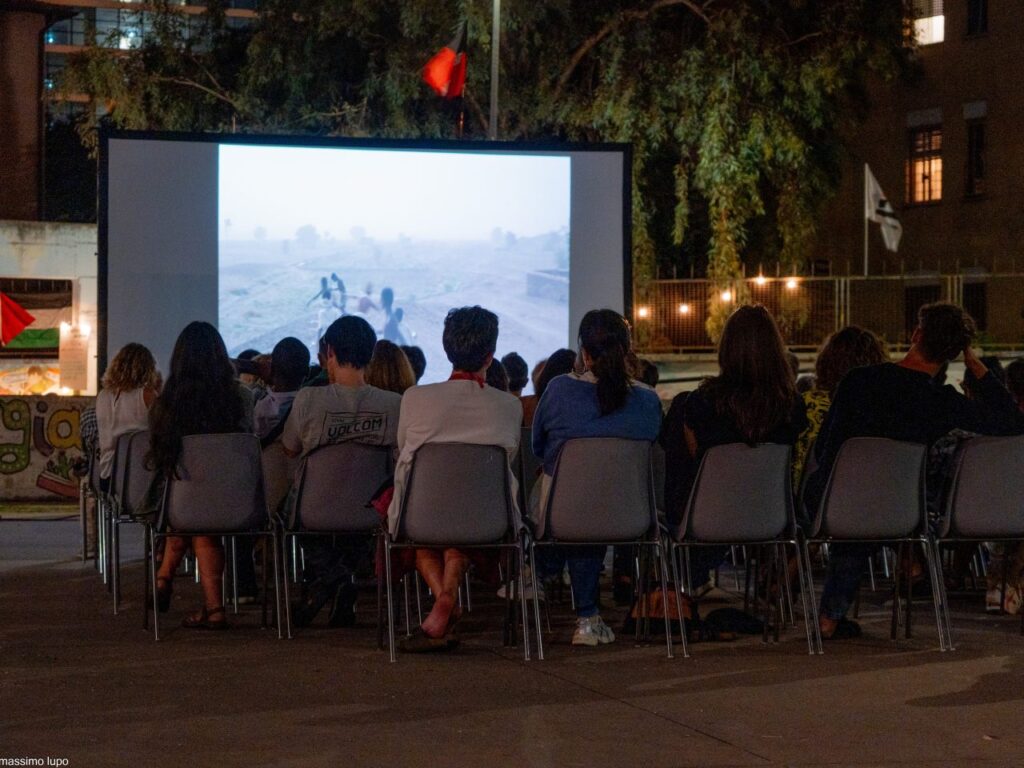
From 8 to 14 September in Rome, the first edition of Arene Decoloniali took place, a festival conceived by Un Ponte Per with the aim of opening an unprecedented and urgent space for reflection in the Italian cultural scene.
For seven days, cinema, literature and debates brought back to the centre what has been repressed for too long: the memory of Italian colonialism, anti-colonial resistance and the consequences of a Eurocentric outlook that still shapes politics, culture and society.
A MEMORY REMOVED
In Italy, colonialism has been removed from collective memory. Massacres, deportations, racist laws and concentration camps have been systematically concealed, leaving room for the self-absolving myth of Italians as good people. A process that not only concerns the past, but also profoundly affects the present, influencing narratives on migration, the Mediterranean and international relations.
With the Decolonial Arenas, we have chosen to break this silence, offering critical tools to address the colonial legacies that still run through us.


CINEMA AS A SPACE OF RESISTANCE
At the heart of the festival was cinema, understood as a political and cultural practice capable of deconstructing the colonial gaze.
From the screening of Adwa - An African Victory by Haile Gerima - which has been awarded the 2025 Decolonial Arenas Prize - which restores the memory of the Ethiopian victory against Italy, to Soleil Ô by Med Hondo, which recounts the migratory experience and post-colonial identity, to Abandon de poste by Mohamed Bouhari, with its ironic and disenchanted look at colonial stereotypes and the "new slaves" of western society.
The festival closed with Andrea Segre's L'ordine delle cose (The Order of Things), which takes the viewer inside the Italian policies of refoulement in Libya.
Each film was a piece of a narrative that overturned perspectives and gave back a voice to colonised and migrated subjectivities. The cinema thus proved to be not only a means of denunciation, but also a laboratory for imagining new forms of storytelling and new practices of solidarity.
As Soumaila Diawara, guest speaker at the festival, recounted:
"Arene Decoloniali is not simply a review that seeks to inform people, but is also a form of resistance, which overturns a distorted narrative especially about colonialism. It is an initiative that can not only inform about historical responsibilities, but also unite people who are often far apart, on a common path'.
To also maintain the direct thread with Palestine and the genocide resistance actions, we hosted the Global Sumud Flotilla link.


BETWEEN MEMORY AND RESIGNIFICATION
The festival did not limit itself to recounting the past. It traversed symbolic and political issues that are still alive: from the stealing of works of art in the colonies to the re-signification of commemorative monuments, such as the one to the fallen of Dogali, which still defines the Italian soldiers who fell in Ethiopia as 'heroes'.
A tribute to Pier Paolo Pasolini, on the 50th anniversary of his death, also offered an opportunity to reflect on his critical but ambivalent view of Africa and the East.
And it was during these evenings that one of the most moving moments took place: the unexpected meeting with Gimè Ahmed, one of the African students interviewed by Pasolini in the documentary Appunti per un'Orestiade africana. Having arrived in Italy from Eritrea over fifty years ago, incredibly, he had never seen Pasolini's film, despite having searched for it for a long time. We welcomed him on stage and his emotion, his story became for us the very symbol of this first edition of Arene Decoloniali: a place of memory, encounter and deconstruction.
BEYOND ANTI-COLONIALISM: TOWARDS DECOLONIALISM
Decolonial Arenas proposed an approach that goes beyond the condemnation of colonialism as a historical fact. To decolonise means to recognise how the Eurocentric vision has structured cultural, political and even aesthetic categories.
It also means questioning concepts such as 'development', 'aid' or 'solidarity', which have often reproduced logics of domination.
We also brought into the festival our experience of international cooperation: not as an act of generosity, but as a practice of reparation, and as building alliances between civil societies, capable of changing the living conditions of oppressed people together.


AN APPOINTMENT THAT WANTS TO TAKE ROOT
This first edition marked the beginning of a journey: a cultural and political process that does not want to limit itself to the event, but intends to continue to grow and contaminate other spaces.
Special thanks go to the many people who participated each evening and to those who enriched the debates: Papia Aktar of ARCI Rome, Takoua Ben Mohamed, Maria Coletti, Marco Dalla Gassa, Leonardo De Franceschi, Soumaila Diawara, Silvano Falocco of the Yekatit 12-19 February Network, Daniela Ionita of the Italians Without Citizenship Movement, Angela Mona, Marina Pierlorenzi of ANPI Rome, Daniela Ricci and Micaela Veronesi of the National Film Archive of the Resistance, Lorenzo Teodonio, Alessandro Triulzi, Vito Varricchio.
Many thanks to directors Haile Gerima, Dagmawi Yimer and Francesco Di Gioia, and allə artistsə who made the closing night unforgettable: Khalifa Abo Khraisse and Valbona Kunxhiu, Mario Eleno and Manuela Mosè, Luca Chiavinato.
Decolonial Arenas has opened a removed wound and, at the same time, a space of possibility: an arena where memory meets resistance, and the future can finally break free from the shackles of the colonial past.
And this is just the beginning, the journey continues: in anticipation of the second edition in 2026, we will continue to offer new initiatives and insights.
Follow the @arene_decolonials page on Facebook and Instagram to stay updatedə.
A solidarity caravan has reached the Rafah crossing point, while the Strip sinks amid bombs, hunger and isolation. In these lines, we report the account of those who were there: voices and stories from the border of the siege. Interview with Giulia Torrini, co-president of Un Ponte Per.
In Gaza, people are dying of hunger, thirst, bombs and silence.
In the days from 17 to 19 May, while the international community stammered and the Western chancelleries divided themselves between timid warnings and diplomatic complicity, an Italian delegation decided to break the deafening immobility. Sixty members of parliament, MEPs, reporters and activists reached the Rafah crossing point to denounce the Israeli siege and the systematic use of hunger as a weapon of war.
The Gaza Strip has sunk into an abyss of inhumanity. Since 2 March 2025, no humanitarian convoys have crossed the borders: water, food and medicines remain blocked at the borders under Israeli control. The United Nations is sounding the alarm: over 14,000 children risk death from hunger and dehydration in the next 48 hours. UNRWA denounces the impossibility of distributing the remaining aid due to the continuous restrictions imposed by Tel Aviv.
In the almost choral silence of the international community, the figures become an epitaph: more than 53,000 Palestinians have been killed since the beginning of the Israeli military operation in October 2023. Entire families wiped out, health infrastructures reduced to rubble, schools turned into targets.
Confirming the systematic brutality of this offensive, on 19 May, the day the Italian delegation was still at the Rafah crossing, Israel ordered the immediate evacuation of Khan Younis and launched an unprecedented air attack on the town. Within an hour, hospitals, homes and civilian infrastructure were hit: at least 135 were killed, hundreds injured. Thousands of people, many already displaced, were forced to flee once again, without destination or protection. The war against the civilian population continues unabated; meanwhile, humanitarian aid remains blocked at the borders.
In an interview, Giulia Torrini - president of the Un Ponte Per organisation and member of the Italian delegation present at Rafah - recounts the moments she experienced near the crossing: 'During our stay at the Rafah crossing, explosions followed one another at regular intervals, every eight or ten minutes. The roar was sharp, penetrating, impossible to ignore'.
While the Netanyahu government declares the objective of 'total control' over Gaza in the name of the fight against Hamas, another truth takes shape on the ground: that of a strategy that many voices, without hesitation, define as ethnic cleansing masquerading as a war against terrorism. The rhetoric of security is thus being bent to justify a war of annihilation, which mainly affects unarmed civilians.

CAIRO: THE VOICES OF THE SURVIVORS
The recent initiative of the Italian delegation, promoted by AOI, ARCI and Assopace Palestine, took on a significance that goes far beyond symbolic solidarity. It was an explicitly political initiative, conceived as an act of rupture against the silent complicity of European institutions and the West's hesitant diplomacy. The presence at the Rafah crossing was not only intended to urge the entry of humanitarian aid, but to openly denounce the international legitimisation of a regime that, with its siege of Gaza, is waging a systematic war against the civilian population.
Torrini recalls the meetings with the Palestinian community in exile that took place in the days leading up to the arrival at the crossing: 'In Cairo, we met what we could call the "survivors": journalists, aid workers, activists who were refugees in Egypt, mostly women. They did not just share their stories: they confronted us with our responsibility, laid us bare, without discounts.
The testimonies, particularly during the confrontations with the political component of the delegation, were direct and incisive. Some activists bitterly expressed their conviction that not enough is being done, pointing out that for months images of violence have been observed and shared without this leading to concrete change. One young woman also raised the question of the use of those images, believing that their dissemination could take away the dignity of the victims, turning them into a spectacle for a now insensitive world. According to her, if even the sight of those bodies cannot shake consciences, perhaps it would be better not to show them at all'.
A provocation, certainly, but also a deeply true statement. A denunciation of Western voyeurism, of our progressive moral anaesthesia.
During these meetings, journalists such as Abdel Nasser, aid workers and activists from the Union of Agricultural Work Committees (UAWC) spoke about the destruction of 90 per cent of the agricultural land in the Gaza Strip: 'A direct attack on food self-sufficiency, part of a strategy that uses hunger as a weapon of war,' reports Torrini. "A worker from the association Vento di Terra told of being evacuated nine times before managing to find refuge in Egypt, exhausted by an existence always under threat. However, he recalled that even there, life for a Palestinian refugee remains extremely difficult. One is not free to work, study, move around. It is the systemic condition of the Palestinian diasporas, from Lebanon to Syria'.
Torrini also recounted another significant moment of the day: an in-depth meeting with an expert on international relations.
Several key elements emerged during the discussion: the declining support of Hamas among the Palestinian population, the growing detachment between the leadership and civil society, but also the maintenance of a certain influence of the movement abroad. The ambiguous role of the Gulf countries, the progressive marginalisation of the Palestinian cause in the Arab agenda, and the total absence of political will on the part of the Israeli leadership to embark on a diplomatic path were all mentioned. According to the shared analysis, Tel Aviv's strategy would not be limited to a containment of the conflict: rather, it would aim at the definitive elimination of the Gaza Strip. Not crisis management, but a systematic project of annihilation.

RAFAH: A POLITICAL GESTURE ACROSS THE BORDER
"The Egyptian soldiers guarded the pass motionless, engines switched off, weapons in their arms: a mute and absent presence. And there we were, in silence broken only by the explosions, punctual every eight minutes. A surreal silence, barely cut by the chirping of birds - you can hear it in the background in all our telephone audio as well. And in the midst of all this, shouting 'Free Palestine', 'Stop the Genocide', 'Stop Illegal Occupation', in English, to break that silence - even though we knew very well that no one was really listening to us - was an act of breaking, a political cry.
The gesture of leaving soft toys and toys on the Egyptian border, unable to cross the border like the girls and boys for whom they were intended, has become the emblem of a powerful protest. Fragile, childish, helpless objects: symbols of a torn childhood. A cry addressed to Europe to stop covering with the language of diplomacy what, in fact, is an ongoing violation of international law.
"To be there, with almost 20 parliamentarians and MEPs in the front line, displaying placards with the faces of European leaders - the same ones who continue to deny the reality of an ongoing genocide or remain inert in the face of the blocking of humanitarian aid - was very strong. And then those puppets, those little clothes scattered on the ground, accompanied by the chalk mark normally drawn around corpses at crime scenes... it was a visual denunciation. In that desolate, empty square, where trucks laden with aid once thronged, today nothing passes by any more'.
With this action, the delegation restored dignity to the word 'presence', transforming it into active witness and direct denunciation. No more generic appeals, but a precise question: where does European policy stand when borders become barriers to life?
GAZA: REPORTERS UNDER THE BOMBS
In a context where the truth is often reduced to the silence of rubble, even the word of reporters becomes a target. At the Rafah crossing, 14 female journalists launched an appeal with a clear and inescapable tone: 'Stop shooting at journalists'. A cry born of the urgency to denounce what is taking place in the shadows. Since 2023, more than 220 Palestinian reporters have been killed under Israeli shelling; dozens are detained and held in prisons, their families persecuted. In the absence of the international press, kept out of Gaza for over 19 months, it is they - exposed and isolated - who are the only eyes left to tell the story. Some, in order to stand out, wear improvised vests with the inscription 'PRESS', which protect them from nothing but invisibility. 'The press is not a witness to the conflict: it is a target', they write. And this is perhaps the most dramatic detail of a conflict that those who document fear. The appeal of the women journalists from the Rafah crossing is addressed to Europe and the world: they ask for the protection of Palestinian reporters and access to the Strip for the international press to be guaranteed.
"A Palestinian journalist," Torrini continues, "explained to us that local reporters now move around inside their homes without wearing the bulletproof vests marked 'PRESS'. Those same vests, which should provide some semblance of protection, are now no longer provided. Nothing comes any more: neither helmets, nor protectors, nor any kind of safety material. Therefore, many journalists make do with makeshift means: they stuff their vests with sponges, recreating a kind of symbolic uniform. It is no longer a means of protection, but a gesture of dignity, almost a form of resistance, a way of saying 'we are there', even though they know perfectly well that those handmade paddings will never save them from a bullet, let alone a bomb'.

EUROPE MOVES, BUT TOO SLOWLY
Under increasing pressure from public opinion and some member states, the European Union announced the revision of the association agreement with Israel, invoking the human rights clause. The UK also suspended trade negotiations with Tel Aviv, while France and Canada threatened sanctions. However, these measures appear belated and insufficient in the face of what many are calling an unprecedented humanitarian catastrophe. Meanwhile, the Israeli army insists on civilian targets: emblematic is the attack against a diplomatic delegation visiting Jenin, in the West Bank, which triggered condemnatory reactions from several European governments.
'Arriving at the Rafah crossing had a strong echo in the Arab world,' Torrini comments. 'We ended up on Al Jazeera, on I Am Palestine, on various Middle Eastern media. It served to tell, to circulate another narrative. Perhaps it is no coincidence that, immediately after our return, some European leaders started to raise their voices. Three MEPs were with us in Rafah. A few days later, the President of the European Commission called for a review of the EU-Israel Association Agreement. Italy and Germany opposed it, predictably, but something moved. The rest of Europe began to react.
As Italian activists, we know that we are in a delicate historical moment. Our government, like previous ones, continues to boast of its 'friendship with Israel'. But this rhetoric is beginning to show cracks, especially compared to other European countries that - albeit slowly and not out of sudden moral conscience - appear to be struggling in the face of growing public pressure'.
Today, international civil society has a margin for action, albeit limited, to denounce the inaction of its governments. In this context, the direct confrontation between the solidarity caravan and local realities has led to the drafting of an official document, addressed to the Prime Minister, with the request for a clear and unequivocal stance against the war.
The symbolic and political significance of this initiative will depend on the ability of the oppositions to remain cohesive and recognise the centrality of the Palestinian issue. The testimonies heard on the ground, the numbers of civilians killed are evidence that can no longer be ignored.
"The Palestinian issue today is much more than a local conflict: it is a reflection of a new global paradigm. On the one hand, a colonial power that uses apartheid as an instrument of conquest and territorial control; on the other hand, an international humanitarian system that, born after the Second World War to protect peoples affected by conflict, is today degenerating into a commercial, even profitable mechanism. Humanitarian aid has become a political lever and its operators are now declared targets. Some fear that we are moving towards a model in which assistance is entrusted to private foundations or pro-Western organisations, supported by Israel and the United States, emptying the very concept of international aid of meaning and legitimacy. In this context, the US decision to cut USAID funds and dismantle the cooperation agency is a clear signal'.
Palestine, in this framework, becomes a laboratory. An experiment. What happens there prefigures models destined to be replicated everywhere: in any context of occupation, siege or colonisation.
'This is why politics must act,' Torrini concludes. "If degradation consolidates in Palestine, it risks spreading everywhere. And this is where political as well as moral lucidity is needed. During the delegation's stay, with jurists and academics, we discussed at length not only the legitimacy of the term genocide, but also the solid international legal framework that already exists: from the rulings of the International Court of Justice and the International Criminal Court, to the legal instruments available to European governments to impose sanctions. The instruments, therefore, are there. What is lacking is the political will. This is demonstrated by the fact that the motion tabled by the opposition to suspend sending arms to Israel was rejected. On the other hand, the majority's motion to make further military purchases from Israel passed. Yet a responsible government should neither sell nor buy weapons from a state that is, in fact, massacring a civilian population as such. In theory, everything is clear, but in practice, the actions continue to fall short'.
Interview by Daniela Galiè published in Dinamopress on 23 May 2025. Photos by Daniele Napolitano.