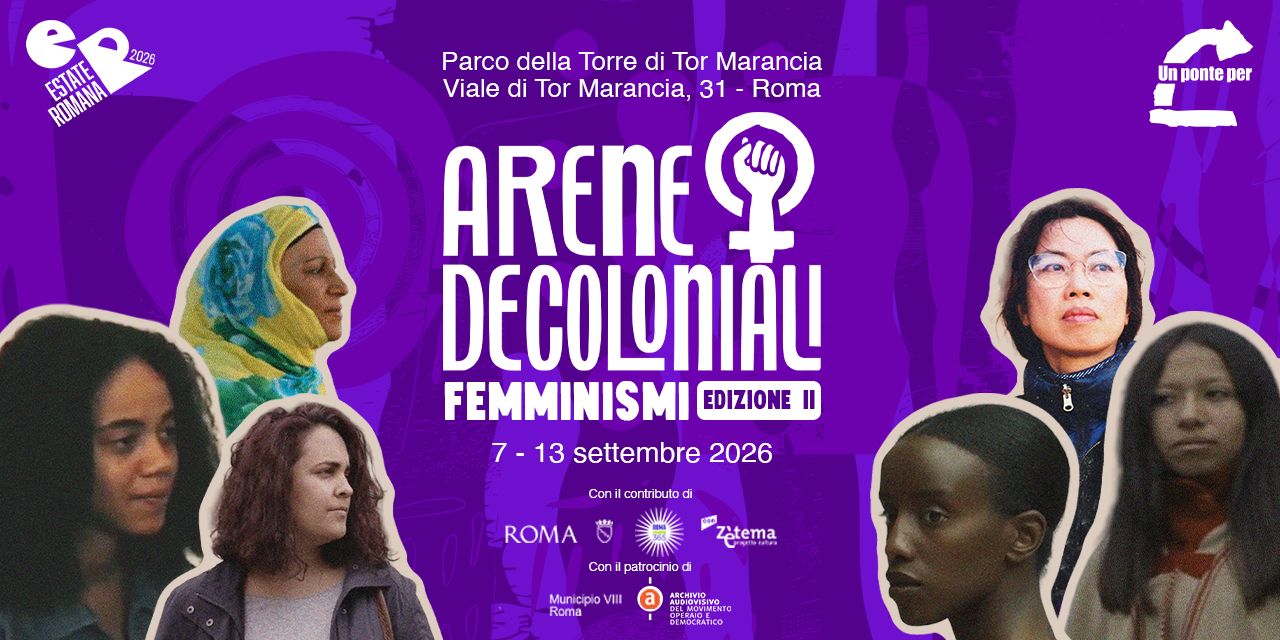
DECOLONIAL ARENAS 2026 KICKS OFF

In the Nineveh Plain in Iraq, between Mosul and Bashiqa, we have been working for many years. We were there before the advance of Daesh (Islamic State) in the area brought destruction and years of fierce occupation; before the battle to liberate it brought further devastation, and a very high price for the civilian population. When it came to rebuilding, therefore, we did not back down. And indeed, among the longest-running commitments - and with the greatest satisfaction for the results achieved - was our 'Salamtak' (Arabic for 'Your Health'). Supported by the Italian Agency for Development Cooperation (AICS), and by the generous donations of the people who responded to our appeal, 'Salamtak' was able to operate from 2018 until the end of 2023.
Six years of work and a shared journey with the local population, which has seen the construction of health centres where none previously existed, the rehabilitation of existing ones, the training of specialised personnel and the sensitisation of communities on the right to physical and psychological health, all with one goal in mind: to guarantee, especially to women in the area, access to their rights.
That to sexual and reproductive health, first of all. But also to pre- and post-natal care, to family planning so that they can choose if and when to have children; to psychological support, where years of wars and conflicts have confined these aspects to emergencies. In a word: self-determination.
"Salamtak" was an important intervention because Iraqi women and girls still face many obstacles when it comes to access to sexual and reproductive health and rights. Discriminatory beliefs, limited independence in decision-making, lack of income and education, and lack of awareness regarding the availability of medical services are just some of the difficulties they still face. As always, war carries a double price for them to pay. That is why, over the years, we have tried to inform them of their rights, accompany them on the path to claiming them, provide them with centres where they can meet other women and find the care and attention of highly specialised workers.
Coordinating the programme over all these years was our Lia Pastorelli, Programme Desk of Un Ponte Per.
"'Salamtak', for us at Un Ponte Per, has represented an important commitment to support the populations of the Nineveh area affected by the devastating effects of the war and the Daesh occupation. During these six years, we have dealt with the serious material damage and psychological challenges resulting from these conflicts together with them, and we have worked our way out of the emergency,' he tells us.
"We have assisted more than 30,000 people in six years and visited an average of 15 per day."
The people we have taken in have averaged between 13 and 65 years of age and have come to the two centres for high-risk pregnancies, maternity services, maternal and child care, infertility, polycystic ovary syndrome, gestational diabetes up to ovarian cancer. The largest numbers of visitors were young women between the ages of 18 and 34.
Among them was 33-year-old Afrah, with four children, who faced significant challenges during her maternity journey. Returning to the area after living for three years in a camp for displaced people, Afrah became aware of the 'Salamtak' programme through a community health worker.
"Afrah had lost a baby two days after birth due to an infection. She was terrified that it could happen again. With the support of 'Salamtak', which provided her with psychosocial support and medical care, Afrah discovered a dysfunction in her gestation. Thanks to a timely diagnosis and the necessary treatment, she was able to carry her last pregnancy to term safely,' Lia recalls.
She explains how, along with the programme, the country has also changed. The way the community - and women in particular - began to perceive their rights and ability to self-determine. 'We have seen the impact of our work: today women are more aware of their rights and the possibility of claiming them,' she explains.
"In the first years, we tried to improve health services in the health centres that were left standing during the war. In particular in Mosul, Bashiqa and Nimrud, areas that paid a very high price, and where we managed to reach more than 12,000 people. In addition to this type of intervention, however, we have always wanted to combine it with extensive community awareness work: we have organised dozens of campaigns to break the social stigma and isolation of people who need psychological support,' Lia explains. "Then we focused on increasing the presence of medical personnel in the various health centres: this allowed an increase of more than 270% in the number of accesses to the guaranteed services".
In the last phase of the project, which ended in December 2023, we joined forces with our partner Solidarité International, and focused particularly on the Mosul area. Once a Daesh stronghold in Iraq, Mosul still bears the marks of war.
"Mosul was a major challenge for us," Lia recalls. "We wanted to increase the quality and accessibility of sexual and reproductive health: women and girls accounted for more than 90 per cent of those reached. Consultations, basic diagnostic examinations and screening, pre- and post-natal care, therapeutic treatments, prevention and treatment of sexually transmitted diseases, family planning, were the focus of our work. Without ever forgetting maternal and child health care services through paediatric consultations, integrated with mental health and psychosocial support'.
Over the past months, we have worked tirelessly to expand our impact in the Iraqi women's community and ensure medical care and the right to health for all.
And on 31 October, we finally reactivated the maternity ward in the 'Hamam al-Alil' hospital in Mosul. "An important milestone to ensure the right to a peaceful pregnancy and quality care for women in the area",
emphasises Lia.
The new maternity ward offers essential services including antenatal and postnatal care, as well as educational programmes covering family planning and breastfeeding. It also guarantees 2-3 safe deliveries per day and provides an average of 250 consultations per month to women and their babies. The facility serves over 39 surrounding villages, totalling approximately 120,000 people.
But 'Salamtak' also supported the only public hospital in the Nineveh governorate that cares for burn patients, the Al Hurok Hospital in Mosul . There, we equipped two emergency rooms, inaugurated a few days before the terrible incident that hit the city of Qaraqosh in September 2023, which were thus able to be operational to respond to that emergency.
Our work has always been carried out in collaboration with the local authorities, and in particular with the Directorate of Health in Nineveh, which we accompanied to address structural deficiencies and the lack of trained personnel. "We have involved 112 members of the medical and paramedical staff of the directorate in the training, so that our intervention is no longer necessary and the local authorities can continue on this path independently," Lia explains.
"Of course we are not abandoning any: we will always remain available for advice and counselling," she emphasises.
We therefore continue to walk alongside the women and communities of Nineveh, as we have always done. But being able to hand over the health centres to the Health Directorate is a major achievement for us. It means that Iraq, at the centre of endless humanitarian emergencies in recent years, can slowly get back on its feet, rebuild from its rubble, imagine a future in which emergency interventions are no longer necessary, and we can simply build, together.