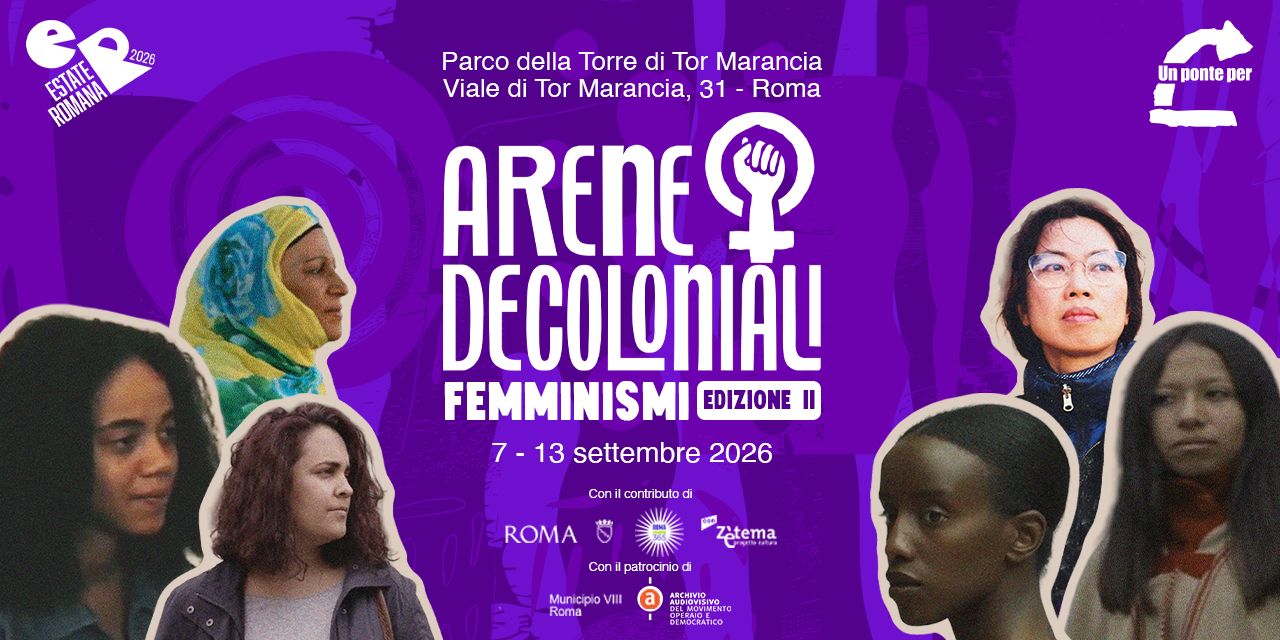
DECOLONIAL ARENAS 2026 KICKS OFF

"Peace Support Ukraine" (PSU) is a project supported by the Otto per Mille funds of the Italian Buddhist Institute Soka Gakkai and implemented with the Ukrainian partners Institute for Peace and Common Ground, Ukrainian Leadership Academy, Association for Middle Eastern Studies and the Romanian partner Patrir. The project aims to strengthen Ukrainian civil society and support the active participation of local youth in social cohesion and stability initiatives, bringing the voice of the younger generation to local and international institutions.
By Alessia Massari and Edoardo Cuccagna
From July 2022, Peace Support Ukraine aims to strengthen the capacities of young Ukrainians to engage in social cohesion, resilience to the trauma of war, and creating spaces for their opinions to be heard and included in the country's reconstruction process.
We spoke about this with Laura Pistarini Teixeira Nunes, Programme Manager for Peace Support Ukraine, who told us about the development of the project and the contribution of Ukrainian civil society to peace building.
"The project is divided into three lines of work. The first is youth support, carried out by the Ukrainian Leadership Academy, which has been engaged in the production of podcasts with the aim of informing the Ukrainian and international public about the initiatives and visions of young people regarding the future of their country. With the beginning of the war, in fact, their involvement was very high,' Laura tells us.
"In addition, the Ukrainian Leadership Academy has created a series of online courses, whose target audience is again young people, from high school to young workers. The topics covered by the course modules concern personal resilience, crisis management, but also international dialogues," she continues.
"The course directly reached more than 350 people, exceeding the planned targets by 77%, underlining that Ukrainian civil society has an interest in the actions carried out by Peace Support Ukraine in the territory," Laura explained with satisfaction.
"The second line of work is another sign of the enthusiasm for the project. Together with the partner Institute for Peace and Common Ground, trainings are in fact carried out, both in presence and online," she adds. The focus here is on resilience-related topics - such as trauma support, mediation, dialogue and conflict-sensitive approaches.
"On a practical level, the aim is to put together a methodology for headmasters, teachers, psychologists and mediators on trauma management techniques and in general on an educational approach that takes into account both ongoing conflict and the trauma experienced," he explains.
"In places of crisis, teachers are the first to be in trouble: the aim of these courses and the manual is precisely to provide them with a methodology adapted to the crisis context that can be applied in the Ukrainian school system."

The project framework is enriched by the actions of the Association for Middle Eastern Studies and its network of activists in the occupied territories of eastern Ukraine. The activists of this network work with civil society to carry out non-military resistance (currently the only possible in many territories); through regular meetings with the network and monitoring missions in occupied areas, their goal is to promote the experience of non-violent resistance carried out by civil society in Ukraine.
In this regard, Laura explained the network's ultimate goal: "The dissemination of nonviolent narratives and activist personal stories brings attention to alternative narratives that challenge internal polarisation, clichés and 'black-white' visions of reality. One such example is the view shared by some that communities in the occupied territories would go along with the Russian occupation, which is not true. Instead, knowledge and sharing of the stories of people who have lived through and resisted occupation and oppression can foster a sense of social cohesion'.
This, according to Laura, will be especially important when Ukrainian civil society comes to termswith the post-war period and has to search for a common denominator. Because while it is true that war makes peoples seemingly more united, with it comes social rifts that are very long to recompose. "Unfortunately, the level of oppression is very high, so the work of the network is hampered on a daily basis," he points out.
The reconstruction of the social fabric is also the subject of training and facilitating discussion spaces organised together with Patrir, such as the two 'Kyiv Social Recovery' conferences held in May and November 2023. The aim of these meetings is to support the reconstruction of the social fabric, supporting communities in transforming and managing their conflict-related experiences. The importance of the inclusion of Ukrainian civil society goes hand in hand with the physical reconstruction of infrastructure and the rehabilitation of basic services for the war-affected population in order to contribute as effectively, inclusively and safely as possible to post-conflict recovery. The recovery process itself should be 'conflict sensitive' to prevent the risk of further violence in the country.
"The basic idea is to provide an integrated, people-centred approach. In addition to the events and trainings, two research strands will also be added: one on the concept of 'human-centred recovery', with the specific peculiarities related to the Ukrainian context; and another on how the large-scale invasion has impacted the younger generation, focusing on the problems and issues perceived as most urgent by the young people themselves.
As Laura argues: 'It is not up to us peace builders to imagine a future for Ukraine, but it is up to Ukrainian society to imagine and be authentically supported in building the future of their country'.
Today, the Peace Support Ukraine project is also made possible by the presence of the Civil Peace Corps of Un Ponte Per, which is currently in Romania, a transit country for people who left Ukraine after the beginning of the war, and which to date numbers more than 80,000. With the support of the Civil Peace Corps, they are given the opportunity to integrate into Romanian society through community activities, language courses and advocacy at local and international level for the respect of the rights of displaced populations.