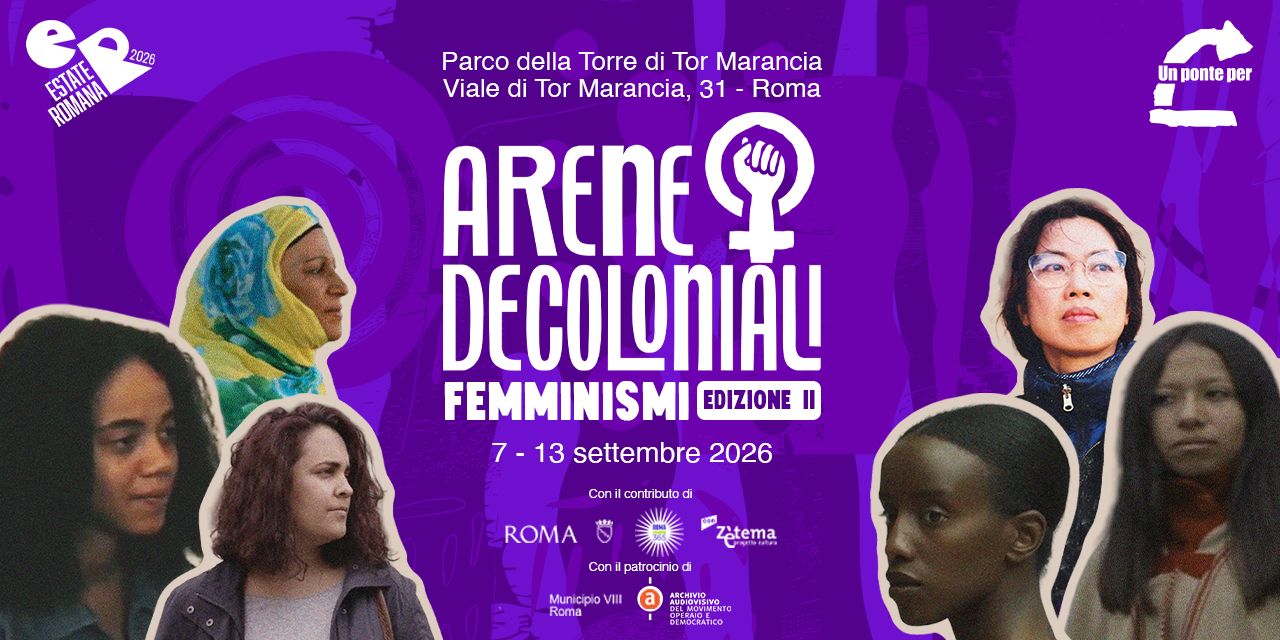
DECOLONIAL ARENAS 2026 KICKS OFF

These are times of high social conflict in Iraq, as evidenced by the mass protests that swept across the country in 2019 in what went down in the news as the Thawra Tishreen, the October Revolution. An uprising moved by a young generation of Iraqis tired of living in a country criss-crossed by conflict, which does not guarantee a future, and who fought to build the foundations of a democratic and inclusive state.
It is in this complex scenario that the role of civil society organisations becomes crucial in bridging the gap between communities and authorities at the grassroots level, trying to create change from below and promote constructive dialogue, ensuring respect for human, social and environmental rights as well as equal participation of men and women in community and political life.
To be most effective, however, local organisations need support. To make their way through the meshes of a complex bureaucracy and build autonomous and horizontal spaces of viability. External support that must be respectful, however, of country-specific cultural and social processes.
This is why the two-year project 'Tatweer', funded by the European Union, was conceived and implemented by our Iraqi colleagues. And it is being carried out by them, with great results.
"We want to empower Iraqi civil society organisations to have an impact in the promotion of human, civil and environmental rights; to enable them to respond effectively to the needs of the community, and to collaborate fruitfully with the authorities," explains Bahman, an Iraqi colleague we meet in Rome, who is visiting our headquarters for a few days.
"Iraqi organisations need to increase their advocacy capacities, provide adequate space for young people and women in leadership, the opportunity to learn how to operate, and the availability of spaces where they can meet and grow together. With this in mind, we have opened three centres: open and safe spaces for exchanges of best practices, meetings, workshops and seminars on human rights, environmental and gender issues,' she tells us.
The centres are now in Erbil, Basra and Mosul, the latter a Daesh stronghold in Iraq during one of the darkest pages of Iraqi history, and have already accompanied and supported the birth and work of more than 40 small local organisations.
"The first centre to open its doors was the one in Erbil, in the summer of 2020, right after the pandemic and the lockdown. In February 2021, we opened the one in Mosul, which operates throughout Nineveh and the areas liberated from Daesh. Finally, the one in Basra opened in May 2021,' Bahman says.
There are many fields in which the centre works to support organisations. First of all, legal advice: 'We have lawyers and experts who provide specific advice free of charge to cooperatives, voluntary groups, local NGOs and trade unions. We also provide support at administrative and management level. Everything we use for training is then made available online, through a platform, so that anyone can benefit from it and improve their work. After training members of organisations, we help them to access small tenders to make their intervention sustainable. We follow the whole process: from setting up the local organisation to accessing funds to project completion and advocacy,' he says.
"Our main objective is to support civil society in the creation of realities and structures that represent it in order to create change, so that they work effectively, transparently, democratically, respecting human and labour rights. Since we started, we have managed to accompany many people,' Bahman explains with great satisfaction.
To date, 24 micro-projects have been financed thanks to 'Tatweer'. Of these, 17 had to do with human rights and environmental issues.
Because in Iraq today, the question of access to rights remains central, especially for the generation born after the US-led invasion of 2003, which grew up with the promise of a free and democratic country, but still struggles with corruption, lack of work, and exploitation of resources. And with climate change, a scourge that worries young Iraqis in particular.

'Iraq today is one of the five most environmentally endangered countries in the world,' Bahman reflects. 'In addition to the consequences of climate change, which we face here as everywhere else in the world, there are also issues related to our context: pollution, the construction of the Turkish and Iranian dams that control the flow of our rivers - the Tigris and the Euphrates -, the severe drought that is affecting the south of the country, fossil fuels polluting the aquifers, and the despoiling of land for oil extraction. We are extremely worried,' he says.
And also in his opinion, after 2003, the challenges for Iraq have been, and remain, many. 'For 20 years, the Iraqi people have been trying to build a democratic system, but there are still many obstacles due to corruption, the lack of experience of the political class, and the rules of application of the constitution. The country continues to periodically fall into spirals of conflict compounded by tribal and inter-communal tensions. The Thawra of 2019 has shown that the new generations want real change. They want a state and a country they can take pride in. That is why it is so important to support civil society organisations: because it is the young people who animate them, trying to build change from below that does not come from above. They have lost faith in the authorities and no longer want to sit still and wait: they try to create change at least at the community level so that the generations that will come after them are not forced to live in the same present,' he concludes.