As Gaza’s summer heat intensifies, the sea has become one of the few places where people can escape the suffocating heat inside the tents. A few days ago, my friends from the displacement camps and I agreed to meet at sunset for a game of volleyball. We set up an old net on the sand and chipped in to buy a new ball, just to give ourselves two hours that felt a little closer to the life we knew before the genocide.
Some of the others had already arrived, while a few were still in the camps. I went to bring them with me, thinking I would only be gone for a few minutes.
Ahmed was the first person I went to see. He lives with his family in a camp not far from the beach and had been looking forward to playing with us.
When I reached Ahmed's tent, I called out for him, but his mother answered from inside.
"He's gone to the community kitchen (Takiya)"
It wasn't surprising. On many days, Ahmed and his family rely on the meal they receive from Takiya and can't afford to miss the food distribution.
I followed the road to the kitchen until I reached a line of men and children. Each of them was waiting quietly to get got meals.
I found Ahmed standing halfway through the line. He smiled when he saw me.
"We are all waiting for you," I said.
He laughed, lifted the pot slightly, and replied,
"Let me make sure we've got lunch first."
I stood beside him.
The heat was intense, even as sunset approached. There was no shade to protect people from the sun, and the line inched forward, one small step at a time, as everyone tried to reach the front before the food ran out.
A few minutes later, the food distribution began.
When it was Ahmed's turn, and shortly afterward, someone announced that there was no hot meals left.
Those at the end of the line turned around and walked back toward the tents.
Ahmed watched them and said quietly,
"Every day, people leave with nothing."
It was not an unusual scene. Even months after the so-called ceasefire, thousands of families across Gaza still rely on community kitchens for their daily meal. But these kitchens can only serve what supplies are available. When food deliveries are delayed or stocks run out, many families have no choice but to return to their tents empty-handed.
Together, we headed toward the neighboring camp.
On the way to the beach, we came across another line. This time, it wasn't people waiting for food, but rows of empty plastic jerrycans with their owners standing nearby, watching the road and waiting for the water truck.
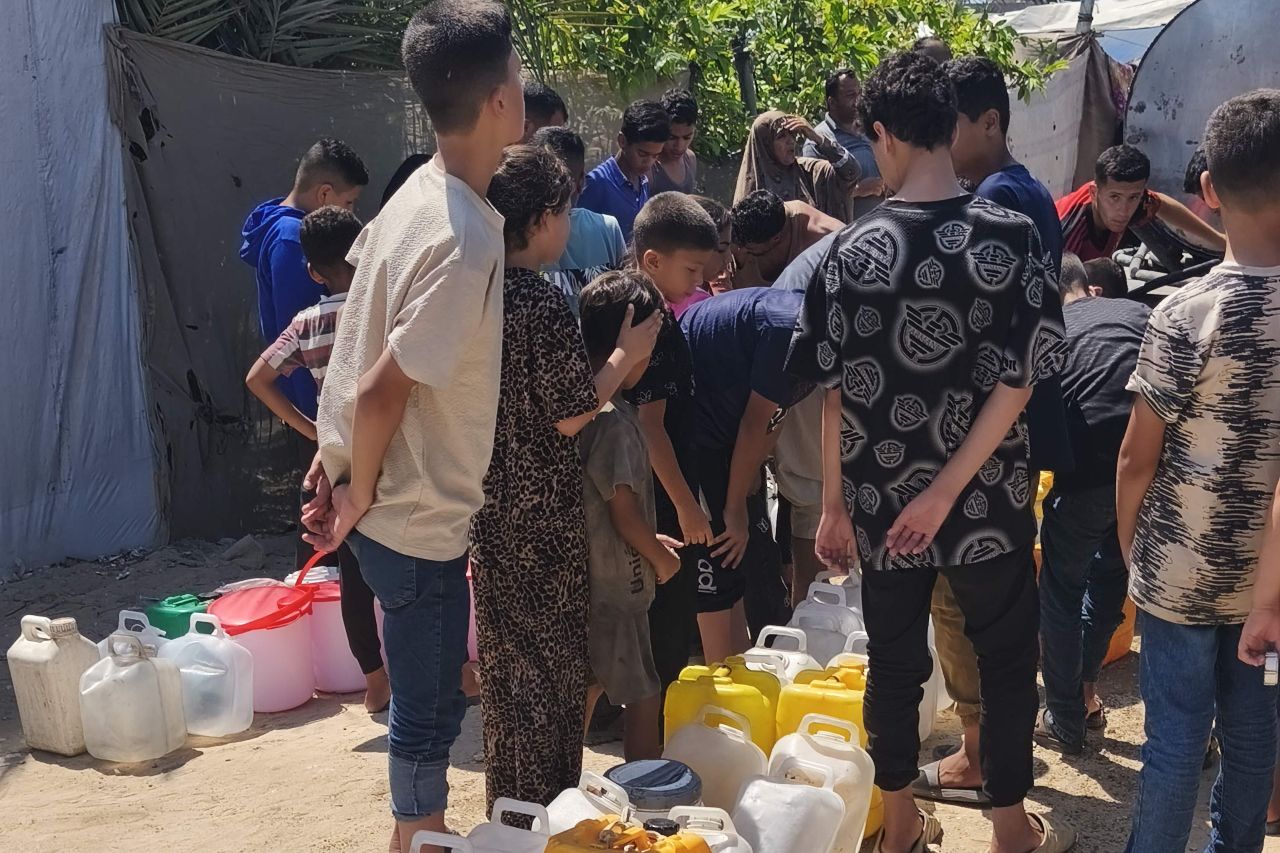
Youssef was among them.
He spotted us before we reached him and greeted us with a wave.
"We're heading to the beach," Ahmed called out. "Come with us."
Youssef smiled apologetically.
"Just give me five minutes to fill the jerrycans."
A few minutes later, we heard the rumble of a truck engine. Within moments, people from every direction hurried toward it, grabbing their jerrycans. It felt as though the entire camp had been waiting for that sound.
We waited for Youssef.
Once they were full, we helped him carry them back to his tent. He set them down by the entrance and paused for a moment to catch his breath.
As he drank a glass of water, he said,
"If I miss the truck today, we could end up going several days without water."
In Gaza, families never know when the next water truck will arrive. The moment people hear its engine, or word spreads that it is on its way, they drop whatever they are doing and rush toward it. Until today, thousands of families still depend on these trucks because much of Gaza's water infrastructure has been damaged and safe drinking water remains scarce. For many, securing water is still an essential part of daily life.
Youssef finished his water, pulled the tent flap shut behind him, then looked at us.
"Come on," he said. "Who's next?"
Only Khalil and Mohammad were left. They are cousins and live in the same camp. We started walking toward them, talking as we went, when an Israli explosion suddenly cut through our conversation.
We all stopped.
A few moments later, people began turning toward the rising smoke, while others ran in its direction. News spread quickly among those passing by: another Israeli strike nearby, with people killed and wounded.
We stood there for a few minutes, trying to make sense of what had happened.
Then Ahmed looked toward the smoke and said,
"If we'd taken the other road, that could have been us."
No one said a word.
We kept walking in silence.
We had set out to collect two friends for a game of volleyball, yet even this short walk was enough to remind us that genocide had never left Gaza. The so-called ceasefire has brought neither an end to the bombing nor to the fear of being killed at any moment. As people struggle to hold on to what remains of their daily lives, the genocide continues, a reminder that what Gaza is living through is not peace, but a war that has simply taken different forms.
We found Khalil getting ready to take his father to have his bandages changed. His father was one of many wounded people in need of specialized medical care. But like thousands of patients across Gaza, he had been unable to leave the Strip for treatment, and the medicine and care he needed were not consistently available.
We asked him to come with us, but he told us.
"You guys go ahead," he said. "I'll catch up once I'm done with my dad."
We left him with his father and continued to Mohammad, who was teaching at a temporary learning space where he volunteers in the camp.
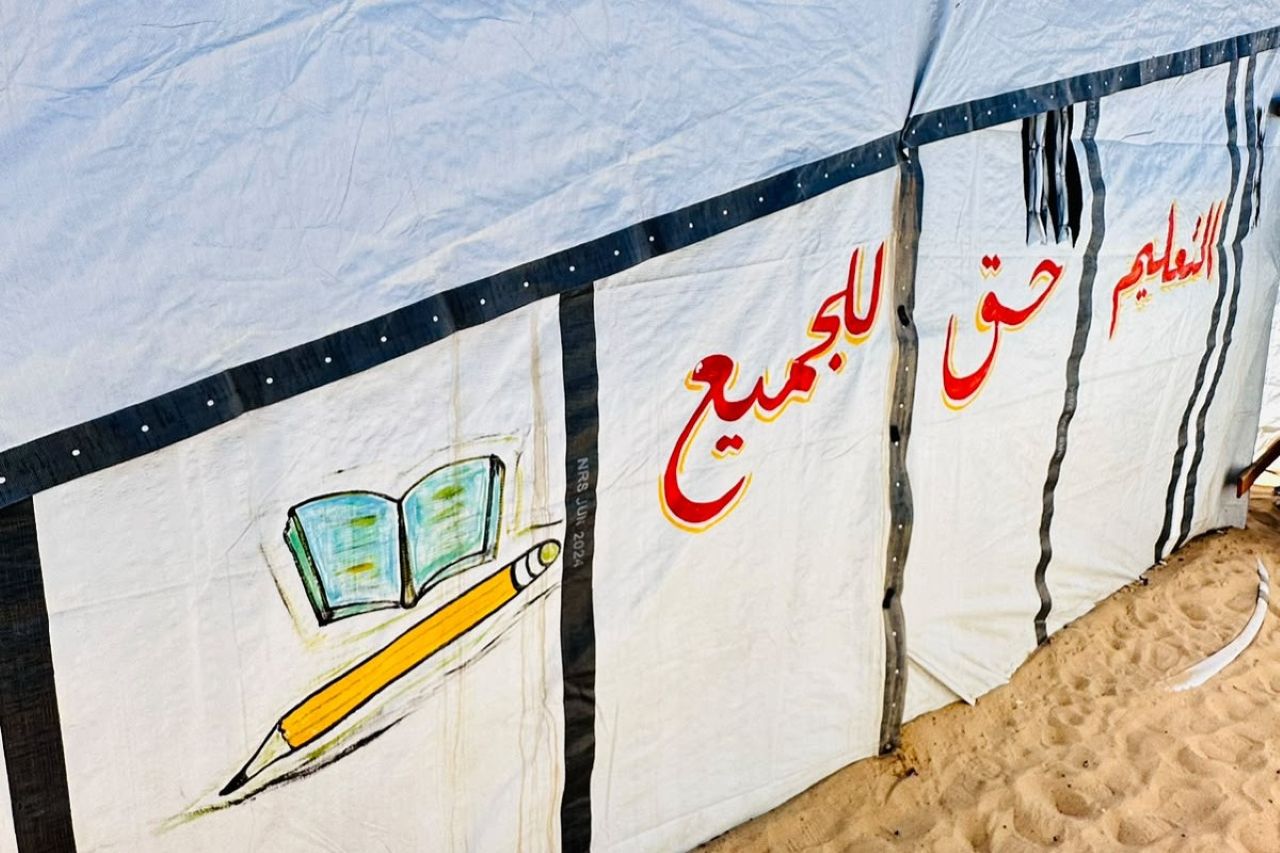
We found Mohammad inside his tent that had been turned into a classroom for children.
Every morning, the bedding is folded away and a mat is spread across the floor. Then the children begin arriving one by one, carrying worn notebooks and pens that have survived months of war and displacement. They sit together in a small circle while Mohammad and a group of volunteers try to give them two hours that feel a little like the life they knew before the genocide.
When the lesson ended, Mohammad stepped outside with a smile, gathering up a few notebooks.
"Come on, teacher," we called. "You're taking too long."
He laughed.
"Just let me close up the tent, then I'll come with you."
Since schools were destroyed by the Israeli occupation or turned into shelters, temporary learning spaces like this have become the only alternative for thousands of children across Gaza. As Gaza's education system faces an unprecedented collapse, volunteers like Mohammad and his sister, Dalia, are trying to keep children connected to learning, even if only for a few hours each day.
Mohammad pulled the tent flap closed behind him and joined us.
For the first time that afternoon, almost all of us were finally together, and we headed toward the sea.
By the time we reached the beach, the sun was beginning to set.
We started playing. We laughed when someone missed an easy return and argued over a few disputed points, just as we used to years ago.
For a brief moment, life seemed to recover something of its old shape.
During a break, we sat on the sand, catching our breath. One of my friends was scrolling through his phone. Then he looked up and said quietly,
"Do you realize today marks a thousand days since the Genocide began?"
A brief silence followed.
No one replied.
A few moments later, someone stood up and sent the ball back over the net, and the game resumed.
But as I walked back to my tent that night, I couldn't stop thinking about what he had said.
That day, I had left my tent simply to gather my friends for a game of volleyball. Instead, the journey took me through a food line, a water truck, a nearby Israeli airstrike, a father waiting for medical treatment, and a tent that had become a classroom.
That was when I realized the journey had never really been about gathering friends. It had become a portrait of what life in Gaza looks like after more than one thousand days of genocide and nine months of the so-called ceasefire, a life measured not by what has returned, but by what people manage to wrest back from it each day.

Hassan Herzallah – Correspondent in Gaza
When we founded Un Ponte Per in 1991 (it was then called Un Ponte per Baghdad), we included an unusual clause in the first set of articles of association: after ten years, the organisation was to be dissolved, unless the members explicitly decided to continue its activities. This was not a mere whim, but a political choice. We believed that a solidarity organisation should not exist merely to perpetuate itself. It should be a means, not an end. If the reasons that had justified its creation were no longer valid, it would be right to wind it up. Every ten years, that deadline forced us to question the meaning of our existence. For practical and legal reasons, that provision was subsequently removed from the constitution, but that spirit has never disappeared.
Today, thirty-five years after the founding of Un Ponte Per, that question resurfaces. Not because conflicts and inequalities have diminished, but because the world has changed profoundly. When we began working in Iraq and then in other countries of South-West Asia, independent civil society was often fragile or non-existent. Today, despite wars and authoritarian regimes, there are networks, associations, movements, feminist organisations, trade unions and youth groups equipped with expertise, project management skills and a fully independent political vision.
The question then inevitably arises: does it still make sense for a European NGO to continue making decisions on their behalf? It would be considered unusual if a Lebanese NGO were to open and run a women’s shelter in Rome. Why, then, should it be considered normal for an Italian NGO to do so in Beirut?
The National Assembly of Un Ponte Per, which met in Salerno on June 27th-28th, answered ‘no’. It unanimously approved a resolution setting in motion a process of gradually transferring decision-making power to local offices, with the aim of building, over time, their full political, organisational and economic autonomy. This is a necessarily gradual process, developed in collaboration with the organisations involved and without jeopardising either ongoing activities or the work of local staff.
The key word is power. For years, the debate on the localisation of cooperation has centred on the transfer of resources and expertise. We believe that the crucial issue is another one: who sets the priorities? Who decides how to use the resources? Who governs the organisations?
The conviction that has taken shape over recent years is a simple one. Local organisations no longer need to be led by European NGOs. They need alliances, international relations, peer-to-peer exchanges and political support.
This also means rethinking the role of Un Ponte Per: moving away from being an organisation that directly manages services in the ‘Global South’ and increasingly becoming a bridge between civil societies, capable of forging connections, promoting joint campaigns and fostering alliances for change, rather than partnerships aimed at implementing projects.
This organisational decision also stems from a broader reflection. The assembly recognised that the current system of cooperation and development aid, taken as a whole, is a mechanism that perpetuates dependecy relationships and neo-colonial control, supplanting the necessary debate on reparations and the inequalities arising from the economic system and colonial history.
This is not about denying the value of the work carried out by thousands of aid workers, including our own. It means questioning the power structures within which even the best of intentions end up operating. And it implies the imperative to get involved in the struggles to change international relations of domination and to question the possibility of using aid for decolonisation rather than control.
We will also change the vocabulary. No longer ‘donors’ and ‘beneficiaries’, but funders and recipients. The resources allocated to development cooperation are not acts of generosity: they are a compensation – albeit still insufficient – of the wealth and opportunities taken away through centuries of colonialism.
We do not yet know where this journey will take us. We do know, however, that it is worth giving it a go. And we want to discuss this with those, in the Global North and South, who are asking themselves the same questions, starting with the seminar ‘Decolonising Cooperation’ that we will be organising in Cotonou, Benin, as part of the upcoming World Social Forum.
Fabio Alberti – Honorary President of Un Ponte Per
Article published on Vita.it
Hassan Herzallah is a translator, writer and storyteller from Gaza. He contributes to various international publications. For the “Water for Gaza” campaign, he chose to share his first-hand account with Un Ponte,documenting his life under siege and displacement. He is in his third year of studying English translation at the Islamic University of Gaza and is continuing his studies online after the university was bombed.
“So you’re a refugee; you’re not from here.”
At first I thought he was joking, but that sentence kept echoing in my mind all the way back to the tent.
In the final days of the semester, we were set a university assignment: to translate a text into English about refugees around the world. It seemed like a routine task, just one of the many academic obligations squeezed in between online lectures, and at first I didn’t think much of it.
I opened the file on my phone and started reading. It was about people forced to leave their homes, the loss of stability, and the search for safety in unfamiliar places. I began looking for the most appropriate Arabic words – expressions that would convey the meaning as accurately as possible.
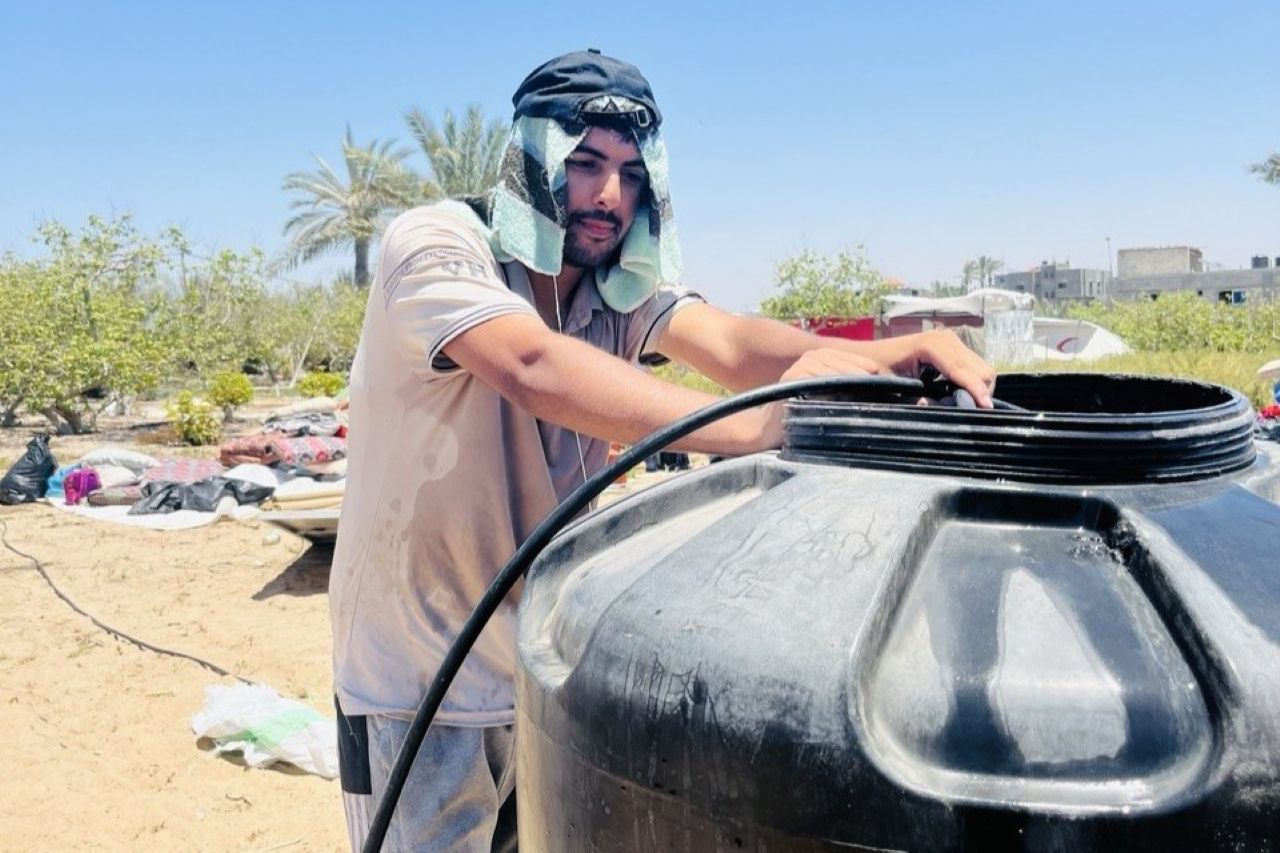
My concentration was interrupted: outside, I heard the sound of the water tankers arriving. I rushed out with the empty jerrycans and made my way over to the lorry. Ever since we were displaced, this has become a daily occurrence in the camp.
Before the war, getting water simply meant turning on a tap. Now it means waiting for a water tanker that may or may not turn up.
I joined the queue with dozens of other people clutching the same jerry cans. Children, women and men. After a long wait and several attempts to fill them, I returned to the tent with just enough water to last a single day.
Then I went back to the text. But I couldn’t keep my concentration for very long.
My mother came into the tent and told me that there was talk of the border crossings possibly being closed due to the new escalation between Israel and Iran. This usually means rising prices, shortages of essential goods and even stricter restrictions on movement imposed by the Israeli occupation. These updates have now become part of daily life, not just passing news items.
I put my phone away again and went out in search of something to eat.
Food is no longer seen as a meal, but as a fundamental necessity for survival in Gaza. In times of famine, a sack of flour can represent a victory and become the fine line between a day one can endure and one one cannot face. Food is no longer what it was before the war; it has become a constant struggle to secure the bare minimum needed to carry on.
I took the first available means of transport: a donkey-drawn cart. On the way, the driver turned to me and asked:
“Where are you from? I feel as though I’ve seen you before.”
“From Rafah,” I replied.
He remained silent for a moment.
“So you’re a refugee… you’re not from here,” he said.
At first I thought he simply meant to point out that I was from a different area, but he was using the word ‘refugee’ instead of ‘displaced person’ for a reason. I reflected on the way these terms are used in everyday language in that very place.
I didn’t reply straight away. That sentence, however, stayed with me throughout the journey.
A few hours later, I went back to my text. This time, I focused on just one word: refugee. I immediately remembered what the cart driver had told me a short while earlier.
I read that word over and over again. As a translator and writer, I had come across it countless times in academic texts and articles. But at that moment, it ceased to be merely a term to be translated. It became a question.
What does it really mean to be a refugee? Is it simply someone who crosses a border and leaves their own country? Or can displacement take another form, even without ever having left one’s home? I put the question aside and carried on with my day.
I noticed that my phone’s battery was running low, so I went to a charging point. Without electricity, mobile phones have now become much more than just a means of communication. I use mine to study, keep up with the news and stay in touch with the outside world. Even charging it involves waiting for what feels like an age.
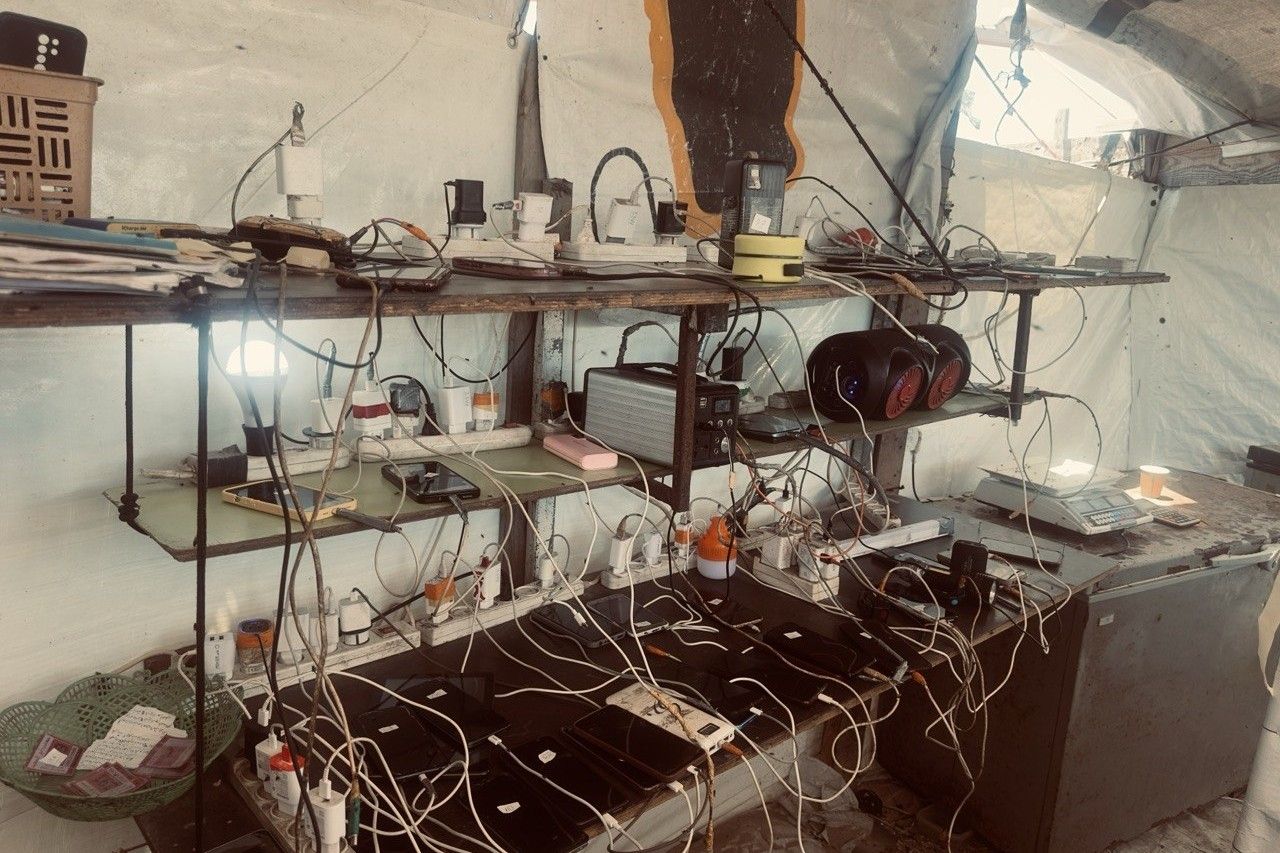
When I finally managed it, I went back to my text. I tried to concentrate, whilst the sounds of life in the camp echoed around me: the constant comings and goings of people, the conversations and the children’s voices, separated from us only by a sheet of fabric.
It was at that moment that I began to relate the text to my own day: water , the search for food, waiting to charge my phone, constantly moving between temporary places. I was no longer translating a text about refugees; I was experiencing the reality it described.
Before the war, I used to wake up to go to university lectures. These days, I wake up thinking about water.
Before the war, I used to carry my laptop and study materials with me. Today, my computer has been destroyed and I’m carrying jerry cans of water.
Before the war, I used to plan for exams, projects and the future. Now I plan how to get hold of what I need just to get through a single day.
I have come to realise that displacement is not just about losing one’s home. It is also about losing the people, the routines, the landmarks and the familiar faces that once gave meaning to a place.
In the camp, few faces are familiar to me. People come from different parts of Gaza, each carrying with them memories of the places they come from; yet none of us truly belongs to the place where we now live.
There is no longer an old road to return to, nor a neighbourhood whose landmarks I recognise instinctively. Places are now identified by temporary markers: the name of a camp, the number of a tent, or even the colour of the tarpaulin covering it.
I no longer define myself solely by the town I come from, but also by the camp where I live and the tent, which has become my current address.
Over time, I have come to realise that the sense of displacement goes far beyond the loss of a physical place. It concerns the loss of the ability to recognise the world around me. The task of translation, together with the realities of that day, felt to me like a journey through the memories of years of genocide and continuous displacement. It forced me to rethink the meaning of being a refugee.
I found myself living in a place that feels alien to me, even though I have never left my city. Here, displacement is not just about the loss of a home; it is also about the loss of that sense of belonging that once made the world recognisable.
That day I realised that being a refugee does not necessarily mean crossing a border. Sometimes it begins when the faces that gave meaning to a place disappear.
My home is still just a few kilometres away. I know the road leading there by heart. Yet, because of the ongoing Israeli military restrictions and evacuation orders, it remains out of reach.
Today, more than 117.8 million people worldwide are refugees or have been forcibly displaced – the highest number ever recorded. But displacement is more than just a statistic. It is the experience of losing one’s home, rebuilding one’s life amidst uncertainty and learning to find one’s way in a world that no longer feels familiar.
In Gaza, at least 1.9 million people – around 90 per cent of the population – have been forcibly displaced, many of them on multiple occasions. Families have fled the bombardments and evacuation orders, finding themselves in tents, damaged buildings and makeshift shelters that bear little resemblance to the lives they once led.
Perhaps, in the end, what we call ‘dreams’ here are often simply rights that people elsewhere take for granted.
Hassan Herzallah – Correspondent in Gaza
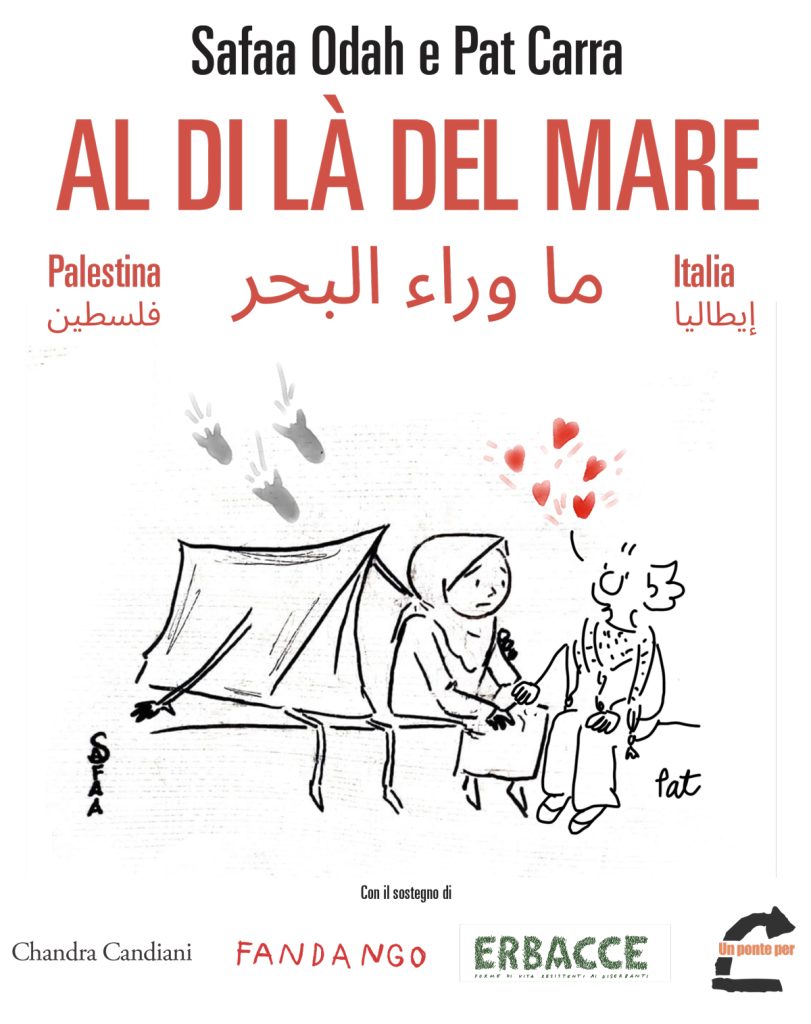
A bond of friendship, solidarity and feminism: this is what unites the cartoonists Pat Carra and Safaa Odah, across the divide between Italy and Gaza. From their meeting in 2024 – whilst Safaa continued to draw and bear witness from the tent where she lives as a displaced person in the Strip – a shared artistic and human journey emerged, which today takes shape in the book Safaa and the Tent. Diary of a Cartoonist from Gaza (Fandango, 2026) and in the travelling exhibition Beyond the Sea. Palestine Italy.
The exhibition, which opens in Lecce on 11 June before moving on to Rome and Modena, brings together illustrations, comics and works created by the two artists, including a number of collaborative pieces that defy the distance imposed by borders, sieges and wars. A project that tells the story of Palestine today through art, humour as a form of resistance and a deeply feminist perspective. Also supported by Un Ponte Per, in collaboration with Chanda Candiani, Fandango and Erbacce, Al di là del mare stems from the book’s publication and the desire to transform a relationship forged between Milan and Gaza into a shared space for encounter, memory and imagination.
We interviewed Pat Carra and Safaa Odah together to talk about comics, friendship, resilience, and the power of images to cross the sea even in the most difficult of times.
How did you meet, and how did your relationship begin?
Pat Carra – I met Safaa in 2024 on social media. I fell in love with her comics; that’s how it all began. I asked her to contribute to *Erbacce*, the feminist humour magazine I’m part of, and we dedicated the column *A Tent in Palestine* to her. An increasingly engaging correspondence developed between us. Fate assigned me the challenge of creating the practical conditions for a joint project, first her book and then our exhibition. In “Safaa and the Tent: Diary of a Cartoonist from Gaza”, there is also a second protagonist: our relationship. We are two cartoonists and share a feminist perspective; Safaa is 30 years younger than me, she is energetic and courageous, and her faith makes her strong. At a painful time for me, she was very close to me. It was a paradox to receive support from Gaza, where genocide is taking place and everything is in short supply. We found ourselves laughing.
Safaa Odah – We met during extraordinary times. Those were extremely difficult times and I was in a very fragile state of mind. As you know, we were going through a genocide. At that time, drawing was a way for me to resist and stay strong. We met on social media and I realised straight away that Pat is not just an artist, but a person. I’ve met many colleagues and artists, but she was the only one to stay, and there was something different about her. Over time, our relationship went beyond the boundaries of collaboration. In this encounter, I found a space where I could be sincere. Through her, I discovered a world of wonderful friendships, including the poet Chandra Livia Candiani. Pat played a very important role in getting my drawings published in the magazine Erbacce, and it was through her that the book with Fandango came about. We connected through our thoughts even before our drawings, and through our feelings even before our words.
What role does drawing play in representing the world around you?
PC – Comics and humour have always been a form of resistance for me. When I draw cartoons about male violence or war, I’m following a path that has its roots in my childhood. Like Safaa, I am self-taught in drawing; she studied psychology, I studied philosophy, yet we both ended up choosing this language, which is simple but not simplistic. It is an art that brings things back to a human scale, revealing the truth beyond the fiction, like the child who says ‘the emperor has no clothes’. Transforming anger, hatred and anguish into a moment of liberation is the essence of the craft. In 2004 I created ‘Cassandra Laughing’, a character who chronicles the Western wars following 9/11. Safaa bears witness to the post-7 October genocide by stripping the oppressor of his supposed omnipotence: Israeli soldiers are unbearable in her cartoons, just as the rats she depicts in front of sacks of flour are.
SO - For me, drawing isn’t just a means of expression, but a way of understanding what’s happening around me. Very often, words are not enough. I draw to document what I experience and what I see – not just events, but also emotions and everyday details that others might not notice. Sometimes I feel I am a witness, and that it is my duty to convey this reality as it is, with sincerity, even if it is very painful. Moreover, drawing is a space through which I can confront this reality, not flee from it. It is my means of staying grounded and of transforming this pain. It is not just art: it is a responsibility. To recount what is happening from my perspective and to leave a real impact on the viewer.
What have these years of genocide been like, as seen from Gaza and Italy?
PC – I march in the squares, attend meetings and follow the news, but my true guide on Palestine is Safaa. We share a common language, that kind of comic: socio-political, feminist, with a touch of humour even when the subject matter is tragic. Italy is a country sold out to the United States and Israel; Milan is a city twinned with Tel Aviv. Safaa is the only cartoonist who continues to draw from Gaza. My commitment from Italy has been to nurture our friendship, recognise her leading role, amplify her voice and join her in chorus. Safaa is a great cartoonist; her work is destined to become a classic, and to feel her trust is an honour. Her struggle is mine: we survive in a capitalism that cannot be defined in human terms.
SO – It’s been a difficult two years, and it’s not over yet. The war has never stopped; we live in constant fear of loss. This takes a very heavy emotional toll. In Gaza, there is no longer any separation between life and death: they are intertwined. For us now, living is simply about trying to survive. Over the years, Pat has always sent me photos and images of solidarity demonstrations from Italy, with truly extraordinary participation. This has been very important to me: it made me feel that our people are not alone, that there are so many people supporting us. I have always known that Italy stands in solidarity with Palestine, but during the war this was even more evident. Through social media I could see just how much solidarity there was, and the support was truly exceptional.
What does it mean to you to see a book and an exhibition resulting from your collaboration today? How did this idea come about?
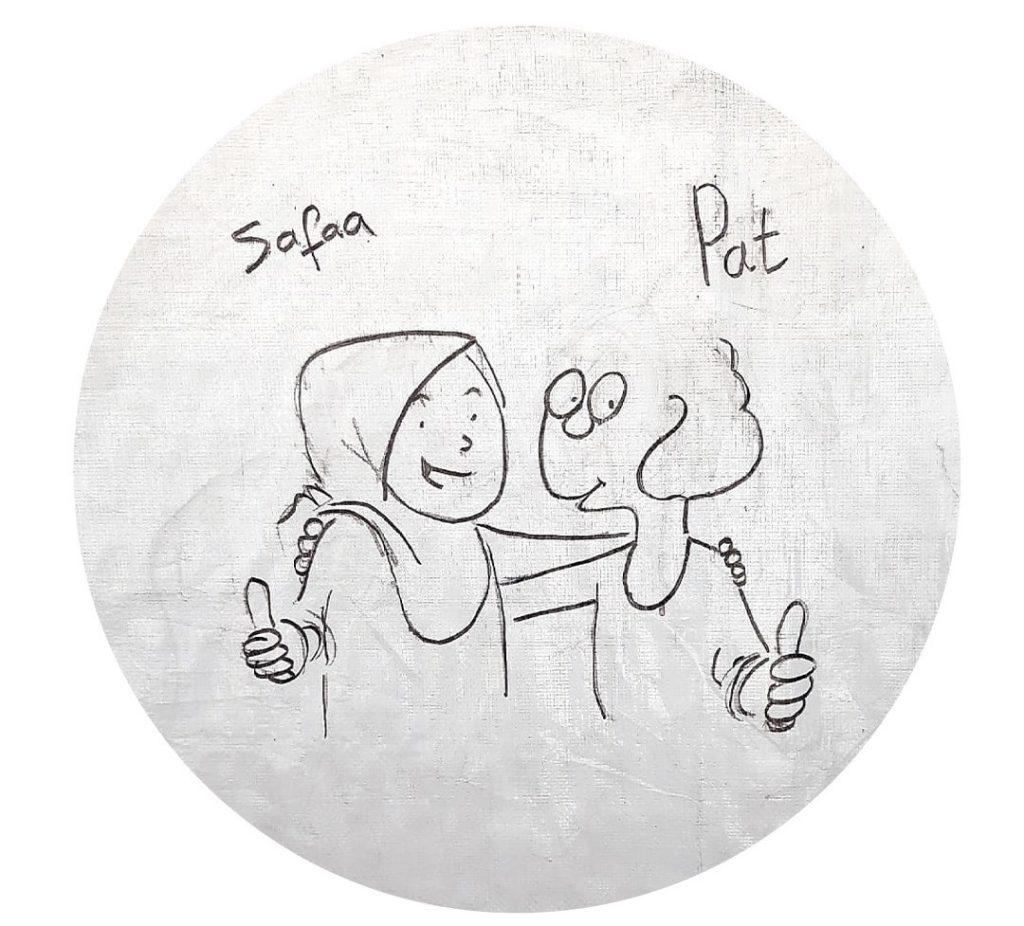
PC – Driven by a desire to put our relationship at the heart of the project, two female comic artists from two different countries. Whilst I was editing Safaa’s book, the practical conditions for working together simply weren’t there. We had to create a narrative thread, make choices and take risks. She would write to me, “keep going”. I wanted to get as close as possible, so that I could carry on. One day in 2025, I had run out of words to encourage Safaa. I chose one of her comics and drew myself next to her: this collaborative drawing became the exhibition’s central image. Others followed, forming the heart of “Beyond the Sea”: we meet in the comic, quite literally. The poet Chandra Candiani, who is with us here through her text “Indomitable Trust”, describes it in this passage:
“And there is the loving bridge between Safaa and Pat, their meeting echoing from one side of the sea to the other. A number of collaborative comics have emerged, like nocturnal sonatas and dialogues in the dark between frightened little girls who reassure one another thus within the evil of the world, without leaving it, with their fragile yet incorruptible instruments of salvation. Through their testimony. Through their working together.”
SO – Seeing my book and exhibition come to life from this collaboration stirs up mixed feelings in me. On the one hand, there is immense joy; I never expected to achieve this. I am grateful and happy for all of this. But I would have loved so much to be there with you. For us, every drawing has a story; every detail is linked to a moment, and it seems to prove that something can continue to exist and grow despite everything.
Venues for the exhibition "Beyond the Sea" (updated)
When I was younger, I used to think the Nakba belonged to older generations. It felt like something distant, tied to black-and-white photographs or to the names of villages people repeated every May.
I heard about it in family conversations, in stories that always began with an old house or a road that no longer existed. Like many people from my generation, I thought the Nakba was something that happened 78 years ago and ended there, even if its effects remained.
But on a night in May 2026, after turning 22 years old, and after my own roof had become fabric, I began thinking about the meaning of the word again.
What does the Nakba really mean to Palestinians today? Is it still only a historical memory, or is it something we continue to live in different forms without always calling it by its name?
That is why I decided to ask several Palestinians, each with a different relationship to the meaning of the Nakba. I wanted to understand how one word could carry all these meanings, and how Palestinians, wherever they are, might still find themselves inside it in one way or another.
I began with my grandmother.
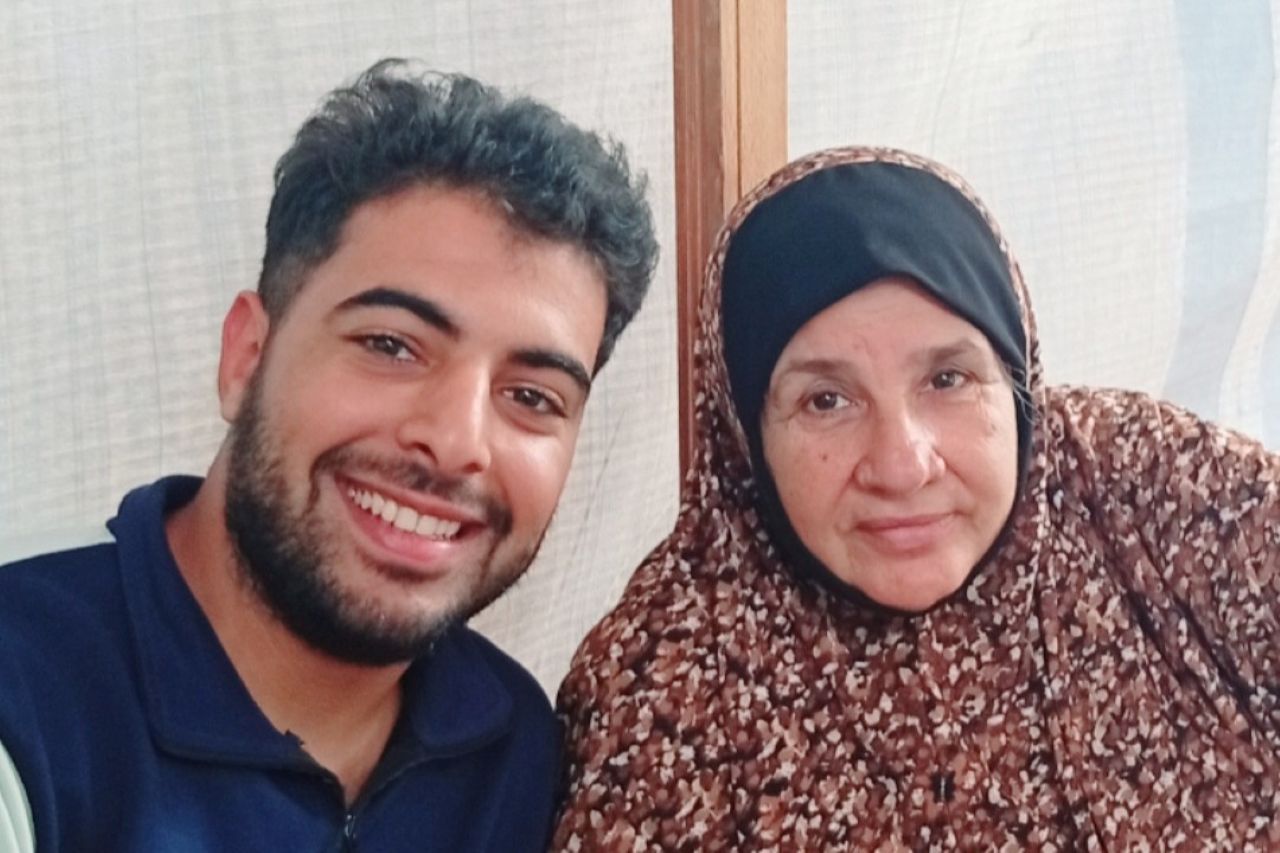
My grandmother did not directly live through the first Nakba. She was born a few years later, but she grew up surrounded by its stories. She used to tell me about the old homes, and about the large keys some families kept for years, as if return was still possible at any moment. She also spoke about how her mother hid gold, clothes, and other belongings underground before fleeing, believing the family would return only a few days later.
When I asked my grandmother whether she saw the Nakba as something that ended decades ago or something still continuing today, she did not hesitate for long.
She was sitting inside her tent in al-Mawasi, Khan Younis, nearly two years after being displaced from her home in Rafah, surrounded by camps that felt closer to a struggle for survival than to real life, with almost no infrastructure and with bombing continuing despite what was being called a ceasefire.
For a few brief seconds, she spoke in a way that seemed to summarize not only her own suffering, but the suffering of an entire generation of Palestinians.
"The Nakba is still ongoing", she told me. “What happened to us in 2023 was worse than the Nakba of 1948.”
Then she added:
“We used to hear about displacement from our parents, and now we are living it with our own eyes.”
And this experience is far from isolated. According to the United Nations, around 90 percent of Gaza’s population has been displaced since the beginning of the genocide, many of them multiple times.
In that moment, I realized that for my grandmother, the Nakba was not simply an old story. It was something passed from one generation to another until it finally reached us, in an even harsher form.
But the Nakba does not look the same for every Palestinian.
I then spoke with one of my relatives living in the occupied West Bank about what the Nakba means to him today. He told me that there, the Nakba does not always appear as tents or displacement the way it does in Gaza, but as a life where everything can change or collapse at any moment.
He said that checkpoints, military raids, and daily fear create a permanent feeling of instability, as if life itself has become temporary.
“Sometimes you feel like you are living in your own homeland,” he said, “but without fully feeling safe or free.”
For him, the Nakba is not only about losing your home. It is also about living without the ability to feel normal, stable, or certain about the future. And when he spoke about Gaza, he said Palestinians are living the same Nakba in different forms. Some live it through bombing and displacement, while others live it through constant fear and suspended lives.
Across the occupied West Bank, Israeli occupation raids, restrictions on movement, arrests, and forced displacement continue in ways many Palestinians see as an ongoing extension of the Nakba.
Abu Hashem, one of my closest friends growing up together, carried yet another meaning of the Nakba.
When he left Gaza to continue his studies abroad, he thought he would only be gone for a few months before returning to his family and normal life. But today, he watches the genocide from afar, following news of displacement and bombardment through his phone, while living with the constant helplessness of being unable to reach or even properly check on his family.
He told me:
“For me, the Nakba is being a Palestinian student living far from home, away from my family, away from the people I love, and away from a life I thought I would return to.”
Later, he added:
“I used to think the Nakba meant being forced to leave your home. Later, I understood that it can also mean not being able to return to it when your family needs you the most.”
For him, the Nakba became a long exile, a constant feeling that you are far away from the place where you are supposed to be, while everything continues there without you being able to do anything.
Then I thought about myself.
On the day I was displaced from my home, I believed it would only be temporary. Like many others, I left thinking I would return after a few days. We left many things behind because we never imagined the absence would last this long. But over time, I began to understand something I had never understood before.
I understood that Palestinians do not need to read history books to know what the Nakba means.
Sometimes, all it takes is losing your home once.
Or waiting for hours at a checkpoint.
Or watching your family being displaced through a phone screen while you are far away.
That is enough to understand that the Nakba was never just an old memory.
After 78 years, the Nakba no longer carries a single meaning for Palestinians. In Gaza, it may mean tents, displacement, and losing your home. In the West Bank, it may mean a suspended life shaped by fear and checkpoints. Outside Palestine, it may mean a long exile and the pain of being unable to reach your family when they need you most.
But despite these differences, one thing remains shared across all these stories: the constant feeling that Palestinian life can be uprooted or changed at any moment.
That is why the Nakba today feels less connected to the past and more connected to the present we are still living through. It is not only an event that happened in 1948, but an ongoing reality that changes from one person to another and from one city to another, while remaining tied to the same root: the ongoing Israeli occupation and the permanent loss of safety, stability, and normal life that comes with it.
And maybe that is why Palestinians do not have a single definition of the Nakba. Because every Palestinian, wherever they are, carries their own version of it.
Hassan Herzallah - Correspondent from Gaza
The war in this region is no longer a breaking news story on our screens: it has become a subtle daily rhythm that inhabits our details, reshapes our consciousness and distorts our collective memory.
As an Iraqi, I see the war not only as a political or military event, but as a heavy presence that has been weighing on our chests for decades, leaving its mark in the language, in the faces of the children, in the tone of the mothers' voices, in the shaking of the doors when fear closes them.
Today, as I watched a scene of panic during the bombing of schools in Mosul, I was not simply seeing children running in panic: I was witnessing history repeating itself with disconcerting audacity. Their cries were not new: we have already heard them in our schools, in our alleys, in our shelters.
There was something painfully familiar in that chaos, in that noise that resembled the sound of the soul when it is taken by surprise by danger. I have seen people flee their places not because they are cowards, but because they are exhausted from being tested in courage every single day.
For us, war is not just material destruction: it is a slow dismantling of our sense of security. Living without trusting calm, being more disturbed by silence than by noise, interpreting every sudden sound as the beginning of a disaster: this is the hidden face of war. Persistent fear, anxiety and tension do not arrive as passing guests, they establish themselves within us as part of our psychological structure.
Even more dangerous is the way people's emotions are reshaped, manipulated and pushed towards sectarianism and hatred. War does not just annihilate bodies, it plants seeds of division in minds and trains hearts to suspicion. Suddenly, the other becomes a threat, belonging becomes a weapon, identity becomes a trench.
What hurts the most - perhaps what scares the most - is listening to the children. Their conversations are no longer about play, dreams or the future, but about planes, bombing and death. They buy plastic weapons, imitate war scenes and recreate what they see with their little eyes.
How far have we fallen? How have we come to teach our children the tools of war instead of the language of peace?
Unfortunately, this is not a passing phenomenon, but a profound change in consciousness. When a child grows up believing that war is normal, we do not just lose his or her childhood: we lose the possibility of building a future. A child who learns about war will grow up carrying it within him or her, even if it ends outside.
As far as I am concerned, war is not an idea: it is a personal story. I lost an uncle in the war; another uncle was a prisoner, and my father bears indelible scars on his body. I was born during the war in 1990, as if I had entered this world through a smoke door. I grew up a little only to find myself in the war of 2003. I was a student then, and that is where I started writing. Perhaps as a means of survival, perhaps as an attempt to understand what cannot be understood.
Then came the civil war in Mosul, and I was among those who tasted the bitterness of violence and terrorism. For me, it was not news flowing on TV, but days lived in fear and anticipation. Then we entered another war against the Islamic State, and death became a daily possibility, life a postponed project. Today we live in a new conflict, as if this land were destined never to rest.
None of these wars passed without leaving a mark. When they end, we do not just remember them: we also live them in their absence.
Here emerges the question that haunts me: when will we experience consecutive years of peace? Has peace become a luxury? How can such a beautiful word be so powerless in the face of the war machine? Perhaps because it is easier than building, thinking, dreaming. Yet, it costs us everything.
As an Iraqi, I am not looking for great answers or slogans. I only long for a moment of calm that is not interpreted as a pause between two wars. I dream of a childhood that is not measured by the number of explosions one has survived. I imagine a country that writes its history not with blood, but with words.
The great powers sharing spheres of influence see nothing in us but maps and interests, waging their cold wars on our burning bodies. As for the United Nations, since its foundation it has appeared impotent or complicit, merely counting the dead instead of protecting them. This international silence is not neutrality: it is another form of violence.
Between political calculations and power interests, it is the human being who pays the price alone, as if his life is worth less than a deal.

Jameel Al-Jameel - Communication Coordinator of Un Ponte Per in Iraq
Before people wake up in other parts of the world, the search for water has already begun in Gaza.
Empty plastic jerrycans line up in uneven rows, some cracked, others barely holding together, as voices rise with the approach of a water truck. Shouting, calling, hurried footsteps on rough ground, and bare feet trying to outrun time.
Then, the sound of a horn.
My brother Mohammed and I rush out, barely having washed our faces. There is no time to think, only to reach the front of the line. All we want is to fill a few jerrycans with water. Sometimes, there is not even time to put on shoes. Being just a few minutes late can mean going an entire day without water.
In Gaza today, people are not just searching for water. They are running after it.
Before the genocide, water was not something we thought about. With electricity, a simple switch would turn on the pump, and water would flow up to the rooftop tank without effort. It took nothing more than opening a tap.
But with the start of the war, everything changed. I remember the early days after electricity was completely cut. My father, Mohammed, and I would carry jerrycans from downstairs up to the rooftop, trying to fill the tanks by hand, while the constant buzz of drones filled the sky above us and explosions echoed nearby. In those moments, even filling water was no longer routine. It became a race against time, and against fear.
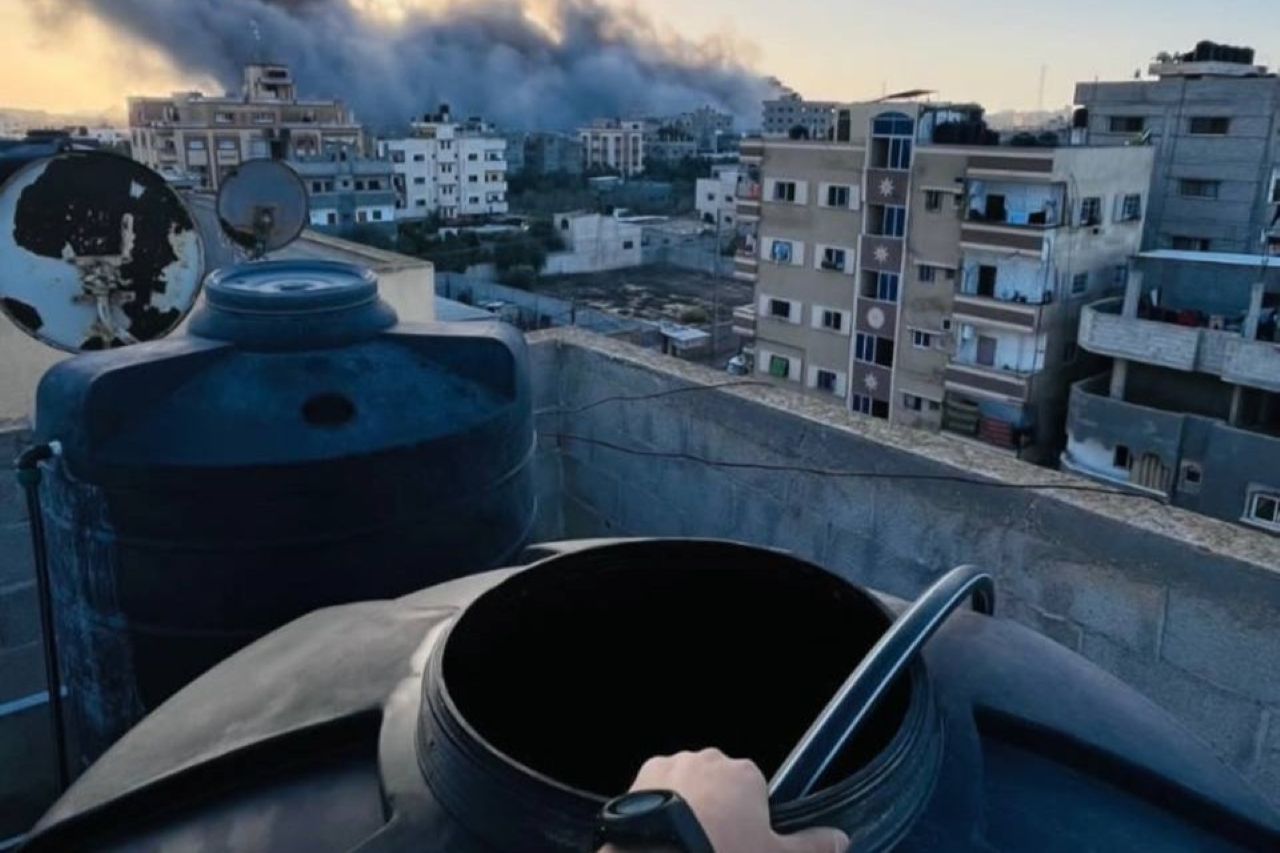
Time passed, the water crisis in Gaza has not eased, even after what is called a ceasfire. The problem is not only scarcity, but also the quality of water itself, which is often unsafe. Many struggle to access water regularly, and even when they do, the amounts fall far below basic daily needs.
This is largely due to the destruction of water infrastructure by the Israeli occupation, turning access to water into a daily challenge.
This crisis did not begin today. For years, over 90% of Gaza’s water has been undrinkable. The genocide and the destruction of water infrastructure by the Israeli Occupation have pushed the system to the brink of collapse, making access to water a daily struggle.
Since municipal water stopped, everything shifted. What once flowed through pipes disappeared, and we became entirely dependent on water trucks. We began filling yellow jerrycans, one after another, waiting for deliveries that might or might not arrive.
Water no longer reached us. We had to chase it.
Hamoda, 21, from al-Mawasi in Khan Younis, lives this reality every day. Before the war, getting water was simple. “We had electricity, we had municipal supply. We used to run the generator and pump water easily,” he says.
Even when we were still in our homes, buying water was affordable. But fear never left. I remember filling the rooftop tank while shelling echoed nearby and drones hovered overhead. Water was no longer just a daily necessity. It became tied to fear.
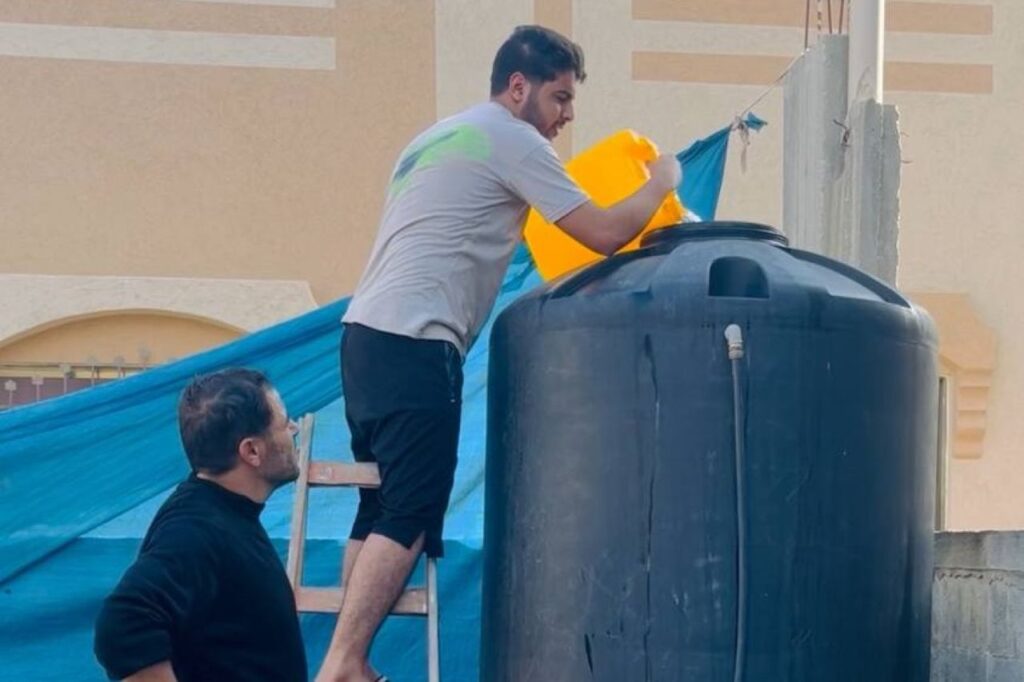
Then came displacement, and with it, a new reality.
Water trucks now arrive every three days, if they arrive at all, and there is no guarantee of quality.
“Sometimes it’s drinkable, sometimes it’s not, but we have no choice.”, he says.
The problem goes beyond taste or salinity. It is about health.
He recalls how his pregnant mum fell ill after drinking the water and had to go to the hospital, where doctors warned her not to drink it. “But what’s the alternative?”, he says.
The alternative is buying water, if you can afford it.
In a collapsed economy, that is not the case for most families. Prices have surged. What once cost a few shekels now costs many times more. With little cash in circulation, even buying water becomes complicated.
“Most of our relatives can’t even afford water,” he says.
The question is no longer whether water is available, but who can afford it.
In this reality, getting water has become a heavy daily burden, often falling on those least able to carry it.
On many days, I am not the one who goes to fetch water. My younger brother, Mohammed, 13, takes on that responsibility. We have two sisters, and I am often away, so the burden falls on him.
He stands for hours in crowded lines, trying to secure a spot before the water runs out. There is no real system, just an open race. Whoever reaches first fills.
When he finally manages to fill the containers, the amount is never enough for a full day.
“What I can carry isn’t enough,” he says.
But it does not stop with our household. After we lost my uncle, his daughters have come to rely on us as well. I try to fill water for them whenever I can, as access is even more difficult for them in such crowded conditions.
In this reality, fetching water is no longer a routine task. It is a daily burden shared by everyone, often carried by the youngest.
These conditions are forcing children to take on responsibilities far beyond their age, in an environment that offers little safety or dignity.
The situation becomes even more severe when the water crisis intersects with illness. With limited treatment and scarce resources, it turns into what can only be described as a silent health crisis.
During my volunteer work in displacement camps in al-Mawasi, I saw that not everyone faces the water crisis in the same way. Those with chronic illnesses, especially kidney patients, suffer the most. For them, it is not just about finding water, but finding clean and safe water.
It is no longer about waiting in line, but about searching for a specific kind of water that may not even be available.
Even during holidays, when joy is supposed to come first, some families are fighting a different battle: securing water that will not harm their children.
They are forced to buy it daily, despite the high cost, because there is no alternative.
While others run after water trucks, these families face a different dilemma. Even the available water is not suitable for them.
In Gaza today, some cannot find water at all. Others find it, but cannot drink it.
Here lies the harshest contradiction. Water, meant to sustain life, has become a source of illness. The crisis is no longer only about access, but about its impact on health.
Even with signs of limited improvement, such as the restoration of water access thousands of children, according to UNICEF, these gains remain partial and do not reflect the daily reality in displacement camps.
In some areas, small water solutions offer a degree of stability.
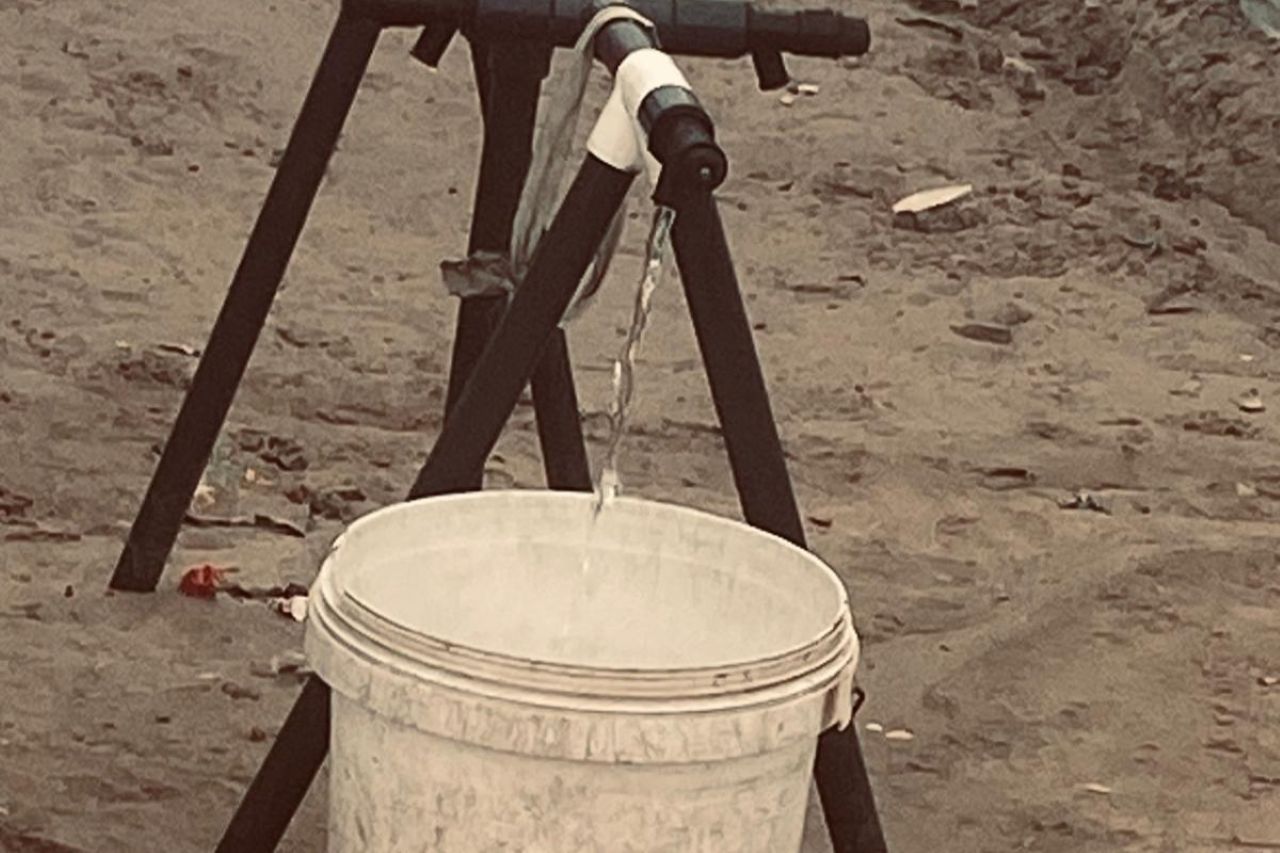
In camps I visited, shared water barrels are refilled every two days, reducing the need to chase trucks and creating a rare sense of stability. In nearby camps, simple wells have been built, allowing people to access water without waiting for trucks, even if the quality is not always sufficient.
But this reality is not everywhere. In other areas, trucks rarely arrive, and access remains unpredictable. This unevenness reveals a simple truth: even suffering is not equally shared.
From what I have seen and heard, the issue is not just water, but the sense of stability and security it brings. People are not only searching for water. They are searching for stability, for a day that can be anticipated, for a moment not dictated by whether a truck arrives or not.
Despite these efforts, solutions remain limited and out of reach for many. As temperatures rise, the demand for water increases, and so does the daily burden.
In Gaza today, water is no longer just water. It is a daily story that captures the full weight of the crisis we live through.
Hassan Herzallah - Correspondent from Gaza
March wasn’t an ordinary month. There wasn’t a single feeling I hadn’t experienced.
People in Gaza are living between the harshness of difficult conditions, the fragility of a ceasefire, and the media blackout on what is happening here. In every tent, there is a story. In every corner, there is suffering that many overlook.
At the beginning of April, I was standing by the sea, trying to think through everything I had lived during the month of March. For us in Palestine, March was not just one month, but several months compressed into one, due to the intensity of events that revealed the reality left behind by a genocide that has not ended to this day.
I began to remember the moments when we wanted to gather with my relatives at my grandmother’s place. We prepared everything, but in a single moment, the weather suddenly changed, and we were forced to stay in our tent out of fear that something might happen. So my family decided that I would go alone.
The journey took more time than I expected. I couldn’t find any means of transportation, not even a horse-drawn cart, and I arrived after the call to prayer. On my way, I remembered that we used to own a car in the past, but now, we have forgotten what a car even looks like.
Even the family gathering we used to have at my grandmother’s place has become something difficult to reach because of the harsh conditions we live in—conditions imposed on us by fear: fear for our fragile tents from rain and storms, and the absence of transportation that we once had.
In this month, I came to understand more deeply the impact and consequences of what the Israeli occupation has done to us. From the moment we invited a woman we know to join us for iftar during Ramadan, but she refused because of what had happened to her teeth and her inability to remove the maskfrom her face.
Then my thoughts moved to the moment when Eid came. We are used to visiting relatives during Eid. My father, being the youngest among his siblings, was the closest to them, and he loved that we visit all our relatives on the first day of Eid.
But on that first day, it seemed that my father did not want to visit anyone, for a reason I did not know. Even though he missed seeing his brothers and sisters in the nearby camps and in different places, I asked him why, but he did not answer. Still, I insisted that we go out together, and eventually we did.
We went to visit one of our relatives - my aunt, who is very close to my father. Her husband was also my father’s friend. When we sat there, she had prepared sweets for us, and it was beautiful to see her after a long time. We began talking about the situation here and how difficult and limited life in the tents has become.
In the middle of the conversation, I asked about her husband,
Forgetting something important—that he had been missing since their home was bombed.
I do not know how I forgot that in that moment. I felt as if something heavy tightened around my chest. My father quickly tried to change the subject, and we continued talking about our past lives—how simple and beautiful they once were.
After a few minutes, we left my aunt’s tent. I expected my father to say something, but he did not.
Then we went to my another aunt, who is one year older than my father. When we arrived, she was very happy to see us, because we are trying to hold on to the traditions of Eid that they were used to.
She told us that she truly wants to visit us, but she cannot—there is no transportation like before, no cashmoney, and she has a problem with her knee that makes it difficult for her to walk long distances, especially since most of the roads are muddy and cracked.
As for us, the daily struggle of fetching water, charging phones, and handling basic needs that were once simple prevents us from even thinking about visiting anyone.
Then she began to talk about her home - how beautiful it was inside. She had bought it just a few months before the genocide, but she did not even have time to memorize its details before everything changed. A single paper forced her to leave Rafah and move into displacement, to an unknown future.
At that moment, she was speaking, but her eyes were speaking even more —filled with grief.
Then her young son came in and said:
“I want to play inside the house.”
He meant the tent next to them.
She replied:
“In home, I had prepared a room for him, but he never saw it. When we were displaced, I was still pregnant with him. Today, Amjad has never seen a home, and he does not know what the word ‘home’ means. The only home he knows is a tent made of cloth.”
After that, we visited more relatives and then returned to our tent.
At that moment, my father said something to me:
“I didn’t want to visit anyone because everywhere we go, there is a different kind of pain in every family we meet.”
Then my thoughts moved to March 21, Mother’s Day. I had planned to write article about it. I went to one of the camps to conduct interviews. I asked a woman about Mother’s Day.
Her eyes filled with tears as she spoke about her missing son. She did not know whether he was killed or imprisoned. I found myself hating the question I had asked.
Then I spoke to another man who told me that he had lost his entire family—his children—and that he was the only survivor. I returned to my tent and abandoned the idea of writing.
Then my thoughts moved to March 30, which is Land Day in Palestine, and at the same time, it was my mother’s birthday.
I wanted to surprise her with a gift. It was not a bag, or perfume, or even a ring - but two kilos of gas, so she would not have to cook using fire especially now, as crossings remain tightly restricted, allowing in only limited supplies, while cooking gas becomes harder to find and increasingly out of reach.
When I went to buy the gas, my friend Al-Nahhal was with me. I kept asking him:
“Do you think my mother will be happy with this gift, or will she laugh?”
He kept telling me that she would be very happy.
Then, in the middle of the conversation, I asked him:
“What did you get your mother for her birthday or Mother’s Day?”
He sighed and said:
“My mother was killed during the genocide.”
I froze. For a few moments, I didn’t know what to say or do. It felt as though my words had turned into chains tightening around my neck. I returned to the tent. My mother was very happy with the unusual gift, but there was still a heavy feeling inside me because of that moment with my friend.
As I stood by the sea, I remembered my father’s words again. Meeting people in Gaza may bring back some of the beautiful moments that once existed, but it also reveals everything that has been lost. Sometimes, a single word or a small detail is enough to open a flood of memories.
My father did not say anything, but his silence was heavier than everything I had heard that day.
On March 30, it was Land Day.
But it was not as we once knew it.
It was no longer a story from the past, but a reality we live every day…
To be connected to a land you can no longer reach.
In Gaza, meeting people is no longer what it used to be.
It carries more of what we have lost than what remains.
All these small details, all these stories, are reflections of a reality created by the Israeli occupation, while the world remains silent.
Perhaps that is why the question is no longer what we are living through…
but how we are still trying to live.
Hassan Herzallah - Correspondent from Gaza
Until 7 October 2023 in the Gaza Strip, despite the siege and many difficulties, thanks to the organisation of the population lə children could still attend schools and kindergartens. Despite the extreme living conditions to which the Israeli siege had reduced Gaza, there was still a daily routine of lessons, relationships and small spaces of normality in which to continue to grow and imagine the future.
The genocide radically transformed the lives of the surviving people. Israel's indiscriminate and genocidal attacks have systematically hit structures essential to the survival of the civilian population, destroying homes, infrastructure, hospitals. And all schools.
Educational spaces have been made inaccessible, while thousands of families have been forced to take refuge in overcrowded camps, where they live in tents and encampments. To the loss of homes has been added the loss of income: more and more families can no longer guarantee food, clothing and basic necessities. And to all this has been added the loss of the future: preventing the right to study for the younger generations means this.
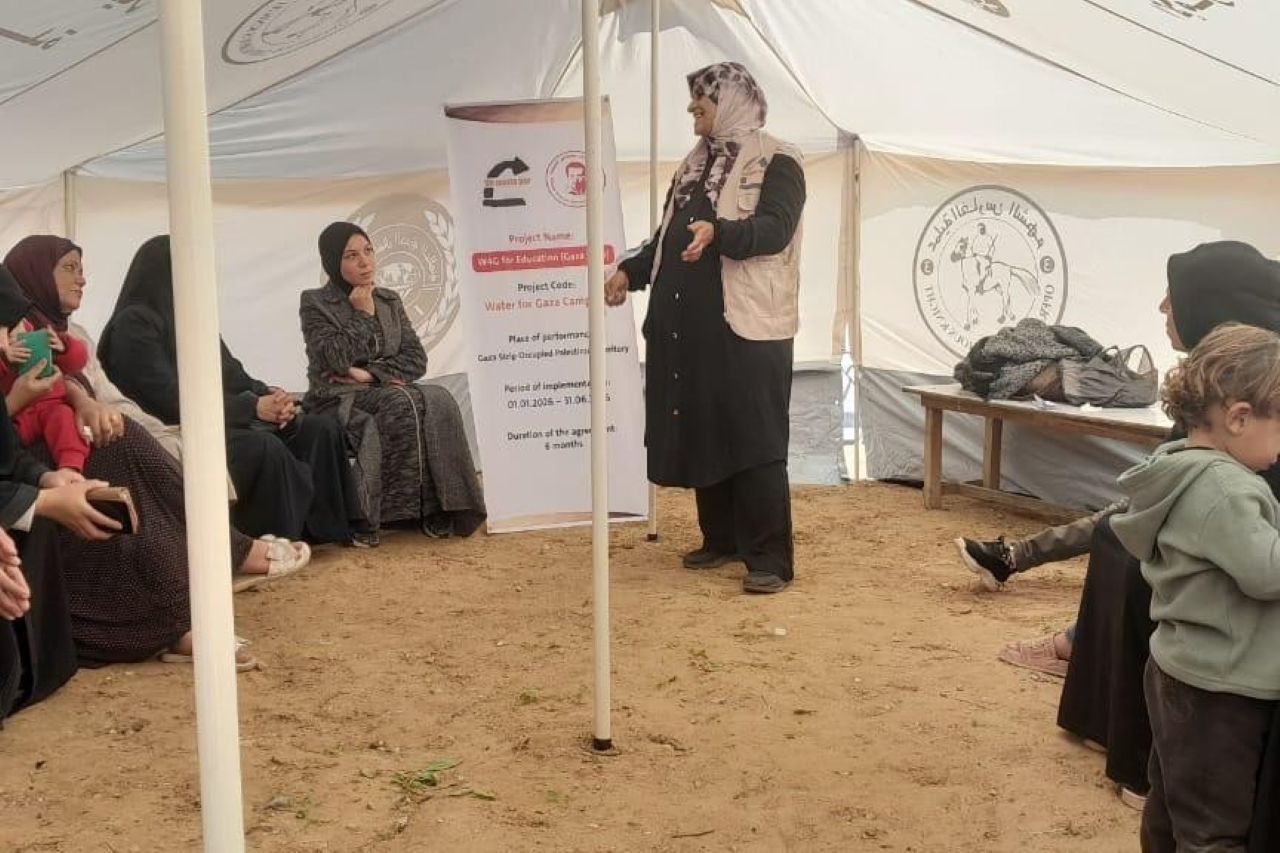
In this disastrous context, lə children have been deprived of their childhood and right to education. Life in the camps exposes them daily to shortages of essential goods, critical hygienic conditions, emotional stress and isolation, and the impossibility of imagining a tomorrow.
This is why, in addition to the emergency interventions we have carried out with the 'Water for Gaza' campaign, we have recently started a new front of solidarity with 'Roots of Resilience'. A project through which, together with the Ghassan Kanafani Development Foundation (GKDF) in Gaza, we try to ensure protection, education and psychosocial wellbeing for children and adolescents.
GUARANTEEING THE RIGHT TO EDUCATION IN GAZA
One goal of this new bridge to Palestine is to ensure that the children have access to the right to education, as far as possible.
Together with the Ghassan Kanafani Association, a Palestinian community organisation working to ensure access to education and psychosocial support for children, and thanks to the generosity of our donor community, we support the creation of temporary spaces for early childhood education and emergency education programmes in the areas of Khan Younis, Deir al-Balah, Nuseirat and Gaza City. Together we organise psychosocial support activities and the distribution of essential materials, such as school supplies and hygiene kits.
In addition to education, another objective is to support the psychological well-being of the children, who have been profoundly affected by war, displacement and the atrocities they have had to endure. Educational activities are therefore integrated with psychosocial support interventions to process stress, regain space for expression and rebuild a sense of security. At the same time, the distribution of hygiene kits helps to improve health conditions and prevent diseases, in contexts where access to water and sanitation is extremely limited.
The work began in January 2026, in a context where returning to create spaces for children was already an act of resistance.
The 'Ghassan Kanafani' association started the first educational and psychosocial support activities involving hundreds of children between 4 and 6 years old, who participated in reading, writing and mathematics lessons, complemented by interactive activities based on play and the use of stimulating educational tools.
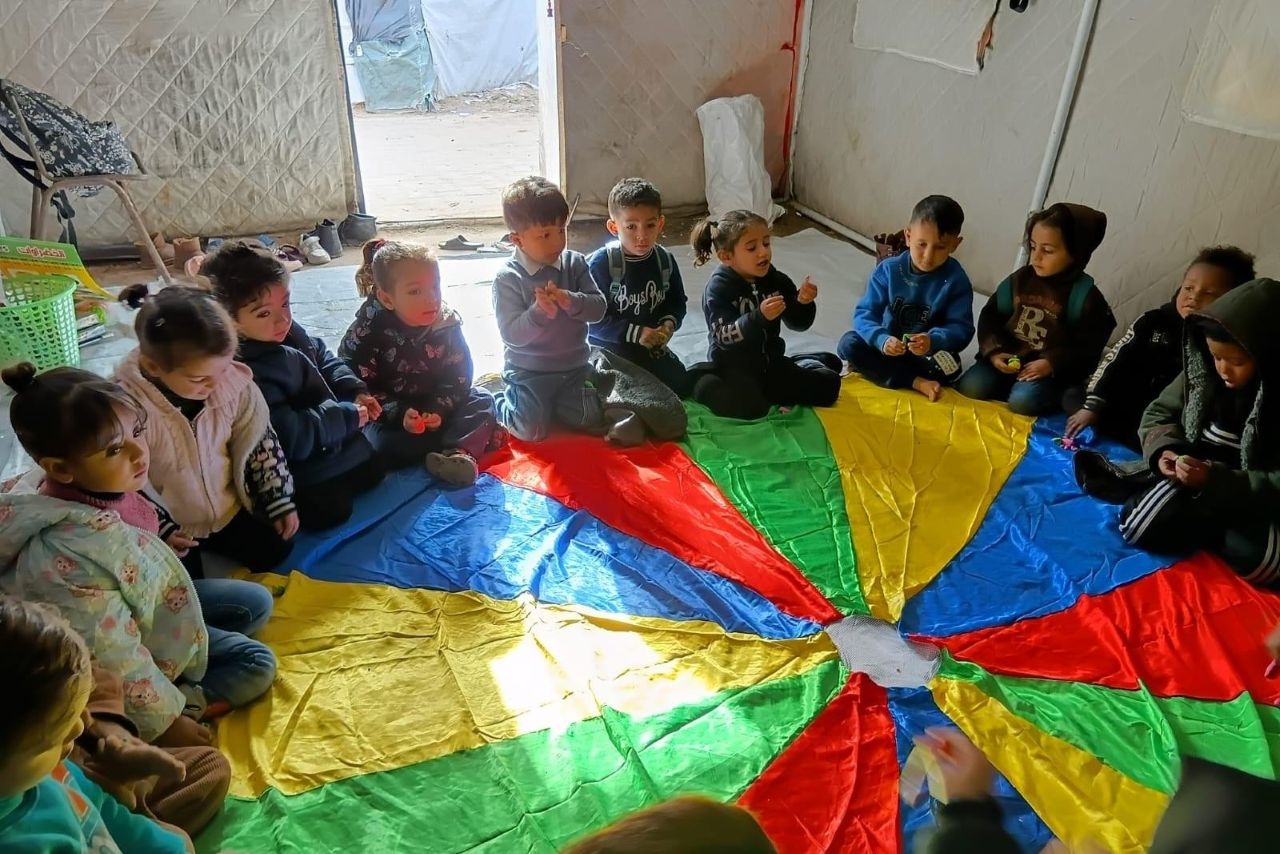
The first results are encouraging. Local partners tell us that lə children attend activities regularly, participate with curiosity and have started to interact more with each other in the classroom. They are also starting to express their emotions through drawing, group games and recreational activities, showing a little more confidence day by day.
Once again, it is not simply a matter of moving in an emergency and trying as best we can to respond to urgent needs, but of defending access to fundamental rights by all means.
All this is possible thanks to the generosity of the donorə community that has always supported us and walked with us, enabling us to take immediate action and respond to the requests of our local partners.
Education and child protection remain an indispensable condition for the dignity and future of the new generations. Especially amidst the rubble of a genocide that is not over, it has only stopped making headlines.
Un Ponte Per, together with civil society organisations committed to the defence of human rights and the promotion of peace, is taking Leonardo S.p.A. and the Italian State to court to stop the sale of arms to Israel and is launching a fundraising campaign to support the legal action.
With the first hearing, to be held on 27 March 2026 at the Civil Court of Rome, the legal action against Leonardo S.p.A. and the Italian State, which we have promoted together with A Buon Diritto, ACLI, ARCI, AssoPacePalestina, ATTAC Italia, and Pax Christi to stop the sale of armaments to Israel, comes to life.
This is a crucial step in a battle that poses a stark question: is it legitimate to continue exporting arms to a country involved in military operations that have caused tens of thousands of civilian casualties and are the subject of serious contestation by the international community?
For us, the answer is clear: no.
A LAWSUIT TO STOP ARMS EXPORTS
On 29 September 2025, we filed a summons with the Civil Court of Rome asking that the arms supply contracts entered into by Leonardo S.p.A. - a company owned by the Italian State - with the State of Israel be declared null and void.
We consider such contracts to be contrary to Article 11 of the Constitution, Law 185/1990 on the arms trade, and international law.
This is not a symbolic protest. It is a judicial action asking the judiciary to verify precise responsibilities.
GAZA, INTERNATIONAL LAW AND ITALIANRESPONSIBILITY
After 7 October 2023, as the Gaza Strip was devastated by bombing and the conflict spread across the region, several European countries introduced restrictions on arms exports to Israel. Italy, on the other hand, did not suspend the authorisations, effectively continuing to allow supplies.
This lawsuit challenges a clear choice: to continue trading in arms even in the face of serious and documented human rights violations. We demand that this choice be judged for what it is.
A FUNDRAISER TO SUPPORT THE CAUSE
Alongside the legal action, we launched a public fundraising campaign to support the costs of the proceedings: legal fees, technical advice and communication activities.
Dealing with a large industrial group and the Italian state in court is a complex challenge that requires adequate resources.
It is an unequal but necessary battle. It is also the only way to turn indignation into a concrete act.
For months we have been watching with anger and helplessness what is happening in Gaza.
Today you can do something concrete. With this legal action you can make your voice heard and turn indignation into action.