Peace has never been just a word, but the very condition for life to endure and cultures to flourish. Without peace, there is no civilisation, no art, no science. Iraq, the cradle of civilisations for millennia, today offers the world a new testimony: countries scarred by war can rise from the ashes and rewrite their destiny in the language of hope.
Situated at the crossroads of geographies, Iraq lies between East and West, between the Gulf and the Mediterranean. This location was never just a matter of borders: it was (and is) a living bridge, a place where cultures intertwined and human histories converged. Here the first cities of Sumer arose, here the laws of justice were engraved in Babylon, and Nineveh flourished as a capital of art and intellect. Today, after decades of upheaval, Iraq re-emerges not as a battlefield, but as a beacon that declares to the world that hope can shine brighter than devastation.
Iraq is an open-air museum. From the Ziggurat of Ur to the walls of Babylon, from the ruins of Nineveh to the cities of the south, each stone tells a story of human resilience, creation and the eternal connection between peace and prosperity. These are not silent remains: they are living messages that whisper to every visitor: 'History began here, and here humanity can rediscover itself'. Today, Iraq opens its doors to travellers, scholars and lovers of beauty, inviting them to see how past and present meet on its land in one wonderful fresco.
Yet Iraq's greatest treasure is not its monuments, but its people, its youth. Emerging from the rubble of war, they carry out cultural, artistic and educational projects that replace the language of violence with that of creativity, transforming memories of pain into energy for renewal. These Iraqi youth are not simply the face of a new generation: they are custodians of hope, guardians of the future. They are the ones who are redefining the image of their country before the world: Iraq, a land of peace, not war.
For too long, the international media has reduced Iraq to images of conflict and division. But local stories are shattering this narrative. Youth initiatives, art movements and cultural events have crossed national borders, reaching global forums and demonstrating that Iraq cannot be encapsulated in images of destruction: it must also be read as a narrative of resilience, reinvention and rebirth.
Iraq is more than a geographical space; it is a philosophical question about the very meaning of humanity. From its ancient civilisations we learn that creativity only springs from the womb of peace. From its modern history we learn that war leaves nothing but ashes. And today, walking the streets of Baghdad or in front of the Ziggurat of Ur, the earth itself asks a timeless question: "What will we leave to future generations?"
From the land that once taught mankind the alphabet comes a new lesson: hope is invincible, and Iraq, with all its wounds and memory, is also a land of great dreams.
CHALLENGES AND WORK FOR CHANGE
It would be dishonest to talk about Iraq without acknowledging the difficulties it has gone through. Decades of conflict have left scars on its infrastructure, society and collective memory. Many people abroad continue to see it only through stereotypes of destruction and despair. However, today's reality is much richer and full of hope. The Iraqi people - especially the youth and civil society - are dismantling those images and building a new model of coexistence, creativity and peace.
And the younger generation has been at the forefront of this transformation. Through cultural initiatives, art projects, educational programmes and volunteer work, they are proving that Iraq is not a battlefield, but a fertile ground for creativity and human endeavour. They are writing a new chapter in Iraqi history, based on dialogue, mutual respect and the replacement of violence with art and development.
Civil society played a key role. Organisations like Un Ponte Per have worked for years with local communities to empower young people, promote dialogue, overcome social divisions and strengthen reconciliation. They have supported women's initiatives, promoted cohesion and trained a new generation of leaders convinced that transformation starts with small gestures that can generate big changes. Our projects have united formerly divided neighbourhoods, revitalised cultural spaces and offered children the chance to dream of a brighter tomorrow.
These efforts have not gone unnoticed. Beyond Iraq's borders, the world has begun to see that its story cannot be reduced to a war narrative. Youth initiatives and civil society projects have reached international audiences, inspiring others and demonstrating that change is possible when we unite with courage and vision.
From Iraq - the land where the first laws were written and the first letters carved in clay - I would like to speak to the global community. It is time to end the arms trade, to stop the arms race that drains the planet's resources and fuels endless conflicts. It is time for humanity to rethink its priorities, investing not in war machines, but in bridges of peace: in education, in art, in health, and in the future of generations to come.
People who have endured war and poverty deserve peace: not as a privilege, but as a basic human right. Peace is not secondary; it is essential to life itself.
Those who hold the power to shape the destiny of the world have a responsibility not to accumulate influence or wealth at the expense of other peoples, but to be custodians of peace, guardians of humanity's future and not of its conflicts.
Let Iraq bear witness that civilisations are only born in the womb of peace, and that our common future can only be built on love, understanding and coexistence. Every human being deserves to live a life of dignity, free from violence.
Jameel Al-Jameel - Communication Coordinator of Un Ponte Per in Iraq
In Gaza, we all know each other. But most of all, we know the shelling. "If you hear them, it means you are safe," we use to say. In Gaza, which has sacrificed itself for the whole world, a cease-fire has come into force but there is still no safe place.
Even after two years of extermination, people are neither angry nor desperate. They have learnt to rejoice in the little things, despite living an indescribable everyday life. A few days ago I managed to talk to my mother: she told me that she had bought a small molokhia plant to prepare a lunch. "I planted it near our tent in Deir el Balah," she told me. "I cooked seven meals with it." He also planted basil and mint. She did it this time, and every time she and the rest of my family had to move, change refugee camps, change tents. And each time she left, she said goodbye to her plants. It is her way of keeping her relationship with the land alive. It is her way of saying: I am staying here.
Beit Hanoun, my town, no longer exists today. There is no home to return to. Yet I walk its streets every night, as soon as I fall asleep. I talk to people, the wounded and those who are no longer there. But it is not enough for me, I wish I could feel their same fatigue. I wish I could tell my mother we are going home. "Come on, Mum. Let's carry this mattress together," I would tell her. The people of Gaza who were killed will never be forgotten, and sooner or later we will come back to keep each other company in heaven.
These days I often think of the Nakba. At the time, the forced evacuations in Gaza lasted three days, and we talked about it for the next 70 years. Now that we have two years of displacement behind us, we have at least two thousand years of stories to tell.
"IF YOU FEEL PAIN, YOU ARE ALIVE. IF YOU FEEL THE PAIN OF OTHERS, YOU ARE HUMAN'.
In Gaza, after two years of genocide before the eyes of a complicit world, people feel they have done all they could to remain human. They managed to send us smiles as they tried to survive a plan of extermination, amidst bombings, hunger and thirst. Amidst the devastation of schools, infrastructure, hospitals and lack of medicine. Amidst the rubble of their own country, still full of life, dignity and pride.
In Gaza, people have chosen as always to cling to life and land. And with the mobilisations of solidarity around the world, they stopped feeling alone. They realised that people understand where the evil lies, they felt they had comrades and allies everywhere, who were able to shout in the squares and speak out for them. People who have taken to the sea - like the activists of the Global Sumud Flotilla - to whom they have said 'even if you have not reached Gaza, you have reached our hearts'. They saw families donating, trying to help even with small gestures.
To those who have been demonstrating for two years at our side; to those who for two years have been waking up at night or sleeping with a heavy heart because of the images they have received; to those who have filled the streets and squares; to those who have donated to help us survive: we thank you no more. You have taught us, shouting in the squares 'we are all Palestinians': we are comrades in the streets and in the struggle, Gaza has opened your eyes and 'taught you life'.
For this we do not thank you any more. But we want to tell you that we heard you. Even when we had too much pain in our hearts. Even when we were standing in line for a piece of bread or some water. Even in the din of the bombs. We Gazawi listen with our hearts more than with our ears, we see with our conscience more than with our eyes.
YOU HAVE EXTENDED US A HAND. NOW WE NEED TWO
With much tenderness and just as much firmness, we say to you: you extended us a hand that allowed us to move forward, one day after another, allowing us to believe that a century of propaganda could be dismantled, leaving room for our voice. Today, we ask you for two hands.
Because the genocide in Gaza continues. The bombs may stop, but not the consequences of two years of extermination and destruction. Today, the Strip is reduced to rubble. Over 70,000 people have been killed, at least 20,000 of them boys and girls, and who knows how many thousands are still under the rubble. Ten per cent of the population no longer exists. Some 4,000 families have been wiped off the population register forever. There are over 180,000 injured people without access to health care, drinking water, food. And 53% of the Gaza Strip remains occupied by Israeli military forces: this means that over two million people are forced to live in 180 square kilometres, 13 thousand per square kilometre.
How do they survive? Same as before. Our house was already besieged: it was just a little wider.
But Israel mainly controls the agricultural land necessary for the population to survive. In the past two years, the people have also exhausted their savings: if for so long they were able to get by with the supplies they had put aside, today the people literally have nothing left.
AN UNCERTAIN FUTURE
Paradoxically, it is when the bombs stop that the most difficult phase begins. It seems impossible to even think about, in light of the images we have observed. But as long as one is focused on survival, there is no time to ask questions. Now, however, we lack answers.
How will we rebuild Gaza? That is what we ask ourselves every single day. And the only possible answer, perhaps, is 'as always'. There are already teams of volunteers everywhere cleaning up the streets, removing rubble, trying to get the hospitals up and running again, and clearing schools of the families who have found refuge there. Because they know very well that the first step is to enable the children not to give up their education. That is what brings life back.
Seeing all this destruction before us feels like living in a desert, without a beginning or an end. And it seems impossible to start again. But then, one day after another, we always do. We just have to start.
It is not over yet. The war is not over. But neither is our hope.
Sharif Hamas - Communication Officer of the "Water for Gaza" campaign
At the end of October 2025, we coordinated the visit of a delegation of women activists from Tunisia and Libya to Italy, to bring the voice of women fighting for their rights in the Mediterranean.
Within the framework of the project "Nisaa' Lil Salam - Women for Peace", promoted by Un Ponte Per and financed by the Eight per Thousand funds of the Waldensian Church, and of the project "Kutub Hurra", financed by the Haiku Lugano Foundation, between 22 and 30 October 2025, a Libyan delegation representing the Libyan Legal Aid Organisation (LLAO) and a Tunisian one representing theLina Ben Mhenni Association (ALBM), took part in a series of events and meetings to compare and exchange views with Italian civil society in Palermo, Rome and Padua. The Tunisian delegation, however, did not receive the necessary visas to enter our country and had to resort to remote connections to take part in the meetings.
IN PALERMO, FOR THE SABIR FESTIVAL
The first appointment was on 23 October, when the delegations took part in the 'Women on the Move' event as part of the Sabir Festival in Palermo. During the meeting, the Libyan representatives brought a valuable and complex testimony on the condition of women and migrants in their country, explaining how the rate of female emigration remains very low in Libya, even after the fall of the Gaddafi regime, when a significant number of women were forced to flee the violence of militias and armed groups. Migrants, Libyan and sub-Saharan, often do not find better conditions in the destination countries and, once rejected, suffer abuse and violence in detention centres and militia-controlled locations. In the absence of official data on female migration, the Libyan Legal Aid Organisation continues to fight for the approval of a law protecting all women, Libyan and foreign, from violence.
Also at the Sabir Festival, together with Un Ponte Per and ARCI, the Libyan delegation also participated in the event 'Colonial Traces: Deportations. A confrontation with the uncomfortable memory', a meeting and presentation of the photographic exhibition 'I relegati libici a Ustica dal 1911 al 1934', which related contemporary migratory and social dynamics to colonial history, in particular the Italian colonisation of Libya and the deportation of Libyan activists to the island of Ustica. The Festival was also an opportunity for Tunisian activists to present the valuable work of the Lina Ben Mhenni Association, and in particular the Feminist School created by the prematurely deceased Tunisian activist - which culminates each year in the 20/27 Festival with workshops and activities such as the Lina Clubs, dedicated to art, creative writing, theatre and cinema - and the distribution campaigns of Arabic-language books in Tunisian and Italian prisons.
On this occasion, the women activists of the Libyan delegation discussed their legal and advocacy work, at national and international level, to implement draft laws against violence against women, irregular migration and human trafficking. They also talked about providing legal assistance to victims of violence and holding training sessions for female citizens and recent law graduates.
IN ROME, BRIDGES OF FEMINIST RESISTANCE
A few days later, in Rome, the association Casa delle Donne Lucha y Siesta, with the participation of a councillor from the metropolitan city of Rome and local activists, organised the meeting 'Bridges of Feminist Resistance'. On this occasion, the Tunisian delegation illustrated several initiatives promoted by activist Lina Ben Mhenni, such as the book distribution campaigns for detainees in Tunisia, the provision of medicines and support for patients suffering from rare diseases, as well as the documentation of the violations against protesters during the 2011 revolution.
The Libyan delegation focused on the condition of women in Libya and the challenges they face due to the legislative vacuum with respect to protection against gender-based violence, the prevalence of institutional violence and militias against women, and the dominance of a still strongly patriarchal mentality in society. The participants discussed the difficulties and threats they face in trying to promote new laws to protect women through advocacy campaigns and legislative proposals to supplement legislation that is outdated and no longer conforms to international human rights standards.
IN PADUA, WITHOUT BEING ABLE TO ENTER PRISON
Finally, a final meeting was held in Padua on 30 October, moderated by the local Guarantor of the Rights of Persons Deprived of their Liberty, which was also attended by institutional figures and representatives of civil society. Once again, Tunisian and Libyan activists illustrated their work, insisting on the importance of strengthening the role of women in reconciliation and peace-building processes in Libya and Tunisia.
Despite the request for permission submitted at the beginning of October to allow the activists to visit the Rome Juvenile Prison, the prison administration did not issue the necessary permits in time. Unlike in Rome, the Padua prison administration had issued the visit permits for 30 October. However, following the issuing of a new directive by the Central Prison Administration on 21 October, both the visit and the related activity planned with our partners in the 'Kutub Hurra' project were cancelled.
The directive revoked the authority of local prison administrations to approve activities and their permits, transferring this competence to the DAP. Although the activity was already planned and approved, the prison administration immediately implemented the new directive and suspended the previously approved planning and permits. A Ponte Per was informed of this decision less than 24 hours before the planned event. Consequently, we proceeded with a symbolic delivery of 100 books during the meeting held on 30 October at the City Hall.
Mohamed Ed-Daoudy - Contact person for the 'Kutub Hurra' programme of Un Ponte Per
"We have no source of sustenance other than the sea. We are like fish: if we go out of the water we die". This is how Ali Awad Al-Amoudi, a Palestinian fisherman who shares his trade with his father, sons and brothers, tells what the sea means to the people in Gaza.
His fishing nets are burnt, his boats sunk, under the bombs of the Israeli armed forces. "And this," he adds, "is not only my situation, but that of all the fishermen in Gaza. When we work at sea, we eat. If we don't work, we don't eat, because we don't know any other trade'.
In Gaza, the sea has always represented breath, hope, sustenance. Despite almost 20 years of Israeli siege, fishing families have never stopped looking to the sea as a primary source of life, hope for freedom.
Since the beginning of the genocide on October 7th, the situation in the Gaza Strip is beyond humanitarian catastrophe. Among the civilian infrastructures indiscriminately hit by Israeli shelling are also those that have always ensured the livelihood of families and communities, such as agriculture and fishing.
Fishing activities in particular, which historically have been a primary source of livelihood for thousands of people in Gaza, are now almost completely interrupted due to the military offensive and the destruction of boats, materials needed for activities, and storage facilities.
After more than 600 days of genocide, thanks to the "Gaza, waves of resilience" project, 50 families were able to receive new nets to return to the sea.
This is a new intervention of support and solidarity that we imagined together with our friends and colleagues of the Union of Agricultural Work Commitees (UAWC), with whom we work on the 'Water for Gaza' campaign, and made possible by FLAI-CGIL. The trade union organisation had already generously supported us in the past, allocating to Gaza and to our campaign the funds collected from workers' contributions in the strikes of the last two years.
Today, thanks to the extraordinary work of our friends at UAWC, who have been supporting Palestinian farmers and fishermen for decades, we have been able to distribute nets to families in Gaza.
Different nets for each fishery: the maltash, light and dense, for smaller fish; the zieda, deep and strong, for larger ones; the precious shanshoula, long and delicate, for more targeted fishing.
In those nets and in the looks of those who received them there is much more than work: there is dignity and love for their people, a refusal to surrender to death. Every thread woven, every exit into the sea, is an act of resistance.
We are with them. We do not stop supporting the Palestinian people.
DECOLONIAL ARENAS
Rome, Tor Marancia Tower Park | 8-14 September 2025
DECOLONIAL ARENAS (Arene Decoloniali) is the festival that brings the theme of decoloniality to the center of public debate — a core principle of Un Ponte Per's approach to international cooperation and solidarity.
For one week, the Parco della Torre di Tor Marancia (Viale di Tor Marancia 31, Rome) becomes a space for discussion and political imagination to explore through images, words and memories the colonial past and its legacy in the present. A programme interweaving art cinema, literature, photography and public meetings, in an open dialogue between arts and activism, history and identity.
The festival is realised under the patronage of the Municipality VIII of the Municipality of Rome.
WHAT TO EXPECT
The first edition 2025 will host the screening of 10 films, documentaries and short films from different geographical contexts, six book presentations, two photo exhibitions and a bilingual Arabic-Italian reading with musical accompaniment, to give voice to the removed memories and resistances of colonised peoples.
The films are subtitled in Italian and introduced in sign language. The arena is accessible to persons with mobility disabilities.
There is also a book stand by the Liberia Griot and afood area.
HOMAGE TO PIER PAOLO PASOLINI
On the 50th anniversary of his death, the festival opens with a retrospective dedicated to Pier Paolo Pasolini. Two days dedicated to his cinematographic works exploring his gaze on otherness, with particular attention to his relationship with Africa and the East.
EXHIBITIONS
During the festival and afterwards, two photographic exhibitions to broaden the scope of reflection:
"Patrimonio Scomodo - Memories of a Colonial Past": 18 panels retrace the history of the Italian colonisation of Libya through photos and texts. Curated by Annunziata D'Angelo and Elisa Russo.
"The Lion, the Judge and the Capestro": 80 shots - mostly from the Bedendo collection - document Libyan resistance to colonisation in the 1930s and fascist repression, up to the execution of Omar Al Muktar. From 16 September to 7 November at the Casa della Memoria e della Storia, in collaboration with theLaboratorioStorico Iconografico dell'Università Roma Tre.
DECOLONIAL ARENAS AWARD
To recognise and valorise the contribution of cinema to the decolonial movement, we have established the Premio Arene Decoloniali, awarded each year to one of the films in the festival according to the opinion of experts and the audience. The prize will consist of a specially created work of art each year. (Regulations of the Decolonial Arenas Award).
HOW TO GET TO THE FESTIVAL
The entrance to the Tor Marancia Tower Park - in Viale di Tor Marancia 31 - is easily accessible by public transport, a few metres from the Colombo - Rufino stop of bus lines 714, 716, 30 or the Tor Marancia - Rufino stop of bus line 160.
The programme follows.
PROGRAM
DECOLONIAL ARENAS
1st Edition
8-14 September 2025 Tor Marancia Tower Park Viale di Tor Marancia 31, Rome
MONDAY 8 SEPTEMBER
Pasolini & the Orient: The Author and the Otherness
This evening is dedicated to a critical look at some of Pier paolo Pasolini's cinematographic works, in particular exploring the author's oriental imagery, not as mere exoticism, but as a complex authorial construction. Through his 'journey to the Orient', Pasolini interrogates otherness and reflects on his own role as a European author.
6.30 p.m.
Presentation of the book Orient (to) Express. Film di viaggio, etno-grafie, teoria d'autore with the author, Professor Marco Dalla Gassa, expert in Orientalism, Arab literature and postcolonial studies (Ca' Foscari University of Venice). Dalla Gassa will present Pasolini's works projected afterwards in dialogue with the audience.
8:30 pm
Short film: The Walls of Sana'a (Yemen, 1971 | 14')*
Pasolini launches an appeal to save the ancient city of Sana'a, threatened by modernisation. A poetic and political short film on the link between culture and urban landscape.
21:00 hours
Screening of the film Il fiore delle Mille e una notte (Italy, 1974 | 129')
Inspired by oriental tales, the film weaves stories of love, adventure and desire in a fairy-tale and sensual world, where the search for the other is also self-discovery.
Trigger points: frequent nudity, explicit scenes of a sexual nature, references to slavery and violence (not graphic).
TUESDAY 9 SEPTEMBER
Africa as a mirror of revolutionary utopia
This day will explore the limits and insights of Pasolini's view of the 'Third World'. Pasolini speaks of Africa and for Africa, but from an external, albeit empathetic and politically committed point of view.
4 p.m.
Human Library with the Association Movimento Italiani Senza Cittadinanza and the Shanghai People's School.
8 pm
Introductory viewing meeting with Professor Vito Varricchio, (history of Africa), in dialogue with Lorenzo Teodonio, historian by passion, author of Razza Partigiana, scholar of decolonial criticism.
21:00 hours
Screening of the film Appunti per un Orestiade africana (Italy, 1970 | 65'). Film-essay in the form of visual notes, in which Pier Paolo Pasolini imagines a possible transposition of Aeschylus' Oresteia in post-colonial Africa, interweaving visual notes, music and political reflections on the continent as a mythical and revolutionary space.
Trigger points: references to violence and slavery (not explicitly depicted).
WEDNESDAY 10 SEPTEMBER
Artistic heritage and re-significations
6.30 p.m.
Presentation of the "Echoes from Dogali" initiative with Giulia Grechi and the Tezeta Association; followed by a presentation by Rosa Anna Di Lella on the collections of the former Colonial Museum and the activities of the Museum of Civilisations (MUCIV). With the collaboration of the Yekatit12-19February Network.
21:00 hours
Screening of Abandon de poste by Mohamed Bouhari (Morocco / Belgium, 2010 | ca. 15) Silent confrontation between a security guard and a life-size African statue: the former on duty in front of a building, the latter chained like ancient slaves at the entrance to an art gallery. An ironic and disenchanted look at the stereotypes of colonialism and slavery through the figures of the 'new slaves' of western society.
21:30 hours
Online connection with the director* and screening of the film Dahomey by Mati Diop (France/Senegal, 2024 | ca. 67').
A Golden Bear at the Berlin International Film Festival, it narrates the return to Benin of stolen objects from the Kingdom of Dahomey during colonisation and kept at the Musée du quai Branly in Paris.
THURSDAY 11 SEPTEMBER
Visions of the colonial removed
6.30 p.m.
Presentation of the book Visions of the Remover, with authors Daniela Ricci and Micaela Veronesi (National Film Archive of the Resistance) in dialogue with Leonardo De Franceschi and the Yekatit12-19February Network.
21:00 hours
Screening of the film ADWA - AN AFRICAN VICTORY, by director Haile Gerima, (Ethiopia/USA, 1999 | ca. 90'); Through testimonies, archive materials and historical narration, the film reconstructs the Battle of Adwa (1896), in which Ethiopian forces defeated the Italian colonial army. A militant work that celebrates African resistance and collective memory against colonialism.
Trigger points: Descriptions and images of war and colonial violence.
10:30 p.m.
Liaison with director Haile Gerima , in dialogue with Micaela Veronesi and Daniela Ricci(National Film Archive of the Resistance), commentary on the film and debate
FRIDAY 12 SEPTEMBER
Decolonial Resistances
6.30 p.m.
Presentation and readings of extracts from the book Il Re Ombra (The Shadow King) by Maaza Mengiste, with the author in connection, together with Sandro Triulzi (Archivio Memorie Migranti) and the writer Djarah Kan*; in collaboration with the Yekatit12-19febbraio Network. Moderator: Soumaila Diawara.
21:30 hours
Screening of the film SEARCHING FOR AMANI (Kenya/USA, 2023 | Director: Debra Aroko | ca. 87' | Produced by Generation Africa - COE) When his father is murdered, Amani, a 13-year-old boy, starts filming to give voice to his grief and search for answers. The documentary follows his journey between grief, memory and justice, offering an intimate and courageous look at rural violence in Kenya and youth resilience.
SATURDAY 13 SEPTEMBER
Decolonising the school
7 p.m.
Presentation of the book 'Tra i Bianchi di scuola' by Espérance Hakuzwimana together with Daniela Ionita from the Italian Movement without Citizenship, writer Christian Raimo, in connection, artist Takoua Ben Mohamed, and Angela Mona from the education working group Un Ponte Per.
21:30 hours
Screening of the film A.O.C by Samy Sidali (2022, France | ca. 18′) in which Latefa and his two sons, Walid and Ptissam, advised by the administration, Frenchify their names when they acquire French citizenship. The film is inspired by a true story.
Followed by the film Soleil Ô (Mauritania/France, 1970 | 98') by M. Hondo. An African immigrant manages to arrive in Paris, he comes up against indifference, rejection, humiliation and racism; presentation of the film by Micaela Veronesi and Daniela Ricci (National Film Archive of the Resistance).
Screening of the short film MUNA (UK, 2023 | 19′)
Muna, a 13-year-old British-Somali boy, wants to go on a school trip. Before departure, she receives the news of her grandfather's death in Somalia. During the funeral, she discovers through traditional music (the oud) a new part of her own identity and roots.
SUNDAY 14 SEPTEMBER
Between poetry and memory: testimonies of Italian colonisation in Libya
6 p.m.
Introduction by UPP and presentation of the poems translated from Libyan to Italian by the poet Fadil al Shalmani, deported to Favignana, the poems will be interpreted by the director, journalist and screenwriter Khalifa Abo Khraisse and the actress Valbona Kunxhiu, accompanied by the projection of the short film La terra dei padri by Francesco Di Gioia. This will be followed by the presentation of the book Il mio solo tormento - Canto di el Agheila, by Rajab Abuhweish, written in the Italian concentration camp in Libya of El Agheila, with readings by Mario Eleno and Manuela Mosè (editors of the Italian edition of the poem). During the readings there will be a musical contribution by Luca Chiavinato, a musician who contributed to the soundtrack of the film "The Order of Things".
8:30 pm
Yesterday's Colonialism and Today's Migrations
Introduction to the film "L'ordine delle cose" with Giulia Torrini, president of Un Ponte Per; Marina Pierlorenzi, president of ANPI Rome; Papia Aktar, head of migration ARCI Roma and Silvano Falocco, Yekatit12-19Febbraio Network, Ass. Tezeta.
9.15 p.m.
Presentation of the 'Decolonial Arenas' Award
Award ceremony for the film in the exhibition that has most contributed to bridging the repressed colonial memory
21:30 hours
Screening of the film L'ordine delle cose by Andrea Segre, 2017, 115'
An official is tasked with stemming illegal immigration from Libya but his journey has an unexpected outcome.
Under the patronage of
Media Partner
In collaboration with
"The most exciting thing for us is knowing that the donations you are collecting come directly from people for people. When we do aid distributions we explain this to the families: this is made possible by fundraising on the streets in Italy, where each person donates what they can. And people understand this very well".
When we manage to talk to our colleague Saad on the phone, after days of continuous network interruptions that have made it difficult to get updates, he himself is standing in line for a can of water. In the Gaza Strip today, there is not a single person who is not in need of immediate help and is not on the brink of starvation. Yet, despite the inaction of governments, despite the impunity granted to Israel by Western complicity, help from below reminds the people of Gaza that they have not been completely abandoned.
This is what we are told by thecolleaguesof UAWC - the Union of Agricultural Work Committees -, the Palestinian organisation with which, since the beginning of this genocide, we at Un Ponte Per have built an alliance in order to bring a minimum of relief to the affected population.
A choice, ours, that was not accidental: UAWC is a grassroots organisation founded in the years of the first Intifada, which has been working from below not only during humanitarian emergencies, but also - and above all - to guarantee food sovereignty for the Palestinian population, forced to depend on external aid due to Israeli settlement colonialism.
THE VIOLENCE OF THE SIEGE
Since Israel's breaking of the ceasefire agreement last March, almost nothing has entered Gaza. The resumption of shelling, with unprecedented intensity, has destroyed what remained of the civilian infrastructure, leaving all hospitals unable to provide treatment.
According to UAWC estimates, two-thirds of the Gaza Strip has been identified as 'no-go zones' by the Israeli armed forces: areas where the population is prevented from entering, confined in increasingly densely populated spaces, without access to humanitarian aid, and with the summer heat making the shortage of clean, potable water even more severe.
"While 95 per cent of the population is at risk due to lack of care, food and water, it is estimated that 100 per cent is on the brink of starvation," lə colleagues from Gaza explain. Moreover, the continuous displacement and the speed with which people are forced to move in order to survive and find shelter also makes it difficult to distribute the aid that we are able to provide through the 'Aqua for Gaza' campaign.
The latest distributions, carried out between spring and summer, were often done at night and under the fire of Israeli snipers. The establishment of theGaza Humanitarian Fund(GHI) has further aggravated the situation.
"It is a very violent operation that aims to break even what is left of social ties and solidarity among the population, because people literally kill each other for a sack of flour," they explain from Gaza.
The US- and Israeli-led initiative completely distorts the principle of humanitarian support, setting a very dangerous precedent in crisis management. "Food and aid have been weaponised and militarised," we are told. As the inhuman images that have circulated in recent weeks have shown, with thousands of people locked in cages and bombed while standing in line for a can of water or a sack of flour. The immobility of the international community in the face of all this shows that impunity in the face of genocide 'is the new normal we must get used to', they reflect.
THERE IS THE WORLD... AND THEN THERE IS GAZA
Yet, the Palestinian population of Gaza is not giving up. "I believe that optimism and hope today are revolutionary gestures," reflects Sharif, our colleague from Beit Hanoun, who now works with us in Italy on the 'Water for Gaza' campaign.
"In recent years, we have suffered so much, between the prolonged siege and the constant Israeli military aggression, that in Gaza we have learnt to always find a way to resolve the situation, even when everything seems to be falling apart. I cannot explain how we do it, but we always find a way to cope with even the worst conditions. Now, for example, there is no more fuel in Gaza. People are burning plastic and they manage to run their cars that way. Next to every tent in every camp, women have carved out a piece of land to cultivate something. We refuse to die in silence. The people of Gaza are not giving up".
This is probably also how UAWC's colleagues manage to help the population with the generous donations that arrive from those who follow and support us in Italy. Despite the fact that it is very difficult to find food at the moment because, as they explain, 'the markets have been completely emptied, and because of the blockade of aid, finding food is increasingly difficult'.
COURAGE AND RESISTANCE
Despite this, UAWC still manages to refer to small producers and farmers who do not charge commission on the sale of the products they grow.
This is how, at the end of May, we managed to reach another 2,000 people with food baskets consisting mainly of fruit and vegetables - cucumbers, tomatoes, melons - bought on the local market at the most reasonable prices.
This work is, as always, made possible by the extraordinary network of local committees and volunteers that UAWC has built up over the years in Gaza. And which is punctually reported and documented with videos and photos, despite the inhuman conditions in which our partners operate.
For the distribution of aid, one now relies on hearing. "We adjust according to the intensity of the Israeli shelling. If they are particularly violent for a few days, we stop. When they slow down, we try to figure out how long it will last and determine where we can get to with the distributions,' Saad explains. Always, however, risking his own life to help his people.
Thanks to this courage, we were able to reach another 500 families with water distributions this spring. Since the 'Water for Gaza' campaign was launched, donations from those who support us have enabled us to reach over 50,000 people.
We were able to distribute food and water, repair some cisterns damaged by the bombings, install toilets in the camps for displaced people, and repair tents during the winter. In each of these cases, we relied on UAWC's assessments, sending what we collected from donations to Italy, and letting them decide what was most urgent.
A practice in line with our vision of the alliance in the territories where we operate: not over-determining, but listening to needs and responding as possible. What has been done in recent months remains a drop in the ocean of needs facing the Gaza Strip today, but it is nonetheless a sign that people - unlike governments - know where they stand.
'There is mankind. And then there are the Gazawi people,' smiles Sharif. "Even in the face of unimaginable conditions, even in the midst of genocide, we refuse to give up. We do not give up. The reality we are going through is unprecedented in the world we know. Yet, we continue to hope'.
They will arrive in Italy for the first time accompanied by their coaches, thanks to a cultural and sporting exchange that we organised together with the Florence-based sports cooperative Centro Storico Lebowski: they are 11 Palestinian children aged between 8 and 13, membersof the 'Palestine Youth Club' football team active in the Shatila refugee camp in Beirut (Lebanon).
From 25 June to 10 July, the delegation will move to various cities in Italy: in addition to the sports camps organised by CS Lebowski in their Florence headquarters, the Palestinian team will also move to Bologna and Rome thanks to the contribution of some popular sports realities such as Atletico San Lorenzo, Acrobax, All Reds Basket (Rome); Palestra Popolare TPO, PCB - Pallacanestro Cooperativa Bologna, Polisportiva Hic Sunt Leones and Hayat APS (Bologna). The support of institutional bodies is important, as well as the valuable support of the Italian Football Coaches Association (AIAC). The project 'Dritti contro il cielo, da Shatila all'Italia' (Straight against the sky, from Shatila to Italy) has in fact received the patronage of theMunicipalities of Florence and Bologna, the VIII Municipality of Rome, the Region of Tuscany, and the support of the AIAC. For this reason, institutional meetings are planned in the three Italian cities in addition to the sports events.
Among the many activities planned is a visit to the Football Museum in Coverciano on 5 July, organised by AIAC president Renzo Ulivieri, which will be attended by the Councillor for Sport of the Municipality of Florence, Letizia Perini.
The Palestine Youth Club's trip to Italy is part of a very long journey of solidarity and sports collaboration that we have built in the Shatila camp, where we have been working for over 20 years in support of the Palestinian refugee population, and where we actively support the sports centre where the team trains.
In 2023, we also accompanied a delegation of coaches from the Lebowski History Centre there. During that week, the team had held football training sessions with the Palestine Youth Club, involving ləkids in a sporting and sharing experience.
Accompanying the delegation then was director Niccolò Falsetti, who in those days shot the necessary footage for the documentary 'Dritti contro il cielo' (Straight against the sky). The documentary has since been screened throughout Italy, in a series of self-financing initiatives that made the exchange possible.
Our goal is, as always, to keep the focus high on the denial of access to rights for the Palestinian refugee population in Lebanon, and to consolidate the bridges we have built over the years, also and above all through sport. The initiatives planned in Italy will also allow us to raise funds from below and make the second part of the documentary.
The delegation arriving from Shatila will be:
in Bologna from 25 to 29 June. To be updatedə on the initiatives you can follow on IG: @palestra_tpo; @pallacanestrocoopbologna; @hsl_basket_antirazzista and @hayat.aps
in Florence from 30 June to 5 July. Updates on @centrostoricolebowski
in Rome from 6 July to 10 July. All appointments on @atletico.sanlorenzo @loa.acrobax @allreds.basket and @casettarossa
Follow us also on our channels @unponteper
On 28 May, the end-of-project conference of 'Tatweer 2', which has seen us support over 500 Iraqi civil society associations and organisations in recent years, was held in Baghdad.
On a hot and windy summer's day, representatives from all Iraqi provinces, delegations from the government and various ministries, as well as a European delegation in Iraq, gathered to take stock and reflect on the scope and achievements of the 'Tatweer' project, which has reached the end of its second phase.
A conference that has welcomed a multitude of voices that have come together in recent years to demand rights for women and minorities, environmental justice, freedom of expression and coexistence between communities. Created to give a space for expression and confrontation to those who in recent years have fought for a freer and more inclusive Iraq, Tatweer in this not only represents a project, but a collective action that has united, from Basra to Kurdistan, a society committed to change and to building a future of peace and coexistence.
Summarising the overall results of Tatweer, Bahman Hassan, project manager of Tatweer, highlighted the overall impact of the project: in addition to the support provided to more than 500 local associations and organisations, more than 376 services were delivered, in workshops covering training on fundraising, project writing, public policy, project management, among others.
In Iraq, a country that has been scarred by wars and conflicts for decades, with repercussions that have lasted for years and wounds that are still open, civil society is committed to supporting a profound, radical change, driven by hope and stories of resistance that have given proof and concreteness that a different future is possible, and in part is already here.
This is testified by the numerous experiences gathered by 'Tatweer', which succeeded in uniting different contexts and fields in a path made up of different themes and contents: among them , climate change and the environment, combating gender-based violence, prevention of violent extremism, human rights (with special attention to women and minorities), environmental and climate justice, peacebuilding, and more.
During the event, Hasan emphasised that the importance of 'Tatweer' is to be found in its concrete and positive aspects to the development and empowerment of Iraqi civil society, 'through the provision of essential resources and equipment for the workers, as well as numerous training and counselling services provided in our five provincial centres'. But it is necessary for the international community to continue supporting Iraq and civil society, as 'changes achieved so far have been instrumental in transforming the country's public policy landscape, encouraging the active participation of young people, women and civic actors in the life of civil society and thus helping to alleviate the challenges faced by citizens and the community as a whole'.
"This project led to the opening of five centres in Mosul, Erbil, Baghdad, Ramadi and Basra. We asked ourselves what the local realities we wanted to support really needed, and from there our approach was born,' says Raid Mikhael Shabah, Country Director ofUPP in Iraq.
"These centres could help support Iraqi civil society, but it was necessary to organise the complete management of a non-governmental organisation for these centres to function and to be able to implement projects and programmes. We also provided small funding so that these NGOs could implement projects and programmes. For civil society, and especially for smaller organisations, the lack of funds was an obvious problem'.
That is why 'Tatweer', explains Mikhael, has taught local organisations not only how to realise their projects, but also how to write a project, how to prepare a financial plan, how to manage it 'from scratch to the end'. But that's not all. It has enabled the creation of a network in Iraqi civil society. Through the various associations, in fact, it was possible to reach even those more isolated realities, which were often not even intercepted by donors, because they were too far away or in areas difficult to reach. "There are governorates in Iraq where nobody really comes. But with these centres it has been possible to get there".
Ajyal Charitable Society for the Development of Intelligence and Creativity is an association that has set up a project called 'Balsam', an orientation and support centre for women and girls who are victims of physical harassment in the community of Diyala province. Mohammed Mundas Ali, project manager of the organisation, says that the Balsam centre has supported over 140 women, providing them with information to share with other women to encourage them to go to the centre.
The organisation works with more than 10 institutions and government offices in the Diyala area, distributing brochures with numbers, contacts and information on the services offered. Anyone visiting these institutions can be directed to the centre if needed.
"An emblematic story is that of a girl with disabilities, whose family initially prevented her from participating in the centre. After dialogue with the operators, the father agreed, and the girl was able to access a psychosocial support programme and a project for economic autonomy," says Mundas Ali.
But other projects are being implemented and developed for the future. Thanks to a small amount of funding, a beekeeping activity was started, involving men and women in honey production with the aim of fostering collaboration between the sexes to reduce incidents of gender-based violence, extremism and conflict, especially in the villages.
The organisation has also written a proposal to promote women's involvement with members of parliament and is working on a proposal to involve them in dialogue sessions with candidates in the Iraqi parliamentary elections next November. 'So that women's issues are brought to Parliament and new laws in their favour are promoted, should they be elected'.
Lavinia Nocelli - Communication Intern, UPP Iraq
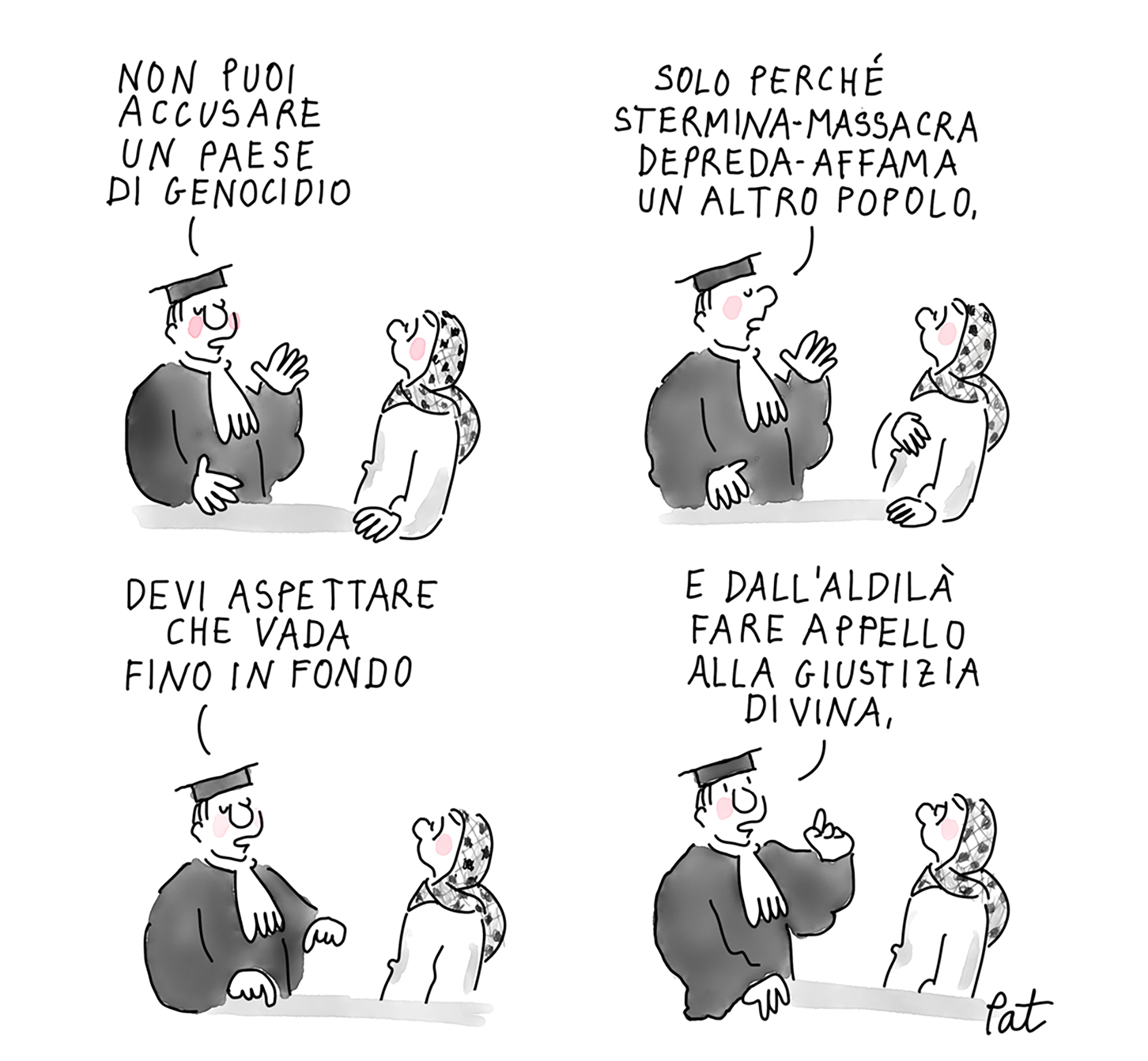
Cartoonist, feminist, author, ironic activist, Pat Carra is many things, and all intertwined. Born in Parma, she has lived in Milan since 1977, a city that she feels has been disrupted by the so-called 'urban regeneration' of recent years. This year Pat donated to us at Un Ponte Per la Tessera 2025. We met her for the occasion and she told us about her life journey, through the weapons she masters best: cartoons. Let's start from the beginning.
Although she started working at a very young age, she never attended an art academy - "my drawing was born self-taught, far from the academic canon" - and perhaps it is precisely this freedom that "allowed me to build a more direct, personal, edgy language and graphic style".
Even as a child, Pat says she felt the need to use drawing to react and process anger in the face of bullying.
Then, the encounter with feminism. "In the 1970s, I started publishing with feminist collectives: posters, books, catalogues. Always using irony and a satirical key'. This is how the cartoon became political expression and a tool for critical thinking, an alternative to established ideologies. "Humour is the only form that has allowed me to never really embrace a preconceived slogan. It is my guarantee of authenticity." In 2019, after the closure - due to a Bayer-Monsanto legal attack - of the historic Aspirin magazine, Pat co-founded Weeds. Weed-resistant forms of life, a self-deprecating, eco-humorous publishing project. "There we understood many things: about pesticides, about agro-industry, about the power of humour as an antidote. We don't call ourselves eco-feminists so much as eco-humourists'.
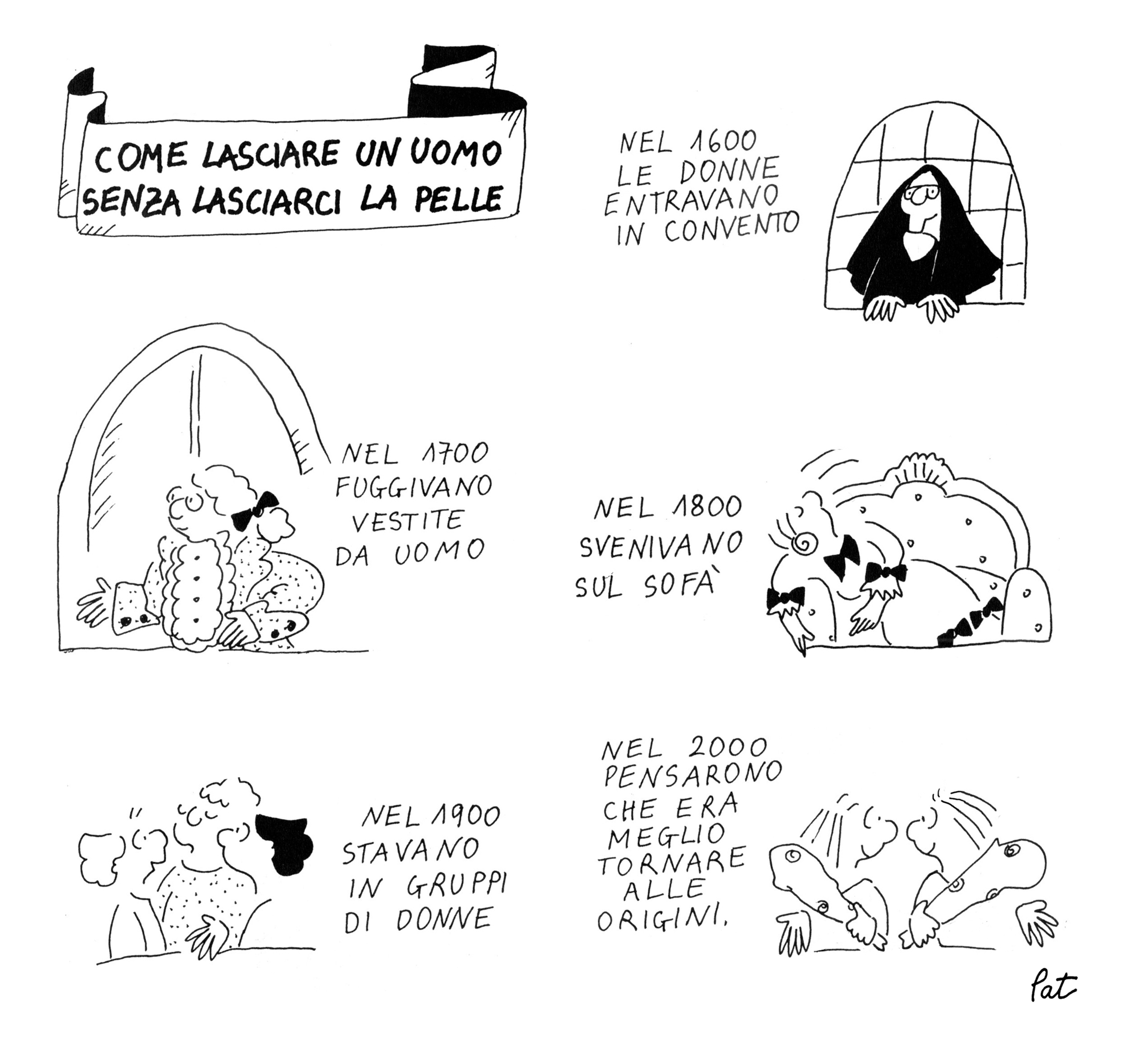
Many of her works intertwine feminist reflection, war and systemic violence. Like the cartoon strip How to Leave a Man Without Leaving Your Skin, published in 1987, unfortunately still very topical. "It is a strip on gender violence, when the term feminicide was not yet used. A comic strip that for me remains central, because it goes beyond the pain, it tries to find a way to save itself. The return to the club symbolises just that'.
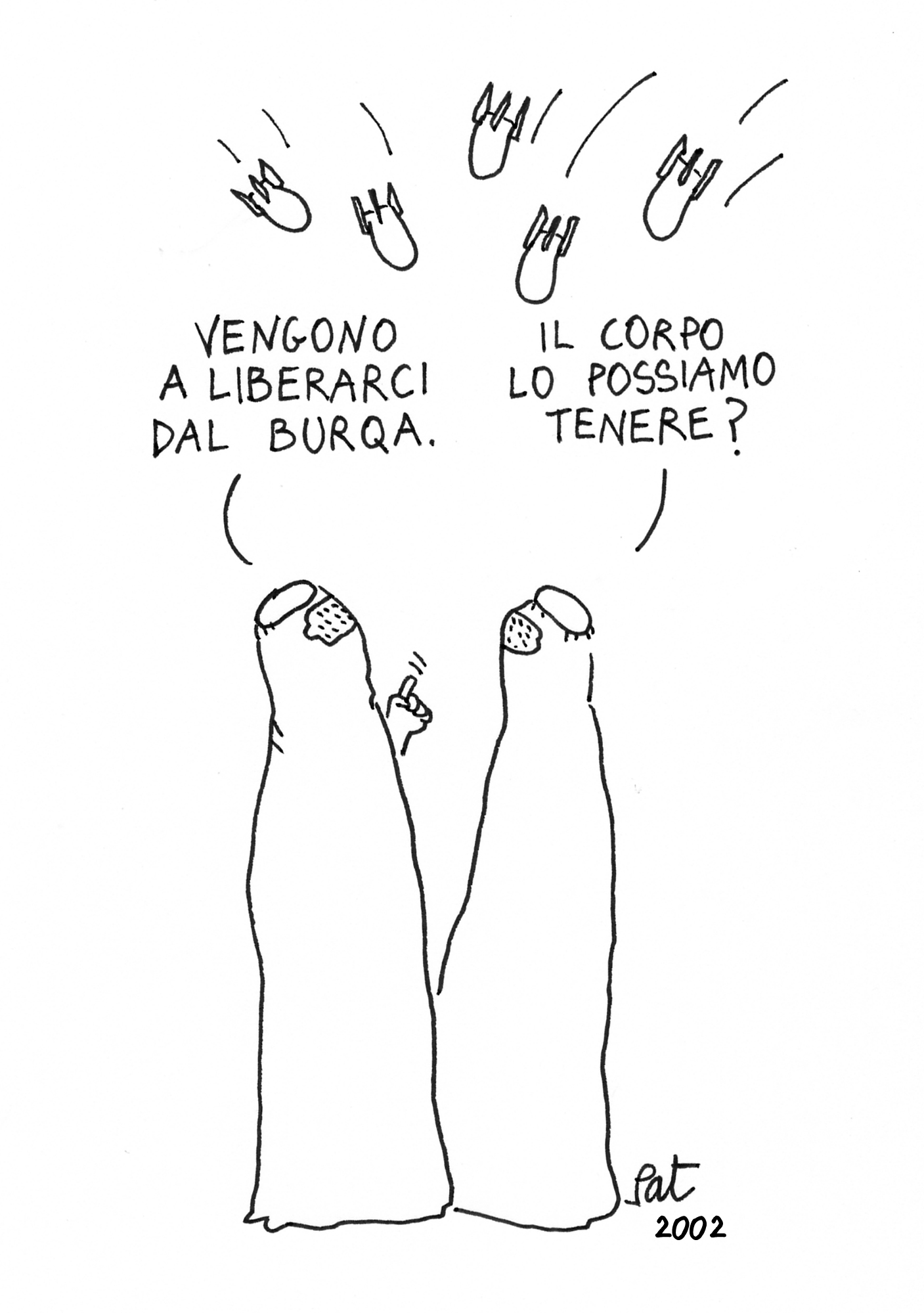
Pat was among the first to depict the connection between war and patriarchal violence with cartoons. "I started with the war in the Balkans, then Afghanistan and post-9/11 Iraq. One of the cartoons showed two women wearing burqas while it rained bombs: one said They come to free us from the burqa, the other asked Can we keep the body?".
War, which for the cartoonist personifies the ultimate patriarchal embodiment: 'Vandana Shiva says that extinction is the only way patriarchy deals with things that are alive and free. It is what people like Trump or Netanyahu do with bombs, along with many other powerful people, men and women'. Despite the moment in history when wars and genocides go on live social, Pat has not lost faith in the future. "I trust young people. I see in them a new, real sensibility that turns less to the other side".
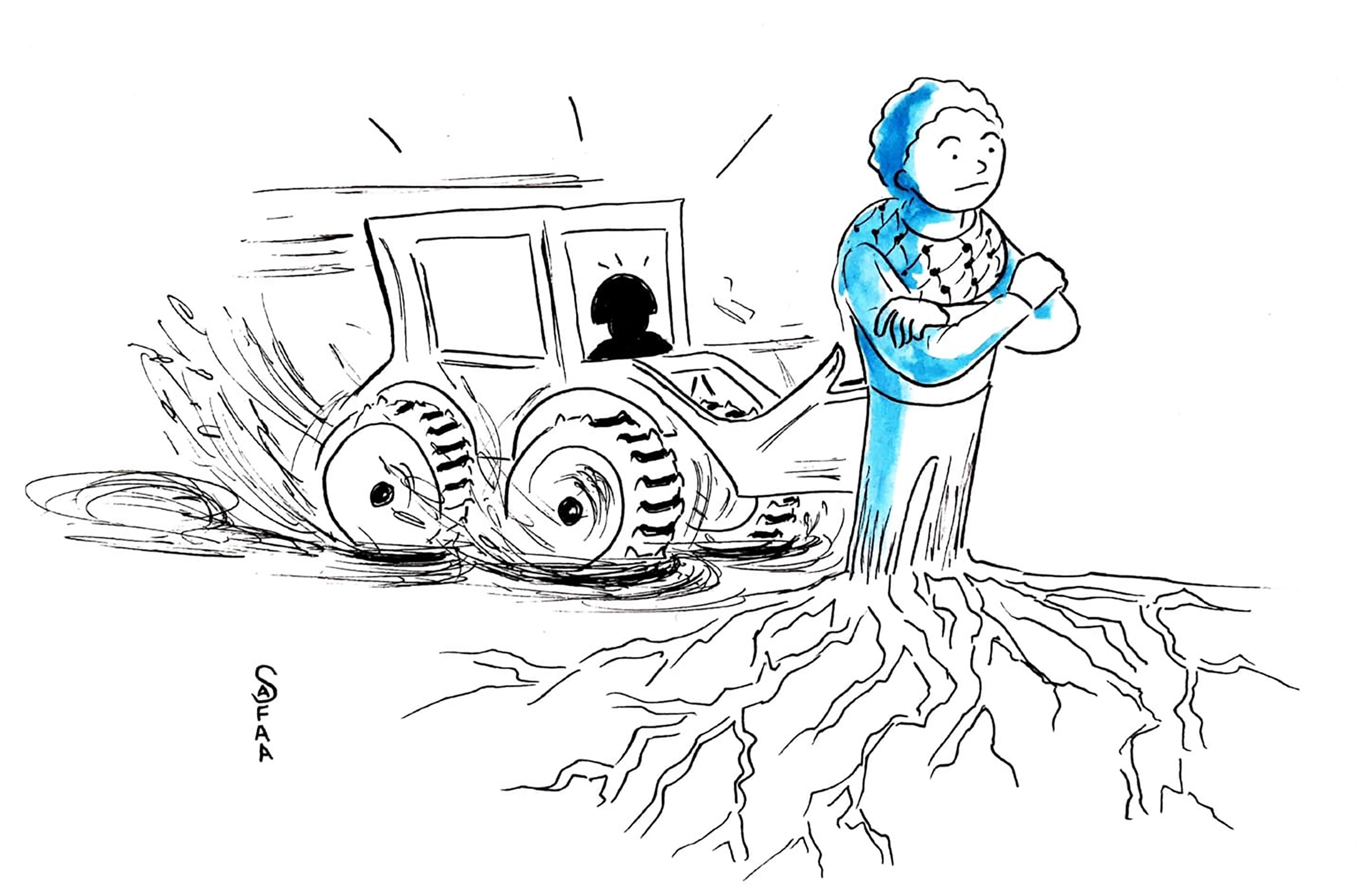
Disillusionment with Western institutions, particularly European ones, is strong - 'the abstract idea of rights has chiselled itself into nothingness' - instead, trust remains in real connections with people. "For me, Un Ponte Per is a living interweaving with a piece of the world. The tile I drew, with those bodies stretching out like a bridge, comes from there. It is the body that connects, it is the relationship of human solidarity that builds'. Like the one for Gaza and its people, subjected to unspeakable suffering. "I have been in continuous contact for months with Safaa Odah, a Palestinian cartoonist from Gaza.
A tent in Palestine, his weekly column in Weeds, is for me and the editorial team the strongest bridge at the moment. Safaa cannot leave the Khan Yunis refugee camp, yet we manage to continue writing to each other. I live in anxiety when a reply from her is late in coming. Words, like comics, build bridges when they seem impossible. I sincerely hope to embrace her one day live'.
After many years of career, today Pat also looks with concern at the digital world and the evolution of work, 'too often throttled by platforms'. In his latest book, The Digital Labourer and Other Stories, he reflects on the continuity between agricultural and technological exploitation. "I tried to parallel the agricultural struggles of the farm labourers with the allotment of the web and global technocracy. From there the idea of the digital labourer was born: one who fights against the big web oligarchs. Amazon, Google, the major social platforms, they are the new masters. And our bodies - even in front of the computer - continue to pay a high price for their wealth'.
Pat Carra continues to experience art in some ways as a physical gesture, an exercise in endurance, unafraid of the pitfalls of artificial intelligence."I tried to ask the AI just one question: can you make a cartoon about war? It replied that you can't do humour on such serious topics... and to think that I have done so many."
Rearmament distances peace Together we build an anti-war movement in a Europe of solidarity
The call for a demonstration on 15 March next, born from an idea of Michele Serra and picked up first by La Repubblica, then by parties and movements, does not convince us. Especially today when Europe, through the 'Rearm Europe' programme, chooses to spend 800 billion euros on an enormous rearmament programme.
Eight hundred billion euros spent on stockpiling weapons, supplying our armies, filling our arsenals with bombs and drones. This is not the Europe we want. That is why, on 15 March, we of Un Ponte Per non will be in the square.
These are funds that would further impoverish already meagre budgets, putting the growth of military spending and the arms business before the necessary investments in the social, for an ecological transition, to combat economic and gender inequalities. As we witness the collapse of the value of international law in increasingly unstable geopolitical scenarios, we fear that this square does not represent us.
We are convinced pro-Europeans, but not of this Europe that makes war to seek peace. We are in favour of disarmament and against nuclear rearmament, and we support the need to resume the path begun in Helsinki in 1975 for the creation of a common and shared security system. We would like to relaunch, 30 years after the Barcelona Euro-Mediterranean Conference, the idea of a Mediterranean that is a sea of peace and cooperation.
These modern times have little to do with the beautiful post-war Europe, the 'free and united' Europe that was imagined in Ventontene. Today, the American dream is a violent act to monetise the money invested over the years in military aid: it claims chunks of Ukraine, dreams of building resorts in Gaza, threatens invasions while starving the world, cutting global spending on international cooperation.
And what does Europe do? It goes into debt and spends on weapons, fortifies itself on the skin of human, social and environmental rights. To make money for the military industry, it jeopardises decades of democratic freedoms and the possibility of stopping the ecocide of our planet.
It is not enough to say 'Europe' if we do not say 'which' Europe we want; if we omit from that appeal the opposition to rearmament and do not even accidentally mention the genocide in Palestine or the very serious attacks launched against the institutions responsible for the protection of international law such as the International Court of Justice and the International Criminal Court.
Aware that many pacifist forces will be in the streets in many Italian cities, carrying peace flags, and with respect for all the citizens who will decide to demonstrate for their idea of Europe, we at Un Ponte Per choose not to participate in the call of realities and parties that too often confuse increasing military spending with building peace.
We know that new appeals have been made, aimed at correcting the initial line all bent towards rearmament and the continuation of wars. This is a positive fact, but in our opinion insufficient to change the potential instrumental use towards militarist drifts that some of the adherents explicitly hope for.
What is needed is a collective campaign to demand not to invest in weapons but in cooperation, to work with civil societies to prevent and transform conflicts and violent extremism. A mobilisation against the great powers that plunder natural resources and impose partitions, deportations and ethnic cleansing. It is increasingly urgent to build a transversal Europeanist movement for peace and justice among peoples. That is why, from 16 March, we will be at the forefront of building a mobilisation against 'Rearm Europe'.
Un Ponte Per
Who we are
Menu
close
What we do
Menu
close
Join
Menu
close
Support us
Menu
close
News
Menu
close
Subscribe
Join our newsletter to stay up to date on our projects.
To provide the best experiences, we use technologies like cookies to store and/or access device information. Consenting to these technologies will allow us to process data such as browsing behavior or unique IDs on this site. Not consenting or withdrawing consent, may adversely affect certain features and functions.
Functional
Always active
The technical storage or access is strictly necessary for the legitimate purpose of enabling the use of a specific service explicitly requested by the subscriber or user, or for the sole purpose of carrying out the transmission of a communication over an electronic communications network.
Preferences
The technical storage or access is necessary for the legitimate purpose of storing preferences that are not requested by the subscriber or user.
Statistics
The technical storage or access that is used exclusively for statistical purposes.The technical storage or access that is used exclusively for anonymous statistical purposes. Without a subpoena, voluntary compliance on the part of your Internet Service Provider, or additional records from a third party, information stored or retrieved for this purpose alone cannot usually be used to identify you.
Marketing
The technical storage or access is required to create user profiles to send advertising, or to track the user on a website or across several websites for similar marketing purposes.