The repeated and layered crisis that has been affecting Lebanon since 2019 and the recent Israeli war on the Lebanese territory have resulted in uncertainty, massive job loss, unemployment and deteriorating working conditions, especially for youth, women and people with disabilities, and in increasing challenges faced by micro, small and medium enterprises. The area of Baalbek-Hermel, historically marginalised and mostly rural and agricultural, has been hit heavier than other regions.
Tourism has always represented a crucial source of income and employment for the country, despite having been too often Beirut-centred. Despite the potential to attract tourists and the presence of the historical site of Baalbek, the area of Baalbek-Hermel suffers from marginalization due to several reasons.
The purpose of this project is To contribute to the human, economic and social development at the local level by strengthening synergies among public, private, and non-profit stakeholders, and to boost local economies through the promotion of inclusive development and business oriented to public value and social impact.
The first component, after having mapped all elements with tourism potential, will support existing enterprises through technical and financial assistance to improve productivity, diversify the tourism offer and reduce their environmental impact. In Baalbek the intervention will support businesses operating in the hospitality sector and the start-up of home-based hospitality activities. The second axis will promote new job opportunities for vulnerable individuals, who will receive vocational training courses in the hospitality and tourism sectors.
The project adopts an integrated approach, involving all stakeholders and intervening at different levels to improve the tourism sector and create lasting change.
Through a participatory approach and a close collaboration with Unions of Municipalities, the intervention aims both to the revitalisation of local economies through the strengthening of economic actors.
The project was initiated in response to the dramatic crisis in the health system in north-east Syria, a direct consequence of US funding cuts and mass displacements in early 2025. As of April, as many as 68 health facilities risked closure and only one in sixteen public hospitals remained fully functional, depriving millions of people of access to essential, life-saving care. Paying the highest price were pregnant women, children and patients with chronic diseases or life-threatening conditions, forced to live without any guarantee of healthcare. In the camps for displaced people, conditions are even more dramatic: overcrowding, poor water and sanitation infrastructure, and lack of basic care have increased the risk of epidemics such as cholera and respiratory infections, while the suspension of support to the National Hospital in Hassakeh has deprived more than 333,000 people of the only public referral point for specialist care.
Through BRIDGE, Un Ponte Per, in partnership with ACTED and with the support of the Syrian Humanitarian Fund, provides free integrated health care to the displaced population and host communities in the areas of Hassakeh, Deir-ez-Zor and Raqqa. The project supports seven health facilities managed by the UPP and KRC: four primary care centres in the camps of Areesha, Al Hol, Serekaniye and Abu Khashab, two centres outside the camps in Tel Tamer and Maabadeh, as well as the Raqqa Ambulance Centre. Activities include the provision of drugs and medical devices, training of health personnel, strengthening maternal and child health and emergency services, and strengthening the system for sending patients to specialist care.
Particular attention is paid to the Hassakeh National Hospital, with full coverage of the costs of surgery, diagnostic tests and treatment for displaced persons, removing economic barriers that had made access to vital care impossible. If services are not available at the hospital, UPP guarantees the transfer and reimbursement of costs to other referral facilities, such as the hospitals in Qamishli.
The project directly reaches more than 107,000 people - 70,901 in the camps, 35,863 in the host communities and 322 refugees - but also strengthens the entire local health system, with indirect benefits for thousands of people, including the inhabitants of the city of Raqqa who will be able to access specialist care through the ambulance system.
A work that Un Ponte Per has been carrying out for more than 15 years, with the aim of guaranteeing continuous access to quality care, from basic healthcare to hospital services, and to strengthen the local health system through the provision of equipment, staff training and health monitoring.
Since the beginning of Israel's genocidal military offensive on 7 October 2023, the humanitarian situation in the Gaza Strip is beyond humanitarian catastrophe. Among the civilian infrastructures indiscriminately affected are those that have always ensured the livelihood of families and communities, such as agriculture and fishing. Fishing activities in particular, which historically have been a primary source of livelihood for thousands of people in Gaza, are now almost completely disrupted due to the military offensive and the destruction of boats, materials needed for activities, and storage facilities.
This new intervention by Un Ponte Per, made possible by the support of FLAI-CGIL, aims to strengthen the food security and resilience of fishing communities in Gaza, providing tools for boat rehabilitation, fishing nets and technical assistance.
The materials will be distributed by our local partner - the Union of Agricultural Working Committees (UAWC) - to about 50 fishing communities, reaching out 400 direct and indirect beneficiaries, including their families, target communities, fish vendors and distributors. In addition to direct aid, the intervention aims to monitor the ongoing human rights violations against the livelihoods of the local population, providing direct evidence of the same violations and advocacy work with international actors to demand the immediate protection of the Palestinian population.
The "Tanseeq" project—meaning “coordination” in Arabic—is a bold initiative aimed at strengthening the relationship between Iraqi civil society organizations (CSOs) and government institutions. In the aftermath of the 2003 regime change, Iraq’s political landscape has been shaped by efforts to pacify deep divisions among political factions, military actors, and communities. This has often taken the form of distributing administrative and elective positions to affiliates of political parties, which has hindered the development of transparent governance and democratic institutions.
Despite these challenges, Iraq has seen the emergence of thousands of trade unions, NGOs, and voluntary groups. Many of these organizations have struggled to maintain independence from political interference, yet a significant number have remained committed to the principles of good governance, democratic participation, and human rights. These CSOs have played a vital role in advocating for institutional reform, engaging in policy dialogue, reviewing draft legislation, and pushing for more inclusive and accountable governance.
The "Tanseeq" project, implemented by Un Ponte Per (UPP) with support from the United Nations Democracy Fund (UNDEF), seeks to build on this momentum by creating structured channels of communication and cooperation between CSOs and government authorities. The project’s overarching goal is to enhance democracy and good governance by improving the administrative and legal environment in which NGOs operate.
At its core, "Tanseeq" is designed to address the bureaucratic and legal challenges that NGOs face when registering with government entities, fulfilling tax and social security obligations, and submitting financial and narrative reports. These challenges are often exacerbated by inconsistent interpretations of the law, outdated procedures, and limited understanding among both NGOs and government staff.
To tackle these issues, the project will organize ten monthly roundtable discussions between NGOs and key government bodies, including the Ministry of Finance, the Ministry of Labor and Social Affairs, and the Directorates of NGOs. These roundtables will serve as safe spaces for dialogue, allowing NGOs to voice their concerns and government representatives to explain their constraints, fostering mutual understanding and collaboration.
In parallel, the project will deliver awareness sessions to 180 government employees across 18 governorates, equipping them with clear guidance on NGO registration procedures and the legal requirements for income tax and social security. A Training of Trainers (ToT) model will be used to build a unified body of knowledge among 20 public administration staff, who will then conduct further training sessions for their peers and for NGOs.
On the civil society side, 360 NGOs will benefit from 18 one-day training courses delivered by trained government staff. These sessions will focus on helping NGOs understand and comply with financial reporting standards, social security contributions, and tax obligations. Additionally, 8 workshops will be held in 8 governorates, targeting 120 NGOs to support them in overcoming the specific challenges they face when submitting annual reports.
To ensure that these efforts are sustainable and accessible, the project will produce two informative video clips and/or manuals in multiple languages. These resources will standardize and simplify the registration process, making it easier for NGOs and government staff to navigate the system.
A major innovation of the "Tanseeq" project is the establishment of a national network of Iraqi CSOs. This network will be formally registered with both the Government of Iraq (GoI) and the Kurdistan Regional Government (KRG), and will serve as a platform for coordination, advocacy, and information sharing. A dedicated website will be launched to facilitate communication among member organizations, and a board of directors will be elected during the network’s first general assembly.
"Tanseeq" is more than a technical intervention—it is a strategic effort to rebuild trust, foster collaboration, and lay the groundwork for a more democratic and inclusive Iraq.
Contributing to the enhancement of cultural heritage and social inclusion of vulnerable and disabled people in Jordan through the promotion of responsible and sustainable cultural tourism in decentralised areas in the south of the country: this is the objective of the new Un Ponte Per intervention, dedicated to the archaeological area of Jerash.
The project aims to protect the rich cultural heritage of the city of Jerash; to enhance it as a tool to promote inclusive and sustainable local development; and to create economic opportunities for the local community. Currently, the local community only marginally benefits from the positive impact that tourism in Jerash could have, as tourists visit the archaeological site and then move on to other destinations, without visiting or staying in the urban area with limited interaction with the local community. The project therefore aims to address this phenomenon by enhancing the area of the Eastern Roman Baths - located in the modern city - as a connecting point between the archaeological area and the urban area. To achieve this objective, the project aims to improve the protection and management of Jerash's cultural heritage, including strengthening the skills of the staff in charge; it also intends to improve the accessibility and usability of the archaeological site and the city's other sites of tourist interest; and to create jobs for the local community with special attention to the participation of people with disabilities.
To this end, actions will be carried out to recover and restore the area of the Eastern Roman Baths; the restoration of the mosaic in the Viaduct Church within the Jerash site; and the development of a plan to improve tourist management. In addition, a golf kart track will be created within the archaeological site, to make it accessible to people with motor disabilities; an app to guide tourists and continuous training for local staff responsible for managing the site; and a community-run restaurant offering job opportunities to trained people.
The El Buss Family Guidance Centre, located 1.5 km south of the city of Tyre, provides specialised mental health services to children under the age of 18 and their carers living in Palestinian camps in the Tyre area. Services offered include counselling, treatment and follow-up in psychiatry, psychotherapy, psychomotor therapy, speech therapy, occupational therapy, assessment testing and social intervention.
In addition to clinical care, the Centre adopts a community-based approach in working with children and families, as well as with organisations, schools, kindergartens and the community so that they overcome their psychological problems in their environment to ensure the acceptance and social inclusion of people with mental health problems.
The aim of the intervention is to support the work of the centre by providing ongoing training and individual and group psychological sessions, as well as psycho-motor and non-formal education activities.
The project has two interconnected components in the fields of Health and Healthcare. The first aims to support the provision of emergency, primary and secondary health care services. The second component aims at consolidating, guaranteeing and, where necessary, establishing the secure medical waste management system in several health facilities in Deir ez-Zor, Raqqa, Aleppo and Hassake.
This has enabled the strengthening of infection prevention and control (IPC) activities carried out in all health facilities in the areas of Deir Ezzorm, Raqqa, the villages of Kobash, Jurneyyeh, al-Hasakeh, Shaddadi, Tell Tamer, the camps for refugees and displaced persons in Al-Hol, Washokani and Areesha. The activities are carried out in partnership with the Kurdish Red Crescent (KRC) and the health services are those reported in the UPP Health Sector Action Strategy.
These are times of high social conflict in Iraq, as evidenced by the mass protests across the country since October 2019. Against this backdrop, the role of Civil Society Organisations is crucial in bridging the gap between local communities and the Iraqi authorities at the grassroots level, promoting constructive dialogue, ensuring respect for human and environmental rights as well as equal participation of men and women.
To be more effective, local organisations need support. An external support, however, that must be respectful of all cultural and social processes. This is why 'Tatweer' was conceived and implemented together with the local population. The main objective of the intervention, active since 202, is to support Iraqi civil society organisations so that they can have a greater impact in promoting rights.
For this reason, in the first phase of the project, five Centres were opened in Erbil, Mosul, Anbar, Baghdad and Basra, entirely dedicated to local associations that can serve as open and safe spaces for exchanging good practices and organising activities; organising meetings, workshops and seminars on the issues of respect for human, environmental and gender rights, also creating a web platform available to the Organisations and a series of micro-banches to make them economically self-sufficient. With the second phase of the project, support continues to be given to the Centres and to the civil society organisations operating there.
Since October 7th 2023, Israel has launched an extremely violent military attack against the Palestinian population in the Gaza Strip. Since then, a vicious genocide has been underway, causing an unprecedented humanitarian emergency, affecting more than 2 million people now reduced to starvation, and resulting in the almost total destruction of civilian infrastructure, including homes, schools, shelters, and hospitals.
Since the beginning of the offensive, Un Ponte Per has been active in trying to bring relief to the affected population, supporting local Palestinian organisations at the forefront of the emergency response, which have played - and continue to play amidst immense difficulties - a central and timely role.
This is why Un Ponte Per in February 2024 launched the Water for Gaza campaign, which aims to provide immediate aid to its local partner - the Union of Agricultural Work Committees (UAWC) - which has been working since decades to support the rights of Palestinian farmers, fishermen and agricultural workers in both the West Bank and the Gaza Strip.
Thanks to their work, it has been possible to bring the affected civilian population drinking water, food parcels, to install containers with toilets in some camps for displaced persons and covers to protect tents in the winter months, and to repair some water tanks.
At the same time, the campaign aims to strongly denounce the genocidal operations committed by Israel against the Palestinian population and the complicity of the International Comunity, encouraging Italian public opinion to get informed and mobilise, in particular by amplifying Palestinian voices, actively participating in awareness-raising initiatives and protests, and joining the non-violent campaign for Boycott, Divestment and Sanctions (BDS) against Israel, and in particular against any kind of trade and military agreements.
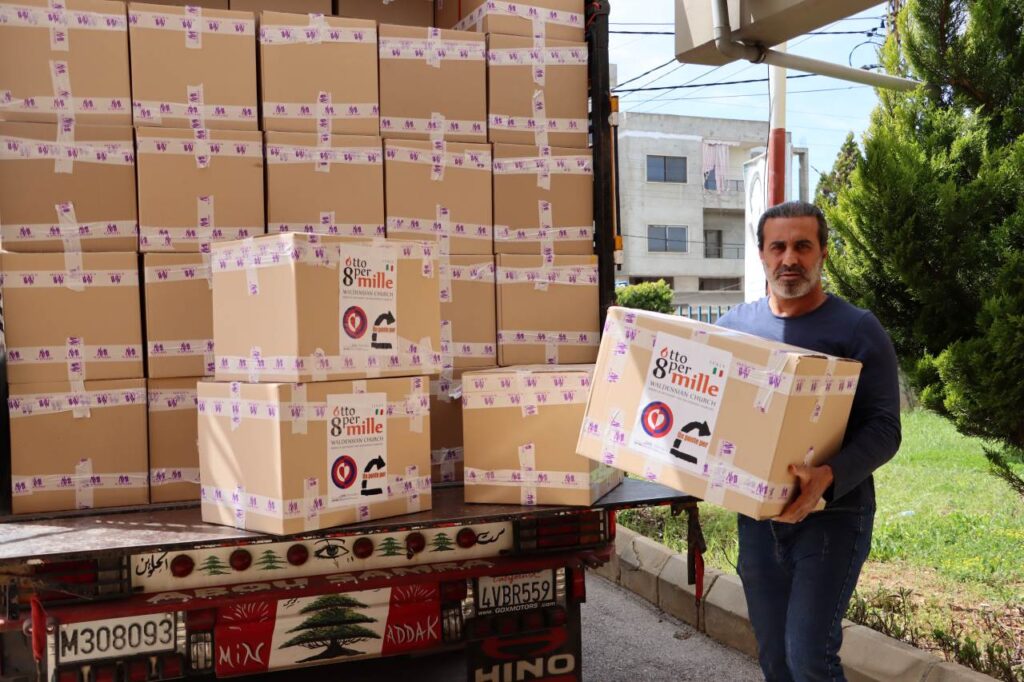
After 11 months of escalating tension at the Lebanese-Israeli border, on September 23, 2024, Israel launched a large-scale military operation in Lebanon, marking the most devastating human toll since October 2023. The intensifying violence has triggered a widespread displacement crisis. This crisis indeed exacerbates Lebanon's existing challenges, including the lasting effects of the Syrian conflict, the Beirut Port explosion, disease outbreaks (such as COVID-19 and cholera), and the country’s socio-economic collapse. In response to these compounded challenges, our local partner Amel has activated its emergency response plan.
To address the most pressing basic needs of Internally Displaced Persons (IDPs) in Nabatyeh governorate, Lebanon, UPP decided to activate in support of Amel by delivering essential life-saving assistance through basic life items. Our focus is on providing vital resources such as hygiene kits for shelters and winterization kits, improving the living conditions of IDPs and supporting their immediate survival needs in this crisis.
The intervention will provide hygiene kits and food parcels based on the needs assessment and identified priorities; select distribution sites in collaboration with municipal representatives and disaster management units, ensuring fair and efficient distribution and distribute 500 hygiene kits and 500 food parcels, ensuring continuous support throughout the project duration with a rotational approach in collaboration with other partners.