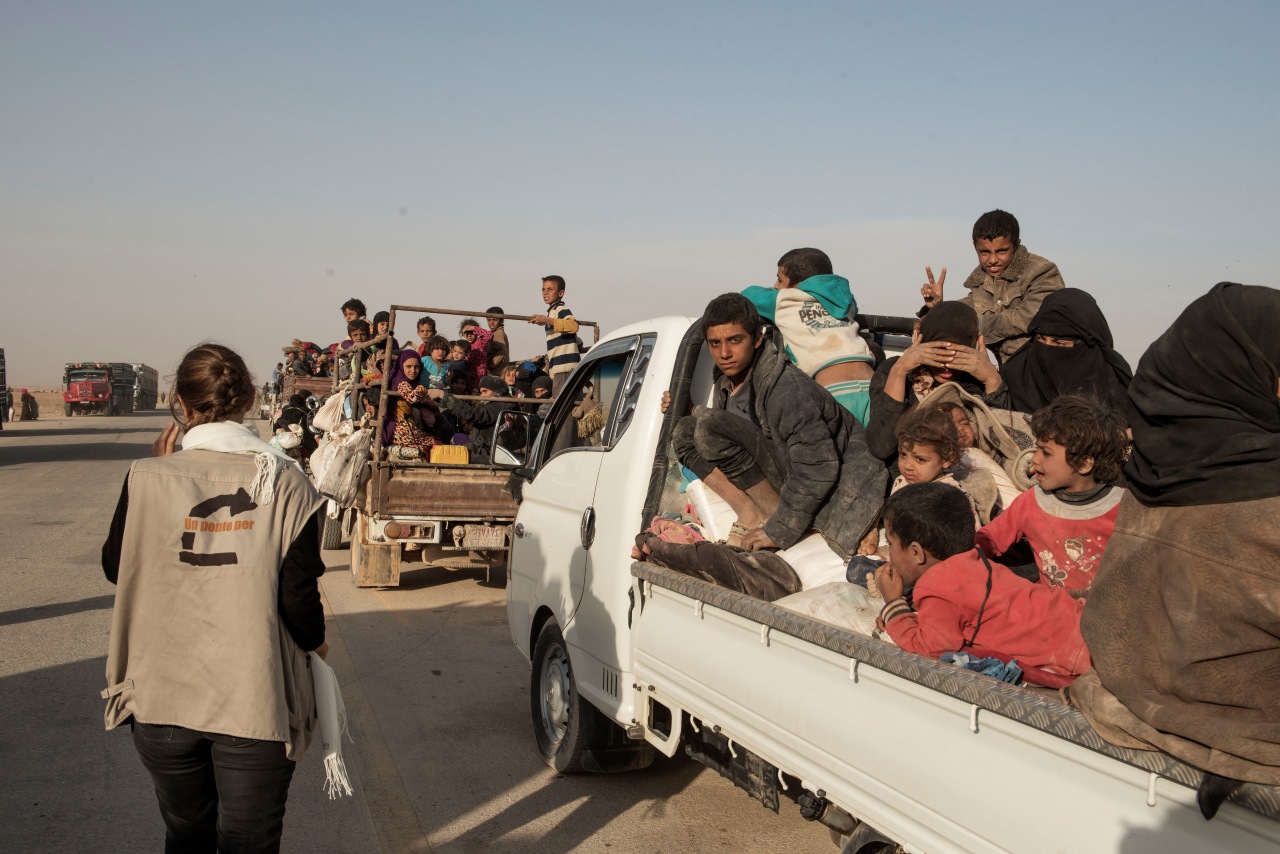
A new emergency plan supported by European funds and private donors is underway, through which together with our local partner, the Kurdish Red Crescent, we will provide life-saving healthcare to war-wounded civilians fleeing Raqqa and the population in north-east Syria.
The first phase, launched in July 2017 immediately after the start of the battle to liberate Raqqa, ensured thousands of injured and trapped civilians in the Daesh (Islamic State) stronghold had access to life-saving treatment for 10 months, through direct support to the country's north-eastern health system.
This, in fact, is the aim of the life-saving health care programme, an intervention thanks to which it has been possible to purchase 15 ambulances, directly support specialised teams of local doctors and health workers, set up 2Trauma Stabilisation Points (TSPs) on the outskirts of Raqqa, before transferring them to the nearest hospitals, thus increasing their chances of survival, 2 Emergency First Aid Centres between Raqqa and the Areesha refugee camp.
For the duration of the battle, the people trapped in Raqqa would not have had access to any health facilities, as the few existing ones were too far away from the frontline where the fighting took place.
The intervention of Un Ponte Per and the Kurdish Red Crescent allowed them to push to the front line by sending ambulances and specialised teams to recover the most seriously injured people and transport them to the nearest Trauma Stabilisation Points.
Thanks to this action, it was possible to lengthen the so-called 'golden hour', the time frame within which a seriously injured patient has a better chance of survival if treated promptly and stabilised, and then moved to hospital facilities in the north of the country.
An action that has been rescheduled month after month to best adapt to the extremely changeable context and best respond to the needs of the civilian population.
In parallel, frontline health workers were provided with training in psychological first aid techniques (PFA), handling civilian casualties in conflict zones, decontamination methods in the event of chemical attacks and how to behave in mined areas.
The first phase, which ended in March, provided healthcare for over 103,000 people. With the second phase, from April to December 2018, the intervention was also extended to the governorates of Hasakeh and Deir er Zor, with the aim of providing health care to 110,000 people.
Through the strengthening of theEmergency Primary Care Centres (EPCCs) and the system of mobile health units to reach the most isolated areas, which will increase to 21 vehicles. Training is also continuing to improve the skills of local health workers and project staff in life-saving procedures and trauma care, primary health care protocols, monitoring and administration. While special attention will be paid to methodologies for identifying and protecting victims of abuse, violence and discrimination, in order to develop dedicated services.
The third phase, which extended throughout 2019, involved the strengthening of all previous interventions and the extension of health services provided outside clinics to reach the most vulnerable segments of the population and increase resilience. It also saw an increased involvement of local communities in the planning and delivery of services, and the deployment of Community Health Workers (CHWs).
An emergency project that is part of the broader intervention that Un Ponte Per has been carrying out in north-east Syria since 2015, through direct support for the work of the Kurdish Red Crescent, its health centres and the training of specialised medical personnel.