The youth population in Jordan suffers from a high unemployment rate that also creates social tension among the young people. In an attempt to bridge the gap between their education and the job offer, Un Ponte Per launched the 'Furas' (Opportunities) project at the end of 2022, thanks to the valuable support of Otto per Mille funds from the Waldensian Church. Targeting mainly vulnerable youth, and in particular refugee communities from Syria, Iraq and Palestine, the aim of the project was to facilitate access to the world of work for young people through vocational training, which was constantly accompanied by peace-building activities, dialogue, psycho-social support, with the dual objective of overcoming stereotypes and discrimination.
Aimed in particular at young people with disabilities and vulnerable people, aged between 15 and 30, we have tried through trainings and meetings to support them in developing technical and vocational skills.
Started in November 2022, 'Furas' has now reached its conclusion with excellent results, providing the necessary protection and development opportunities to over 1,230 young people, and over 1,000 relatives and family members.
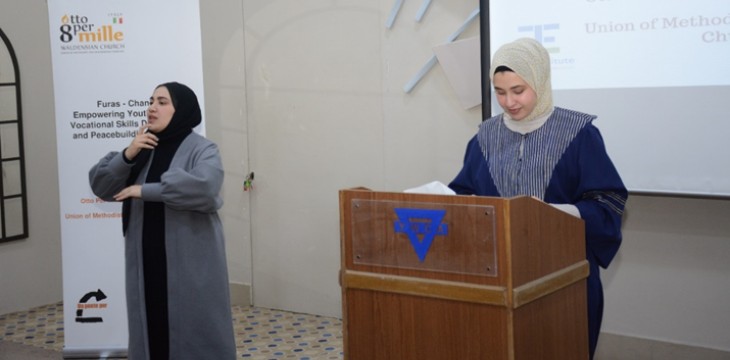
In September 2023, we prepared and launched the vocational training courses, selecting 20 trainees between the ages of 18 and 30, prioritising the provision of opportunities to people with disabilities, who were over 50% of the total number of participants, Jordanians, Syrians, Iraqis and Palestinians, fostering an environment where diversity was celebrated and embraced. All of them successfully completed the course and were then included in practical training in different workplaces.
We then focused on enhancing the skills acquired: participants moved from classroom learning to real-world application by engaging in a month-long training programme, which led to guaranteed employment contracts in several local organisations.
Thanks to the cooperation with the local partner Athar for Youth Development Association, we were also able to start 'Conversation Clubs': safe spaces for young people aged between 15 and 18, where in addition to being trained on peacebuilding and overcoming stereotypes and discrimination, they were able to receive support and psycho-social assistance.
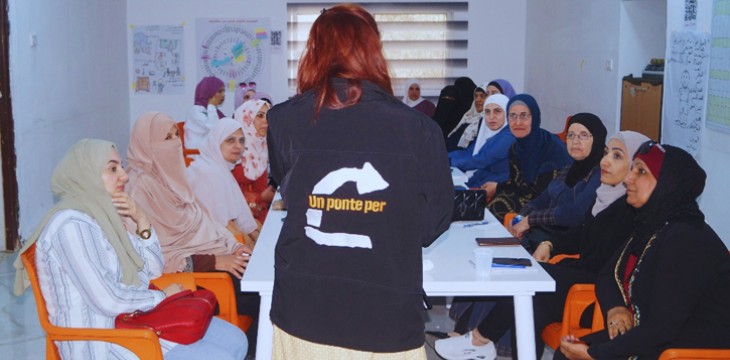
Through educational, recreational and training activities, the educators provided psycho-social support and a hotline service for women, girls, men and boys. In collective dialogue sessions, topics chosen by them were addressed, including conflict resolution, respect for human rights, and combating bullying and discrimination that many still face on a daily basis.
The main objective was to provide participants with tools to resolve conflicts with their peers, to develop self-defence and positive reaction mechanisms, to use differences between them as a resource, to promote social cohesion between communities, to be aware of their own rights and the rights of people with disabilities without adopting discriminatory attitudes.
According to our partner, these activities were absolutely necessary in a context that lacks training on these topics and spaces where young people feel free to express themselves.
Finally, thanks to the collaboration with local mental health experts, it was also possible to provide individual and group counselling by accompanying survivors or those at risk of Gender Based Violence (GBV), women at risk of sexual and physical harassment and abuse or lack of resources; as well as children at risk and victims of child labour and exploitation due to family socio-economic conditions.
All young people who participated in our training courses then received a certificate and attended a final event.

Sradicatə is a series of articles that aims to explore in depth the intricate links between the climate crisis and migration. An essential part of our approach has been to focus on target countries - Italy, Iraq, Tunisia - as we believe it is crucial to seek the perspectives of those actively involved in the direct management of the climate crisis and its consequences.
In particular, we wanted to delve into the personal stories of the people interviewed in relation to the climate crisis, recognising that their direct experiences can offer a fundamental key to understanding the complex dynamics of this global phenomenon. We focused on three main aspects:
The first section gathers valuable information on some aspects of the participants' life journey;
the second, the segment on the activist's work, was designed with the aim of gathering detailed information on their experience of activism and personal involvement in dealing with the climate crisis;
finally, the section on climate crisis and migration, whose specific focus explores participants' perceptions and concerns on these crucial issues. The conclusions drawn from the responses provide us with a valuable perspective on the dynamic relationship between the climate crisis and migration. snsdbsdjfsdjjsjdnjsdjdjdjdjdjnnfnjfnjfnjfnjfnjfjfnjnvjnjndjcjcnjcjcjcjcjcjcsjscjsj dsk


If in the first phase (below) the Sradicatə column explored in a more general way some key concepts (e.g. the definitions of "climate crisis" and "environmental migrants", the lack of legal norms, etc.), in this second phase the focus has been on the in-depth study of some specific territories: Iraq, Tunisia, Nepal, Peru and Italy, chosen both because they are the countries in which our 2 associations operate and because they are territories strongly affected by the phenomena in question. In these articles, we will focus on some of the issues related to the climate crisis in these countries.


***

The Sradicatə column is the result of the work carried out within the Universal Civil Service project "Territories and Expendable Bodies", a collaboration between Un Ponte Per and El Comedor Estudiantil Giordano Liva: a series of articles exploring the links between the climate crisis and migration. During this journey we will dwell on the stories, concepts and problems that emerge around this fundamental theme, in an attempt to better understand our world and our contemporary society.
Curated by Giulia Bigongiari, Martina Marcuccetti, Sara Mariani, Alessia Massari, Alessandra Mauceri and Sara Raffaeli.


"I am very proud of this great achievement," said Bahman Qadir, our Iraqi colleague who coordinates the Tatweer project, an ambitious programme we have been running since June 2020.
"After starting the second phase and establishing the centre, we managed to involve more than 50 local organisations in Baghdad and the surrounding provinces. The centre will be a crossroads for the exchange of experiences and good practices between organisations,' Bahman added in the aftermath of the new centre's inauguration. An achievement made possible by the synergy with many local Iraqi partners, such as the organisation Al Mesalla.
Today, Iraqi society is facing a phase of strong contraction of rights, which is why the role of civil society organisations becomes crucial: to bring about change from below, to promote respect for human, social and environmental rights as well as equal participation in community and political life for both men and women.
In order to be more effective, however, local organisations need support, to be able to make their way through the meshes of a complex bureaucracy and build autonomous and horizontal spaces of viability. This external support must be respectful of the country's specific cultural and social processes.
'We want to empower Iraqi civil society organisations to have a greater impact in promoting human, civil and environmental rights; to enable them to respond effectively to the needs of the community, and to collaborate fruitfully with the authorities,' Bahman continues.

"Iraqi organisations in fact need to increase their advocacy capacity, provide adequate space for young people and women in leadership, the opportunity to learn how to operate, and the availability of spaces where they can meet and grow together. With this objective, already in the first phase of the Tatweer project, we opened centres in Erbil, Basra and Mosul. Now finally also in Baghdad,' he tells us.
Open spaces together are safe spaces for exchanges of good practice, meetings, workshops and seminars. In the new space, we have already started an intensive training course for local organisations on good administrative governance, strategic planning, fundraising, and writing proposals to independently access international cooperation funds. In addition, we will be providing a series of legal and expert advice sessions on administrative, logistical and procurement issues, as well as financial and human resources management in the coming months. All this is designed so that Iraqi organisations can stand on their own two feet and our support is no longer needed.
"Our main objective is to support civil society in the creation of realities and structures that represent them to create positive social change, so that they work effectively, transparently, democratically, and with respect for human and labour rights. Since we started, we are succeeding in accompanying so many people,' Bahman concludes with great satisfaction.

According to figures released by Reporters Without Borders, which monitors violations committed against news workers around the world, at least 105 journalists have been killed in Gaza since October 7 while carrying out their work. However, according to local Palestinian sources, the number is even higher, taking into account the thousands of people still under the rubble or missing, which would reach 130 news workers killed since the beginning of the Israeli military offensive, or 75% of all news workers killed in the whole of 2023.
The alarm is being raised by all the international organisations that monitor press freedom in the world, including the Committee to Protect Journalists (CPJ), which for months has been keeping up the alarm to request international protection for those who, today, are the only witnesses of what is happening in the Gaza Strip.
Already a few weeks after the beginning of the Israeli military operations, the Palestinian Press Syndicate had defined what is happening as a "journalistic murder": Palestinian information workers do not "die" under the bombs, but are killed, and have become a target of the Israeli armed forces.
In a context in which access to the international press is completely denied, Palestinian journalists are the only ones to witness what is happening, and they continue to do their job by reporting live on a genocide that affects them directly. Just think of the price paid by many of them, who are now displaced, who have seen their homes destroyed and their families exterminated: this is the case, among others, of Wael Dahdouh, an Al Jazeera veteran in Gaza, who lost his wife and children, including Hamza Dahdouh, also a journalist, who was killed by a targeted bombing of a press convoy.
View this post on Instagram
In this Instagram video, Wael Dahdouh expressed gratitude to the public after the great solidarity he received in the aftermath of the killing of his son Hamza. A loss that came after that of his wife, brothers and other relatives and colleagues.
Today we celebrate World Press Freedom Day, and our thoughts can only go to Gaza. The place where even the right to inform and be informed is constantly violated.
The ban on international press access to Gaza is indeed a very serious violation of freedom of the press and information in Europe and the West. At the same time, it is crucial to remember the invaluable information work being carried out daily by Gaza journalists, whose voices should be heard and amplified.
"The problem is not that Western journalists cannot enter Gaza," Hossam Shabat, a young Palestinian journalist, wrote recently. "The problem is that we Palestinian journalists are not respected. My colleagues and I risk our lives every day to report on this genocide. Nobody knows Gaza better than we do. If you care about what is happening here, amplify our voice. We don't need Western journalists to tell our stories: we are capable of doing it ourselves'.
View this post on Instagram
Hossam Shabat, in one of many live reports from Gaza
Youmna El Sayed, to whom our friend Rita Petruccioli dedicated the beautiful portrait on the cover for the 'Libere di Rompere' campaign, also told the Manifesto:
"In the West, it is thought that Palestinian journalists must necessarily be affiliated with some political group and therefore cannot be objective. This is ridiculous. When foreign journalists enter Gaza, they do it with the help of a Palestinian fixer, a Palestinian translator. They talk to Palestinian officials and the Palestinian population. Those are considered credible stories, but ours are not'.
View this post on Instagram
Youmna El Sayed, as an Israeli bomb explodes behind her back.
And so, we dedicate this 3rd of May to all the journalists in Gaza. To those who have lost everything, to those who have been killed, to those who after 6 months of uninterrupted massacres continue every day to do their work with professionalism and courage. And we renew our call to amplify their voices, the only direct witnesses of the ongoing genocide against the Palestinian population.
Thanks to the 'Free to Break' campaign: immediate care and protection for women and girls survivors of violence.
Cases of gender-based violence tragically increase in war contexts. Lower wages, unsafe working environments, reduced access to education expose women to less access to services and early marriages. All factors that increase the risk of gender-based violence.
Un Ponte Per has created safe spaces in Syria to provide protection for women and girls survivors of gender-based violence and child marriage. And supported clinics to ensure reproductive health and psychosocial support.
Lasu, Protection Specialist in Raqqa with Un Ponte Per, says:
"We work to ensure protection and rights for children exposed to violence, child labour, early marriage.We help them to identify the risks and provide them with the tools they need to report incidents of violence and abuse, especially prevalent among girls and young women".
In Syria, women and girls pay the highest price for the war. They are the first to lose the opportunity to study, to be exposed to violence, to be discriminated against. And the last to be supported.
In North East Syria after 13 years of conflict still 2 million people are in need. The emergency affects women and girls differently and contributes to gender-based violence, economic inequalities, child marriage and child labour. Defending the rights of women and girls in Syria is crucial to ensure protection and active participation in the public life of their country.
Un Ponte Per has been present in Syria since 2015 to bring care, medicine and protection to all and sundry, rebuilding a free, public health system and providing essential health services such as field clinics, hospitals, training and protection for the mental and physical wellbeing of the population, particularly women and children.
"They experienced things that even we adults could not have managed. When we arrived in Raqqa they didn't play with their schoolmates, they didn't even have friends, they didn't trust anyone. They were dark and shy.Today they smile and manage to form relationships with their peers,' says Nada, the mother of Mariam (8), Bissan (11) and Ghazal (13).
Syria continues to be squeezed between a humanitarian and economic crisis. Humanitarian needs are at an all-time high after more than 12 years of war and in the wake of the devastating double earthquakes that hit the region in February. According to the UN, nearly 12 million people - more than half of Syria's population - do not have enough food and another 2.9 million are at risk of starvation.
In 2020 Un Ponte Per opened 3 Safe Spaces in Raqqa to provide safe places, protection and psychological wellbeing for women and children.
In our Safe Spaces, anti-violence and child protection workers coordinate to ensure a specialised psycho-social support pathway, depending on the case.
In particular, thanks to the 'Free to Break' campaign:
Un Ponte Per launched the 'Free to Break' fundraising campaign in December 2023 to ensure child protection, economic participation and access to care for women and girls in Syria in the three Safe Spaces in Raqqa and in clinics and hospitals across North East Syria.
The campaign was created in response to the crisis of women's and girls' rights in the country: in Raqqa, 60 per cent of boys and girls do not go to school; every year, 25 per cent of girls in the country are forced to get married before they turn 18; only 7 out of 100 women survivors of gender-based violence have access to psychological support and protection services; the health system is collapsing and especially in camps for displaced people, health is an emergency.
The 'Free to Break' campaign has enabled us to support Syrian girls and women who, amidst many obstacles, are today breaking down walls of stereotypes and oppression to rebuild their dignity and determine their own future.

by Fabio Alberti, founder of Un Ponte Per
A grey veil seems to cover Kathmandu when you see it from the porthole. Upon landing, one realises that it is not fog, but pollution. Kathmandu is one of the most polluted cities in the world, due to its location in a basin and the development of civil motorisation. A continuous darting of motorbikes slaloming between pedestrians, small Korean and Chinese cars and old Bees converted into collective taxis. A continuous traffic jam. Apart from this, Kathmandu is a marvellous city, immersed in a restrained spirituality that accompanies the lives of Nepalese men and women and made manifest by the omnipresence of temples and small temples, Hindu, Buddhist, Indo-Buddhist, dedicated to a vast pantheon of gods, including a living goddess. There are more temples in Kathmandu than churches in Rome, in a country where mixed marriages are still celebrated without one of the spouses having to change religion. A country governed by a leftist front, Marxist Leninists and Maoists included, but where the privatisation of education and healthcare imposed by the International Monetary Fund can be felt in the streets by the huge number of private clinics and schools and agencies for study abroad, and where the inhabitants of the shacks on the river bank are threatened with collective eviction in honour of the city's 'beautification' process imposed by the new tourist vocation suggested by the World Bank, as a way of development after the reconstruction in large part by the 2015 earthquake.

Kathmandu thus welcomes, from 15 to 19 February, with its contradictions and thanks to a powerful mobilisation of trade union forces and the NGO Federation of Nepal - thousands of affiliated NGOs working in all fields, almost a state apparatus - the thousands of activists convened here from all over the world and especially from South Asia. Perhaps more than a World Social Forum, in fact, this was a continental forum: from the Indian subcontinent there were truly masses present, numerous delegations, made up of activists, but also simple participants in the many social movements that animate the political life of Nepal, India, Pakistan, the island of Ceylon, Bangladesh. And then presences, albeit more limited, from the Philippines, Korea, Africa. The European and American presences are almost symbolic. From Italy, in addition to Un Ponte Per, there were Legambiente, committed since the network to the defence of the high mountains, as well as Unione Inquilini and a few local organisations. They were three days of well-attended discussions, conferences, presentation of projects, convergence on common actions: over 400 meetings on a very wide range of topics, all of a high level and many reporting on social struggles. As in the style of the Social Forums, no official conclusions, but many statements on different topics that together make up the political programme of the possible alternative. The forum was organised in a park in the centre of the city, with large tents hosting the seminars, around a large central square surrounded by small stalls offering food, local handicrafts, most often related to projects to strengthen women's economic autonomy, as well as documentation material on activities and issues. A spatial organisation that favoured exchange and encounters between the people who swarmed that space, moving from one seminar to the next. Here the word socialism is still pronounced with a strong sense, but even more pronounced is the word colonialism, which recurs systematically and in different forms and adjectives in almost every debate. What Europe has put under the trapet by pretending to forget where its wealth comes from is still on the table here and waiting to be addressed. An example of this was the seminar on the 'Decolonisation of Development Aid' in which we, as Un Ponte Per, participated in the run-up to a campaign to establish a day of remembrance for the victims of colonialism.

"We don't want your aid any more, nor do we want to submit to the conditionalities you impose in order to grant it, including gratitude," it was said. "Instead, you still have to repair the damage of colonisation, to which we must add the damage of climate debt"; "It must be the recipients and not the so-called donors who decide where and when to allocate funds". A radical stance especially against aid from states and the World Bank, which often entails the obligation to privatise and liberalise economies. But Western NGOs have not been spared either. The South, at least this South present here, which has grown and networked thanks to the World Social Forum process, is aware that it does not need to go to the Europeans for lessons and that it often knows more than the 'kids who, with no specific knowledge of the place, come here and think they can give directions'. It is clear here that the relationship between northern and southern NGOs must change. Also climate change, another pervasive issue; just as pervasive now is the damage that the populations of these continents are suffering and expect to suffer as a result of the continual rise in the climate, mainly caused by European and US industrialisation, which have discharged far more greenhouse gases into the atmosphere than they would have been 'entitled' to in a fair way. Here the issue of global warming is not only a question of the policies to be followed in order to avoid the continuous rise in temperature, an issue on which the social movements are very committed, but it is also an issue of climate justice that claims the existence of an ecological debt of the West to the global South that must be paid off and that is in addition to the colonial debt. War, on the other hand, has not been much of a topic. The impression is that the war in Ukraine is seen by most as a small intra-European, 'inter-white' war, with a certain annoyance towards both contenders, NATO and Russia. Rather, eyes seem to be focused with concern on the South China Sea, as the place where the global war between the West and China is likely to break out. Natural and unanimous identification instead with the struggle of the Palestinian people, against the decades-long occupation. It is a spontaneous solidarity between former colonised and colonised, even with some sporadic excesses. However, the flag that flew the most at this forum was the Palestinian flag, quite a difference from previous meetings in which the Forum had held a more cautious attitude by not taking a position and considering the issue at least partly controversial. The damage Netanyahu has done to the image of Israel and the Jewish people, measured here among the vast majority of the world's population, is incalculable. Here one really realises how much of the globe's white population is an exception, and how marginal Europe is. And of this smallness of ours it will be good to realise.

Text and photos by Fabio Alberti, article originally published on 1 March 2024 on serenoregis.org

by Fabio Alberti, founder of Un Ponte Per
"I have in my eyes the dreadful scene of the waves of an enemy sea that, after swallowing dozens of people, tosses what remains of a lifeboat of hope, stranded and then destroyed, near Crotone. Only the last known shipwreck. How many unknown ones we do not know by definition.
But we do know that there will be many more because a forced conduit is in operation, forcing growing masses to emigrate, a sort of watering hole that no one seems to want to turn off.
So take this as an outlet. And forgive some inaccuracies.
But I wonder why, out of hundreds, perhaps thousands, of committees, associations, organisations for assistance, relief, and defence of the rights of migrants, not a single one can be found that asks the Italian government and the European Union for something concrete to protect the right of those who live in the Global South to remain in their own land in dignity and safety? Why do we have to hear the fateful and hairy 'let's help them in their homes' from the Lega and instead there is no concrete indication of what this means?
Why do we keep accepting and repeating the phrase 'they flee from war and hunger', as if war and hunger were midsummer fortunes and not products of human policies, without ever mentioning those who provoke war and hunger, organise it, and practice it.
Don't we have more to ask for than welcome? And if we do, why don't we do it in the same tone of voice? Why don't the demonstrations we make on the issue of emigration carry the sign 'No more colonial exploitation' high in the front row ?
However, this concentration on the issue ofreception (don't get me wrong, necessary and rightful) has ended up shifting the issue of emigration from a political and rights issue to a mere humanitarian one, so that it almost seems as if reception is a pleasure to be done out of a good heart, 'humanitarian' indeed. And not, if not a right, as it should be the right of every human being to be able to take up residence wherever he or she wishes, at least a duty, ofEurope, being itself, with all the evidence, through ecological debt, through arms trafficking, through its colonial past, the cause of the evil that it attempts to confine across borders.
For this is the truth that we all know, but too little is said.
The wars from which those who migrate flee are fuelled, when not provoked, wanted, organised as part of the struggle to grab land and raw materials for industry in the North. Of course there are local causes, but these are intertwined with legacies of colonialism and above all with the activity that the former occupying powers continue undaunted to produce in determining governments and policies. And not a few African leaders have been in trouble for denouncing the interference of the former colonial powers, Thomas Sankara for one.
The adverse climatic conditions that force migration are a direct consequence of Western industrial production, since it has been calculated that African populations produced less than one tenth of the carbon dioxide caused by European overdevelopment. There is therefore a European debt to Africa that should impose the reception of a surveyed share of the 216 million potential environmentally displaced persons predicted by the World Bank. So much for humanitarianism. Here, reception is a duty.
The hunger that forces people to look elsewhere for sources of life does not come from nowhere or even 'from nature', but from, among other things, the transformation of subsistence agriculture into monocultures for export resulting from integration into the world market, with whose proceeds the richest fractions of the population buy goods produced in the North, often imported at the expense of local production that has been denied protection as a result of liberalist trade treaties.
Corrupt regimes, swallowing up resources, holding populations hostage by stealing futures and resources are often 'friendly' regimes, supported, fortified, sometimes installed by western countries. And economic policies that have not allowed development are often advised, when not imposed by a monetary fund dominated by the US and European nations.
All this is known to all. Or at least to us. It is not everything, of course, but it is a significant part of the phenomenon.
Why then do we clamour for the revision, or cancellation depending on the radicality or point of view of each, of the legislation that prevents migrants from entering Europe and do not demand, demonstrate, petition in the same way and with the same force for example to demand a revision of trade policies, from the BITs to the free trade agreements, through which the European Union and Italy with it, continues to maintain unequal terms of trade with African countries?
Why do we accept that only those who, whether militias or smugglers, are only the last link in a chain of causes that lead to the deaths of thousands of people that has at its origin multinational crime syndicates that plunder resources by exploiting those who work for starvation wages?
I know very well that there are those who, much better than I, have already said these things and who have studied and written about Italian and European foreign and trade policies towards Africa. That I am not saying anything new, but don't hold it against me if I say that the public confrontation seems to be only between those who ask for hospitality and those who do not want to give it. Instead, the responsibility of foreign, economic, commercial, military, in essence neo-colonial, Italian and European policies as the cause of emigration does not seem to be on the agenda, and therefore neither is that of actions to overturn them.
Perhaps there is a need to build a platform for a new foreign policy that seriously focuses on the right to stay as well as the right to emigrate. Perhaps the fight for reception would also have more force, because it would be part of a process that at least calls for, if it cannot yet envisage, a reduction and then an end to this epochal deportation of the people of Africa (and not only) that not the sea, but politics, transforms into bodies carried by the waves."
** By 'reception policy' I mean here the claiming, advocacy, and campaigning policies that focus only on the humanitarian aspect of reception and end up being at the expense, in fact, of a discourse on rights, an analysis of the causes, and therefore the claiming of actions to change Italian and European foreign and trade policies necessary to put an end to the obligation to emigrate.
Article originally published on 2 March 2023.
Two years have passed since 24 February 2022, when the Russian invasion of Ukraine began.
Since that day, the public debate has been poisoned by a bellicose logic that has ended up disfiguring the very face of the European Union. We at Un Ponte Per joined the 'STOP THE WAR NOW' caravans , bringing solidarity to the aggrieved population and strengthening our conviction - demonstrated by the festering conflict - that there is no military solution to the war.

We never called for the surrender of Ukraine, which has, of course, the right to resist the invader. But we have reminded governments to read in full Article 51 of the UN Charter, which states the right of the attacked country to defend itself; but until the UN Security Council, i.e. the international community, has taken the necessary steps to restore peace and security through negotiation and diplomacy. Instead, for the past two years we have witnessed the total cancellation of all acts of diplomacy and the renunciation of politics to choose other paths than that of arms and military confrontation.
After two years of war, more than 14 million people in Ukraine are in need of humanitarian assistance, some 6.5 million have left the country and 3.5 million are displaced. In Russia, Putin is stepping up the repression of dissent and the criminalisation of pacifists - as evidenced by the sentencing of Boris Kagarlistky to five years in prison - while he continues to hide the numbers of soldiers killed or wounded, estimated at around 300,000.
The massacre on both fronts must be stopped and wemust continue to demand the withdrawal of the occupying Russian forces.
From the beginning we have been active in supporting the Ukrainian people in dealing with the dramatic consequences of this war and in defending pacifists and conscientious objectors in Russia, Belarus and Ukraine.
We have supported Russian activists who have fled abroad in building counter-information and condemnation campaigns against the war to be spread within the country.
Together with our local partners, we now work in Ukrainian schools to strengthen the social cohesion of young people, with programmes dedicated to trauma management, psychological first aid and peace education. We have involved more than 200 schools in this process. The schools themselves have been involved in the production of podcasts, so that the children can tell their stories, with the hopes and wishes of those growing up with bombs in their ears.
With our Civil Peace Corps, we are working on theinclusion of the Ukrainian refugee community in Romania, with a particular focus on women and young people.
In the last 6 months we have continued to support the legal costs of threatened pacifists, such as Olga Karatch of 'Our House', who has been fighting for human rights in Belarus and for the right to conscientious objection to military service for years. Olga is persecuted and faces the death penalty in her own country, where she is considered a 'terrorist'. Just yesterday she was awarded the Alexander Langer prize in Montecitorio.
We join Olga's appeal, launched from a stage in Rome last October: 'The European Union must return to its role for peace, standing firmly for a cease-fire and working for a political solution to the conflict'. Words we have made our own.
Let us stop this self-destructive spiral, let us shout together our NO to war. Only peace is a good investment.

83 years ago. On 19 February 1937, Italian settlers, backed by the Royal Army, took to the streets of Addis Ababa in what has been described as 'the most furious black chase the African continent had ever seen'.
Ethiopian men, women and children were lynched in the streets, their homes set on fire and property destroyed. Twenty thousand Ethiopians, perhaps 30,000, lost their lives.
On this anniversary, which is celebrated as Remembrance Day in Ethiopia, we want to remember the too many victims of Italian colonisation.
The massacre of Addis Ababa, like that of Debora Libanòs, like the mustard bombings, like the deportation to concentration camps of the population of the Gebel, like so many other crimes, have for too long been expunged from the collective memory, erasing over half a million victims in the 70 years of Italian colonisation.
The oblivion of colonialism, in Italy as in Europe, prevents us from understanding the dynamics behind the migrations and conflicts in West Asia and North Africa and exposes us to the risk of repeating that history.
Thisis why we applaud and make our own the proposal to establish a 'day of remembrance of the victims of Italian colonialism' and propose to the organisations of Italian civil society to start a common campaign to obtain the establishment of such a day.
For adhesions of individuals and organisations write to decoloniale[at]unponteper.it
In the Nineveh Plain in Iraq, between Mosul and Bashiqa, we have been working for many years. We were there before the advance of Daesh (Islamic State) in the area brought destruction and years of fierce occupation; before the battle to liberate it brought further devastation, and a very high price for the civilian population. When it came to rebuilding, therefore, we did not back down. And indeed, among the longest-running commitments - and with the greatest satisfaction for the results achieved - was our 'Salamtak' (Arabic for 'Your Health'). Supported by the Italian Agency for Development Cooperation (AICS), and by the generous donations of the people who responded to our appeal, 'Salamtak' was able to operate from 2018 until the end of 2023.
Six years of work and a shared journey with the local population, which has seen the construction of health centres where none previously existed, the rehabilitation of existing ones, the training of specialised personnel and the sensitisation of communities on the right to physical and psychological health, all with one goal in mind: to guarantee, especially to women in the area, access to their rights.
That to sexual and reproductive health, first of all. But also to pre- and post-natal care, to family planning so that they can choose if and when to have children; to psychological support, where years of wars and conflicts have confined these aspects to emergencies. In a word: self-determination.
"Salamtak" was an important intervention because Iraqi women and girls still face many obstacles when it comes to access to sexual and reproductive health and rights. Discriminatory beliefs, limited independence in decision-making, lack of income and education, and lack of awareness regarding the availability of medical services are just some of the difficulties they still face. As always, war carries a double price for them to pay. That is why, over the years, we have tried to inform them of their rights, accompany them on the path to claiming them, provide them with centres where they can meet other women and find the care and attention of highly specialised workers.
Coordinating the programme over all these years was our Lia Pastorelli, Programme Desk of Un Ponte Per.
"'Salamtak', for us at Un Ponte Per, has represented an important commitment to support the populations of the Nineveh area affected by the devastating effects of the war and the Daesh occupation. During these six years, we have dealt with the serious material damage and psychological challenges resulting from these conflicts together with them, and we have worked our way out of the emergency,' he tells us.
"We have assisted more than 30,000 people in six years and visited an average of 15 per day."
The people we have taken in have averaged between 13 and 65 years of age and have come to the two centres for high-risk pregnancies, maternity services, maternal and child care, infertility, polycystic ovary syndrome, gestational diabetes up to ovarian cancer. The largest numbers of visitors were young women between the ages of 18 and 34.
Among them was 33-year-old Afrah, with four children, who faced significant challenges during her maternity journey. Returning to the area after living for three years in a camp for displaced people, Afrah became aware of the 'Salamtak' programme through a community health worker.
"Afrah had lost a baby two days after birth due to an infection. She was terrified that it could happen again. With the support of 'Salamtak', which provided her with psychosocial support and medical care, Afrah discovered a dysfunction in her gestation. Thanks to a timely diagnosis and the necessary treatment, she was able to carry her last pregnancy to term safely,' Lia recalls.
She explains how, along with the programme, the country has also changed. The way the community - and women in particular - began to perceive their rights and ability to self-determine. 'We have seen the impact of our work: today women are more aware of their rights and the possibility of claiming them,' she explains.
"In the first years, we tried to improve health services in the health centres that were left standing during the war. In particular in Mosul, Bashiqa and Nimrud, areas that paid a very high price, and where we managed to reach more than 12,000 people. In addition to this type of intervention, however, we have always wanted to combine it with extensive community awareness work: we have organised dozens of campaigns to break the social stigma and isolation of people who need psychological support,' Lia explains. "Then we focused on increasing the presence of medical personnel in the various health centres: this allowed an increase of more than 270% in the number of accesses to the guaranteed services".
In the last phase of the project, which ended in December 2023, we joined forces with our partner Solidarité International, and focused particularly on the Mosul area. Once a Daesh stronghold in Iraq, Mosul still bears the marks of war.
"Mosul was a major challenge for us," Lia recalls. "We wanted to increase the quality and accessibility of sexual and reproductive health: women and girls accounted for more than 90 per cent of those reached. Consultations, basic diagnostic examinations and screening, pre- and post-natal care, therapeutic treatments, prevention and treatment of sexually transmitted diseases, family planning, were the focus of our work. Without ever forgetting maternal and child health care services through paediatric consultations, integrated with mental health and psychosocial support'.
Over the past months, we have worked tirelessly to expand our impact in the Iraqi women's community and ensure medical care and the right to health for all.
And on 31 October, we finally reactivated the maternity ward in the 'Hamam al-Alil' hospital in Mosul. "An important milestone to ensure the right to a peaceful pregnancy and quality care for women in the area",
emphasises Lia.
The new maternity ward offers essential services including antenatal and postnatal care, as well as educational programmes covering family planning and breastfeeding. It also guarantees 2-3 safe deliveries per day and provides an average of 250 consultations per month to women and their babies. The facility serves over 39 surrounding villages, totalling approximately 120,000 people.
But 'Salamtak' also supported the only public hospital in the Nineveh governorate that cares for burn patients, the Al Hurok Hospital in Mosul . There, we equipped two emergency rooms, inaugurated a few days before the terrible incident that hit the city of Qaraqosh in September 2023, which were thus able to be operational to respond to that emergency.
Our work has always been carried out in collaboration with the local authorities, and in particular with the Directorate of Health in Nineveh, which we accompanied to address structural deficiencies and the lack of trained personnel. "We have involved 112 members of the medical and paramedical staff of the directorate in the training, so that our intervention is no longer necessary and the local authorities can continue on this path independently," Lia explains.
"Of course we are not abandoning any: we will always remain available for advice and counselling," she emphasises.
We therefore continue to walk alongside the women and communities of Nineveh, as we have always done. But being able to hand over the health centres to the Health Directorate is a major achievement for us. It means that Iraq, at the centre of endless humanitarian emergencies in recent years, can slowly get back on its feet, rebuild from its rubble, imagine a future in which emergency interventions are no longer necessary, and we can simply build, together.