'Civil Peace Corps' is the name given to young volunteers who carry out non-governmental peacekeeping actions in 'conflict areas'. The institution, born in Italy in 2013 within the Department for Youth Policy as a non-violent and unarmed civil defence corps, has in recent years taken many young Italians to different areas of the world for a year of activities aimed at conflict prevention and interposition. The last year has just ended and the young people who left with Un Ponte Per have recently returned to Italy from Lebanon, Jordan and Romania. The following document reports their precise considerations on the current situation of international escalation and very serious human rights violations. In what capacity do they express themselves? Article 2 of the decree for the organisation of the Civil Peace Corps, point 2., letter c), expressly mentions 'monitoring respect for human rights and humanitarian law' among the programme's areas of intervention in conflict areas. This is why the following communiqué is particularly significant.
"2 October 2024 - As volunteers CCP (Civil Peace Corps), we denounce and condemn the human rights violations that have been taking place in Palestine and Lebanon for almost a year. Since 7 October, the state of Israel has been carrying out a genocidal campaign against the Palestinian people that has exterminated, to date, over 42,000 civilians, including over 16,000 children. Israel has knowingly razed to the ground civilian homes, hospitals, schools, newspaper offices. With the deception of so-called 'safe places', it has forced people to move from one place to another in the Gaza Strip, bombing both those very makeshift spaces referred to as shelters, and the areas crossed by the fleeing population. Since 8 October, the state of Israel has been carrying out a bombing campaign in southern Lebanon, hitting military and civilian targets. In the last week, Israeli bombs have reached the capital Beirut, causing over 1,000 deaths, razing entire civilian neighbourhoods to the ground and causing theforced exodus of thousands of people. On Lebanese territory, in addition to the white phosphorus bombs already reported, destructive bunker busters were used on Friday 27 September, which, penetrating even underground locations before exploding, literally pulverised the bodies of civilians killed in the attack, making it almost impossible to give an exact estimate of the real number of victims. On the brink of aground invasion into Lebanese territory, which cannot be justified in any way by the 'right to defence', we are concerned and disheartened by theinadequacy of our policies in countering these operations. The war crimes and crimes against humanity that the state of Israel has been committing for almost a year now have been denounced by all international bodies, from the UN to the Hague Court; however, the criminal conduct of the Jewish state goes unpunished. Just as the crimes committed by Israel since its foundation remain unpunished. The UN Resolutions aimed at countering Israel's continuing campaign of occupation of Palestine and the Middle East - an intent well spelled out by Israeli Prime Minister B. Netanyahu at the UN headquarters - and the plan for the ethnic cleansing of the Palestinian people, the apartheid regime, as well as those Resolutions enshrining the right of Palestinian refugees to return to their land in Palestine, remain just words. We are well aware, therefore, that even these words of ours will remain just that and that they will be added to the many others that have been uttered before, without making any noise. Nevertheless, we know that this is the only right thing to do. To denounce by every means at our disposal, in every space we cross, the horror and inhumanity that is taking place before our eyes, to express solidarity with the Palestinian and Lebanese people, to carry out small daily practices aimed at opposing the normalisation of a criminal state. First of all, follow and join the BDS campaign , Boycott Divestment and Sanctions.
We invite readers to not only follow the campaign's indications of daily funding and purchases, but to develop a greater awareness of the impact of each seemingly small action, to further empower themselves. We also invite you to support, according to your possibilities, fundraising campaigns to address the urgent needs of the civilian population in Gaza and Lebanon, in cooperation with the Palestinian Union of Agricultural Work Committees (UAWC) and the Lebanese Amel Association International, respectively. To donate:
Aware, moreover, of the great synergy between the army, industry and academia in Israel, and in line with the desire to oppose the normalisation of a state that violates UN Resolutions, we denounce all agreements on cooperation in the military and defence sector between the Italian and Israeli governments, first and foremost the sending of Italian arms and the presence of 1,000 Italian reservists with Israeli passports in the ranks of the Israeli army.
In this regard, we recall how Law 185/1990 explicitly prohibits the sale of arms to countries whose governments are responsible for proven violations of international human rights conventions.
We also denounce the normalisation practices between the Italian and Israeli governments that are expressed through collaboration agreements between Italian and Israeli universities, economic-commercial agreements, and cooperation agreements in the field of research and industrial, scientific and technological development. In this regard, we recall how on 29 October 2023, in the midst of the bombardment of Gaza, an agreement was signed whereby ENI and other companies obtained a licence to exploit a gas field in the sea off Gaza. What has been written so far is part of our rights and duties as human beings and political subjectivities, as members of the so-called 'civilised nations' whose general principles of international law on which our Constitution is based should be in force. Well, our Constitution, our partisan history, and our mandate to "monitor respect for human rights and humanitarian law" as Civilian Peace Corps oblige us not only not to remain indifferent to the genocide in Palestine and the massacres in Lebanon, but to express our dissent and put in place practices and tools to raise awareness aimed at not normalising inhumanity. We invite anyone reading this communiqué to do the same.
Civil Peace Corps members just returned from a year-long mission in Lebanon, Jordan and Romania with the association Un Ponte Per
We are happy to share some important news for you who follow and support us! Together with Iraqi activists and associations, we have organised the first solidarity trip to south-central Iraq. An unforgettable experience in the cradle of civilisation: ten days from Basra to Baghdad to discover the most important archaeological and natural sites, the country's ancient and more modern culture, and its vibrant civil society.
"This is a journey that goes beyond sightseeing, giving you the chance to experience the warmth of Iraqi hospitality in a sustainable way and to rediscover a country rich in history, culture, natural and social beauty, starting from Basra, passing through Basra, Nassiriya, Ur and Uruk, Najaf, Kufa, Karbala, Babylon and ending in Baghdad" Issam, activist and local tour guide.
Explore Mesopotamia in a sustainable way. Discover the wonders of Mesopotamia in a sustainable, safe and environmentally friendly way, admiring the beauty of historical and religious sites that tell the story of the cradle of human civilisation, while contributing to local development projects.
Immerse yourself in Iraqi culture and traditions. Stay in local guesthouses, enjoy authentic cuisine and meet local people, associations and activists committed to promoting human and environmental rights.
Support sustainable tourism in Iraq. Help promote a positive image of Iraq and contribute to the development of sustainable tourism, promoting the cultural rediscovery of the country.
Visit UNESCO World Heritage Sites. Explore several UNESCO World Heritage Sites, including southern Iraq's Ahwar (the wetlands of the marshes), the archaeological cities of Ur, Uruk and Babylon.
Eco-Fair Trip to Iraq
PERIOD: 10-19 NOVEMBER 2024 DURATION: 10 DAYS, 9 NIGHTS COMMITMENT: MEDIUM LOCAL GUIDE IN ENGLISH COST: 2,000 €
N.B. The following are excluded from the cost of the trip: airfare, insurance, visa for Iraq and transport to/from the airport.
Ask Issam, an activist, guide and interpreter from Nassiryia who has worked with Un Ponte Per in projects to enhance the archaeological and environmental heritage of the South, and Aurora, a member of our National Committee, who will guide you through this experience.
Hurry, places are limited! SEND AN EMAIL to travels@unponteper.it TO RESERVE YOUR PLACE!
More than 40 years after its release, Un Ponte Per brings "IL LEONE DEL DESERTO" (1981, directed by Mustafa Akkad, starring Anthony Quinn, Irene Papas and Oliver Reed, 173', sub Italian language version) to Italiancinemas for the first time to recall the responsibilities of Italian colonialism in Libya.
A historical film based on the life of the Senussite leader Omar al-Mukhtar who led the fight against colonial occupation and the harsh Italian repression, it was never shown in cinemas. The film has been boycotted in Italy since its release. Considered by the government to be 'detrimental to the honour of the army', its distribution was blocked. In 1987, the Digos prevented its screening in Trento during a pacifist meeting.
On 16 September 2024, Libyan Day in memory of the victims of colonisation, Un Ponte Per organised its screening in 12 cities: Rome, Turin, Naples, Milan, Arezzo, Monza, Bologna, Modena, Pisa, Catania, Florence and Verona!
The event is promoted as part of the initiatives for the establishment of the Day of Remembrance for the victims of Italian colonialism, and aims to bring attention to the responsibilities of our country during the period of colonial occupation in Libya, the Horn of Africa and the Balkans.
Each screening will be preceded by a brief introduction and historical contextualisation. X INFO write to decoloniale@unponteper.it
Programme and details of events on 16/09* in each city:
ROME, (16 September SOLD OUT), Nuovo Cinema Aquila, Via L'Aquila 66/74. H 19:20 Introduction with Prof. Alessandro Volterra, Director of the iconographic research and historical documentation laboratory; H 20:00 Aperitif; H 20:20 Film screening. Event organised in collaboration with Nuovo Cinema Aquila. Admission 7 euro - 10 with aperitif. ADDITIONAL 2nd PROOF FOR 23 SEPTEMBER, again at the Nuovo Cinema Aquila, H 2:20 [bookings closed];
ADDED 3rd SCREEN SHOW in ROME ON 30 SEPTEMBER, H 20:20 always at Nuovo Cinema Aquila
[Reservations closed].
--
TORINO, Centro Studi Sereno Regis, Sala Poli, Via Giuseppe Garibaldi 13. H 18:00 Talks by Gabriele Proglio, Nicola Salvini and Pietro Polito, followed by an aperitif and screening of the film Il leone del deserto. The screening will be included as an off event in the "Give Peace a Screen" festival. Event organised in collaboration with Centro Studi Sereno Regis. --
NAPLES, on 20 September, Ex Asilo Filangieri, Vico Giuseppe Maffei 4. H 18:30 The screening is part of the week of initiatives on Italian colonialism and decolonial thought. --
MILAN, Cinema Beltrade, Via Nino Oxilia 10. H 20:00 Introduction by Prof. Antonio Maria Morone of the University of Pavia and the journalist and writer Nancy Porcia. Followed by a screening of the film. --
AREZZO, Circolo Culturale Aurora, Piazza Sant'Agostino. H 18:30 introduction by Prof. Beatrice Falcucci and Khalifa Abo Khraisse, Libyan journalist, scriptwriter and director. H 19:45 Apericena. H 20:45 screening of the film The Lion of the Desert. Event organised in collaboration with Circolo Culturale Aurora, ANPI Arezzo, Arci Arezzo, Oxfam Italia, Onda d'Urto, Associazione Amicizia Italopalestinese, Arezzo per Gaza. --
MONZA, Capitol Anteo spazioCinema, Via Alessandro Pennati 10. H 20:00, event organised in collaboration with Arci Scuotivento. --
BOLOGNA, Le Serre dei Giardini Margherita, Via Castiglione 134. H 20.15 meeting with Samanta Musarò, Viviana Gravano and a representative of Next Generation Italy - Bologna. H 21.00 film screening. Event organised in collaboration with Associazione Attitudes. --
MODENA, Cinema Truffaut, Via degli Adelardi 4. H 20:30 presentation by historian Gianluca Gabrielli, followed by screening. Event organised in collaboration with Associazione MOXA - Modena per gli altri, Centro Documentazione Memorie Coloniali and the Historical Institute of Modena. --
PISA, on 21 October, at the Cinema Arsenale, Vicolo Scaramucci, 2.
Time being defined. --
CATANIA, Arena Argentina, Via Vanasco 10. H 20:00, event organised in collaboration with Ass. Centineo and Anpi. --
FLORENCE, Cinema Astra - Piazza Beccaria 9. H 20.30, event organised in collaboration with Black History Month Florence, Recovery Plan and Fondazione Culturale Stensen. --
VERONA, Museo Africano, Vicolo Pozzo 1.
H 19.30, refreshments and brief presentation of the film's themes before the screening. Event organised by Nigrizia.
The entire programme of events is organised with the support of Associazione Nazionale Partigiani d'Italia - ANPI Nazionale, Rete Yekatit 12-19 febbraio and WILPF Italia.
And thanks to the support of all local associations on the list of individual initiatives.
Thanks to Magesticfilm and the cinemas that will host the event.
The film will be shown in its original version with subtitles. Viewing is reserved for audiences over the age of 14.
Would you like to organise the screening in a cinema in your city? Write to decoloniale@unponteper.it
* all screenings are scheduled for 16/09/2024, except where otherwise indicated [NAPLES, 20 September; PISA, 21 October].
In the Pisan countryside, the government is preparing to build a military base that has catalysed the opposition of social movements, pacifists and environmentalists for the demilitarisation of the territory. The costs -520 million taken from the Development and Cohesion Fund- have already tripled. We will discuss this in Como on 7 September at Altra Cernobbio.
by Fausto Pascali and Martina Pignatti Morano, originally published in Sbilanciamoci
In the Pisan countryside, the government is preparing to start work on the construction of a military base that has catalysed the joint opposition of social movements, pacifist and environmentalist for the demilitarisation of the territory. Even non-politically active citizens in the municipalities of Pisa and Pontedera have understood the scale of the hoax: for this base, an allocation of 520 million euro is planned to date, taken from the Development and Social Cohesion Fund and from resources allocated to the Ministry of Infrastructure and Transport, a cost that has already tripled compared to the first base project. The local and national associations involved in contesting this project will discuss it on 7 September in Como in the context of the Sbilanciamoci Forum 'L'Altra Cernobbio', but in order to broaden the protest to the trade union and social forces, it is important to reconstruct the facts.
Two years have now passed since the spring of 2022, when the council group Diritti in Comune (Rights in the Municipality) in Pisa discovered and publicly denounced what had appeared in the Official Gazette: a small paragraph in which the Draghi government identified by ministerial decree 'the infrastructural intervention for the construction of the headquarters of the Gruppo Intervento Speciale (Special Intervention Group), the 1st Carabinieri Parachute Regiment 'Tuscania' and the Canine Defence Centre as a work intended for national defence'. In reality, it was to be discovered later that there was a well-detailed project, known for more than a year, but kept hidden by the local authorities involved: the Municipality and Province of Pisa, the Region of Tuscany and the Migliarino San Rossore and Massaciuccoli Natural Park Authority. The popular indignation that followed the denunciation led to the birth of the 'No Base neither at Coltano nor elsewhere' movement, which immediately forced the new government to stop developing the project, but also to move to pursue the militarisation of the territory by other means. In May of the same year, on the one hand, the project was placedunder commission as it was characterised by 'a high degree of project complexity, a particular executive or implementation difficulty involving a significant impact on the socio-economic fabric', and on the other, an inter-institutional round table was set up 'with the task of identifying solutions to relocate the headquarters' of the special wards. A round table that turns out to be an institutional farceaimed mainly at bamboozling public opinion, but which in fact takes place behind closed doors, involving not the population, but the very bodies that knew about the project from the outset and had kept quiet, a round table whose meetings are not known except for contradictory news in the newspapers, while the extraordinary commissioner of the project proceeds apace: asks for and obtains new funds for a pre-feasibility study in the area of the Centro Interforze Studi per le Applicazioni Militari (Cisam): a wooded area also within the San Rossore Park and where for decades it has been planned - financed but not implemented - to clean up the waste of what was a nuclear research reactor for military purposes decommissioned in the 1980s. The technical study is entrusted to Integra AES - a consultancy firm specialising in defence systems and operating worldwide, including in post-conflict areas such as Iraq or Afghanistan - and which returns, at a cost of 65,000 euros of public money, an aerial map showing the new areas and which, without specific data or in-depth analysis become the guidelines of the Interinstitutional Table that in October 2023 approves the new location in San Piero a Grado (still in the province of Pisa), specifying that the funds will be taken from the Ministry of Infrastructure and Transport and promising that there will be compensatory works in the territories of Coltano and Pontedera. And above all, guaranteeing a transparent process going forward: 'The various planning phases will be carefully shared with all the bodies involved, and all the procedures envisaged by the regulations in force will obviously be respected, also taking into account the park's management plan,' reads the minutes signed by the mayor of Pisa Michele Conti (centre-right area), the president of the Tuscany Region Eugenio Giani (centre-left area) and the president of the Park Authority Lorenzo Bani (one of the first to propose the park as a potential site for the military base). Another promise that turned out to be in vain, because from the institutions - from the local to the national ones - silence fell, even blatantly refusing to answer the explicit requests for information from ordinary citizens and those regularly elected.
At the end of June 2024, the military base surreptitiously returned to the omnibus decree (also including the 'Ponte', the Mattei plan and much more) known as the 'Infrastrutture'decreebrought forward by all the ministers of the Meloni government, but without the signature of the person directly concerned, 'Defence Minister Crosetto'. By now it is well established: the work that will serve to train and house the special corps of the Carabinieri, those that operate mainly abroad in conflict situations, the always active units that prepare Italian military interventions in war scenarios, are bureaucratically framed as a 'public security garrison'. For this reason, the base will be financed, outside the explicit military expenditure, with the money allocated in the budget for Public Buildings and taken from the Fund for Social Cohesion and Development. Specifically, in the decree, which was converted with a vote of confidence as early as August 2024, 20 million euros are taken from what were the reserves set aside to cope with increases in the cost of materials following the crisis in Ukraine and the pandemic-health crisis, and are used to open a special account, aimed at starting work on the construction site as soon as possible.
In the folds of the government papers, the No Base Movement discovers much more, details once again known to all political forces in Parliament, but concealed from media attention. The total cost of the work has risen from 190 million to 520 million (half a billion euros). The planned surface area doubles from the 70 hectares initially planned at Coltano to the total 140 spread between San Piero a Grado and the municipality of Pontedera. At least in part, what should be the compensatory works are unveiled, which in reality do not compensate for anything at all. In Tenuta Isabella, another predominantly green area and unfortunately also at hydrogeological risk in Valdera, an open-air firing range and a training track are planned: facilities built for the military and which it is said 'will also be available to civilians'. In Coltano, the reclamation of some historic buildings is included, but more than compensation it seems to be a matter of bonuses for the complicit local institutions: the Villa Medicea, currently managed by the local Proloco and owned by the municipality of Pisa; the abandoned Buontalenti stables, owned by the Region of Tuscany; the former Marconi Radio Station, owned by the State Property Office but in concession to the municipality of Pisa, which had casually regularised the contracts a few months before the decree. There is talk of reclamation, but it is not specified either what the new destinations will be, or with what participatory process the citizenship will be involved in deciding the future of these places, the reclamation of which has already been planned for over thirty years, regardless of any military works. Among the compensations in San Piero a Grado there is also the restructuring of the Bigattiera building, owned by the University of Pisa, which has been trying - unsuccessfully - to sell it off for over 15 years: it should be noted that the University of Pisa has not taken part in any discussions, nor does it have any role, except for the fact that it owns most of the land surrounding the area earmarked for the new war infrastructure. Another hoax that is told by government propaganda is that 120 million will be allocated to the reclamation of the area, but it is not said that this reclamation was already planned, as expressly stated in the Court of Auditors' resolution 'The reclamation of the Defence Sector' no. 14 of June 2022 regarding Cisam: 'The subsequent decommissioning activities are currently planned according to a financial line already outlined that foresees, as of today, a conclusion of the activities by 2032'. Lastly, there is talk of compensating for the cutting of thousands of centuries-old trees, recognised as part of Unesco's natural heritage such as the Tuscan Coastal Forest, and for this reason protected by special regulations and safeguards, with new plantings that, in actual fact, will take decades to recover the defence and ecosystem regulation function they have today. Not to mention that one of the riches of the nature reserve is its biodiversity, with particular regard to the reproduction of some rare bird species, which would be irremediably compromised both by the felling of the tall trees and by thehigh impact of human activity associated with the new armed settlement.
The Meloni government therefore continues to be determined to push ahead with this umpteenth military infrastructure, within the general framework of strengthening Tuscany as a nerve centre of global war logistics, and seeks ways to make the public accept this both with the farce of compensation and with a longer-term action, which has cultural roots in propagandising the culture of defence, the need for security, and thus to make the taxpaying public accept further military spending. In the meantime, the No Base Movement continues to curate counter-information to dispel the false myths promoted by the mainstream media and to animate the social and political forces that oppose the construction of this work. The movement's method continues to be based on openness and participation in activities that are mainly study and in-depth and that have led to significant protests in the last two years. In June 2022, tens of thousands of people marched under the scorching sun in the then little-known Coltano countryside and then, in October 2023, just a few days after the ratification of the new decision, thousands of people lined kilometres of barbed wire in the pouring rain, from the nearby huge American military base of Camp Darby to the Cisam nets, where a gap was symbolically opened to demonstrate the protesters' determination not to cede their territory to the war economy. Meanwhile, in June of this year, on the Tre Pini path, which separates the Avanzi centre (the centre of research on sustainable development at the University of Pisa) from the militarised area, the No Base Movement inaugurated a permanent peace garrison, aimed at the care, knowledge and monitoring of the projects underway and the defence of the territory.
In the future scenario, the challenge is to block the financing of the new military infrastructure, and therefore, looking at the 2024 budget, the No Base Movement has called for a new meeting in the square, on 13 September, under the Pisa City Hall, where political, trade union and social forces, both local and national, are called upon to take sides openly: are they on the side of the economy of peace or the economy of war? What could be done that is really useful for the social and human security of the people with 520 million euro as an alternative to a new Special Intervention Group headquarters? At stake is not only the specific issue of the base, but a radically different idea of local territorial development and approach to international conflict resolution. In order to reduce violence and the risk of armed conflict, is it necessary, as the government says, to invest in defence systems and the military sector, strengthening existing war logistics hubs and subtracting funds from social spending, or is it preferable to invest in reducing social and economic inequalities, financing cooperation and civil peacebuilding interventions? The answer cannot be rhetorical, but must be collective and increasingly shared.
Un Ponte Per joins the petition launched by ReCommon to demand that Eni immediately stop its agreement with Delek Group, one of Israel's largest energy companies, which is on the UN blacklist of companies operating in the illegally occupied Palestinian territories.
The petition has already been signed by the following Italian civil society organisations: Greenpeace Italia, Friday for Future Italia, FOCSIV, A Sud, Scomodo, Rinascimento Green, Coordinamento nazionale No Triv, BDS Italia, Presidio Libera Potenza 'Elisa Claps e Francesco Tammone', Cova Contro, Teachers for Future Italia, L.E.A Berta Cáceres, WWF Potenza and internal areas, Paesaggi Meridiani, Comitato per la Pace Potenza and Un Ponte Per.
Last April, the six-legged dog signed a merger agreement between its UK subsidiary and the British Ithaca Energy, 89% owned by Delek Group. The synergy with Ithaca Energy aims to produce over 100,000 barrels of oil per day in the North Sea in the short term and over 150,000 by 2030. Yet another confirmation of the company's desire to continue with its fossil 'business as usual' to the detriment of the climate and the environment, in this case aggravated by its relationship with a company, Ithaca Energy, whose 2023 proceeds, over 350 million dollars, have been transferred almost entirely to Delek Group, complicit in the violation of the rights of the Palestinian people.
Delek Group provides services to support the maintenance of the Israeli settlements and, also in the settlements, uses natural resources, particularly water and land, for commercial purposes. Recently, evidence has emerged showing that the Delek Group has links to the Israeli army. Israeli Defence Forces (IDF) vehicles have been able to refuel at hundreds of petrol stations owned by Delek Israel, another of Delek Group's subsidiaries.
"Eni has a strong business relationship with a company that is in fact helping to finance the war in the Middle East," said ReCommon's Eva Pastorelli. "This is why we feel it is right for Italian civil society to make its voice heard and ask our country's main multinational to break this controversial link. No economic interest can justify perpetuating a conflict that has already claimed tens of thousands of victims and whose end is currently not in sight,' Pastorelli concluded.
In a context of war, taking care of the environment is not a matter of course. Instead, since2012, the new institutions of theautonomous administration of North East Syria have beenbased on the principles of democraticconfederalism, gender equality andecology.
Years of conflict have resulted not only in the destruction of cities and the displacement of entire populations, but also inanacute environmental crisis."During sandstorms, in the desert areas one sees real clouds of waste, especially plastic bags, floating in the air," explains Roberta, Un Ponte Per's Environmental Programmes Desk. "The waste is mainly piled up and burned in open dumps, most of which are not up to standard, with very serious consequences on the health of the communities, already unfortunately affected by the conflict that has now lasted more than adecade.
Since 2022, in collaboration with the Kurdish Red Crescent (KRC) and with the support of theBarcelona Metropolitan Area (AMB) and the ProsolidarFoundation , we have been supporting the first municipal'door-to-door' wastecollection and recycling system forsolid urbanwaste, launchedby the municipality of Hasakeh, together with the Directorate of theEnvironment .The project involves the citizenship both through regular meetings withkominrepresentatives (on a neighbourhood basis) and through various awareness-raising campaigns organised in the involved neighbourhoods, schools and universities. Between April 2023 and March 2024, more than 5,462 people were directly involved in awareness-raising activities on the subject of environmental health and the effects of pollution on health, the 3Rs principle - reduce, reuse, recycle - and the new waste separation and recycling system set up by the municipality.
Awareness-raising campaign in a primary school in Hasakeh
The system currently involves three komin (Nos. 4, 7 and 8) and theAl-Hal market, one of the largest fruit and vegetable markets in the city of Hasakeh, with a total of 996 private homes and 303shops, restaurants or offices involved in the recycling system. During the period between April 2023 and March 2024, 16,158 kg of organic waste, 3,056 kg of plastic, 3,476 kg of cardboard and 118.35 kg of metals were collected and diverted from landfill .
Distribution of materials for "door-to-door" waste collection in Hasakeh
So much support is certainly still needed to be able to expand the system to all districts of the city and ensure its fulleconomic and technicalself-sustainability, but it is a very important first step towards building a future based on fewer public health risks, greater environmental sustainability, and hopefully alsoregional peace.
It was 2012 when we at Un Ponte Per, who had already been working in Iraq for years, began our journey alongside the thousands of people crossing the border into Syria at the time, fleeing a war that no one could imagine would last so long.
At the time we were among the few NGOs in the country, and we responded to that emergency by going to the border and directing the arriving people to the humanitarian assistance services that the Kurdish government in the north of the country was already setting up. Soon thereafter, 10 camps would be opened to receive refugees, in which we would immediately start work. First by trying to understand the needs of the people who had arrived from Syria. Then, choosing to work with them to provide psychological support to those who were carrying the trauma of the conflict: inAugust 2013, there were already 220,000 Syrians in Iraq, 90% of whom were refugees in Iraqi Kurdistan. Right from the start we realised that psychological assistance was not considered a priority, although it was a central need.
Lia Pastorelli, Program Desk of Un Ponte Per, who has followed the programme for many years, tells us this long story.
"At the end of 2012, we obtained funding from UNHCR to intervene in this area, and immediately started working with the Directorate of Health in Dohuk and Erbil, in Iraqi Kurdistan, to provide training for local staff, distribution of medicines, individual and group counselling, and psychological assistance for children and girls," he tells us.
"We do this thanks to the supervision of our psychiatrist, Paolo Feo, who builds specific training to offer support especially to minors. The staff working with us is mostly Syrian: many people who arrived from Syria had a background in psychology, but their qualifications were not recognised by the local authorities. However, by putting themselves at the service of their communities with the desire to help them, they have contributed in a fundamental way to the work we have carried out over the past 10 years.We also realised that the general approach was very much focused on medicalisation: the Syrian staff was instrumental in encouraging a different therapy, more based on dialogue, which only resorted to medicines when strictly necessary,' Lia explains.
"There has been a great focus on children and adolescents, through the technical supervision of specialised personnel and following programmes structured by UNHCR.This has allowed us to base our work on scientific evidence and to appreciate important changes thanks to very precise evaluation and monitoring systems,' he emphasises.
Lia remembers well that most of the problems concerned cases of depression, anxiety, post-traumatic stress.For the children, on the other hand, there was nocturnal enuresis, aggression, difficulty in concentrating. "All this was mitigated through resilience groups, play therapy, leisure activities designed for them," he says. "We also worked a lot on training the teachers within the camps, so that they would recognise the children who needed more structured support," she explains.
Today, there are over 260,000 refugees from Syria in Iraq. 90% of them live in Iraqi Kurdistan: 40% are still in camps, the others have moved to urban areas. "We have also worked in the cities to accompany their integration into the social fabric and to guarantee access to care and psychological support, a right that many of them did not even know they had," Lia recounts.
The best thing about these years of work has been to see the positive impact. "Seventy per cent of the people who have benefited from our support have been women. Over time we saw them and the refugee community change: they realised that mental health is a right, that this support was not something to be ashamed of.And we received consistently very positive evaluations of our intervention," she explains.
In fact, over 90% of the people we have accompanied over the years have said they have experienced relief of their symptoms. Levels of anxiety and stress have decreased, interactions between the children and their families have improved, aggression has decreased. "There remains of course the challenge of being a refugee, of not feeling they belong to the host community, the lack of access to economic opportunities, which continue to have a major impact and remains a heavy legacy of any conflict," Lia acknowledges.
But the most important achievement, probably, 'was that we managed to work for so many years with Syrian staff who never changed, without wasting the skills we had acquired and relying on their expertise.I think of our colleague Rashad, a psychology graduate from Damascus who fled the war and wanted to help his community in every way,' Lia recalls. "His degree, however, was not recognised in Kurdistan. He worked with us as a counsellor for years, and we finally managed to get his degree recognised by UNHCR.It was a wonderful achievement for him, but also for us.
In 2023, then, our work came to an end. In 10 years, we managed to support 250,000 people and provide psychological support to another 23,000.
Together with UNHCR, we chose to transfer all the intervention to our colleagues from 'Wchan - Organisation for victims of human rights violations', a local Kurdish-Iraqi NGO, which now carries on the support for refugees. "The work continues, but our support is no longer needed," Lia says with satisfaction.
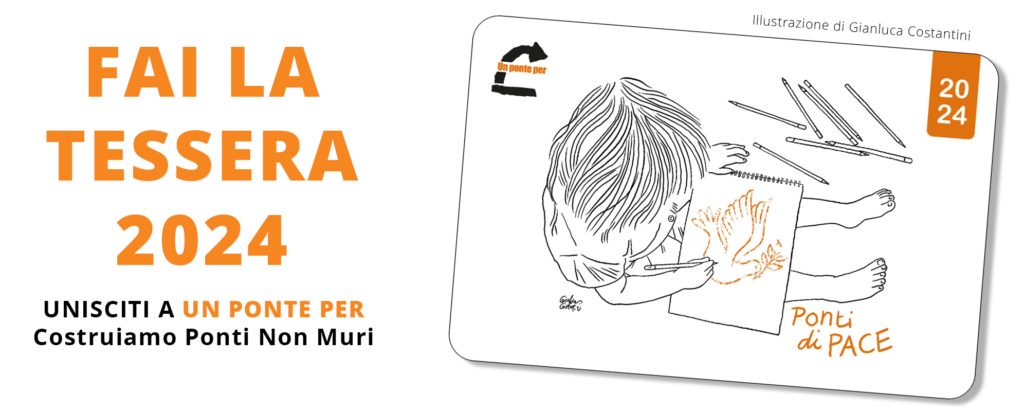
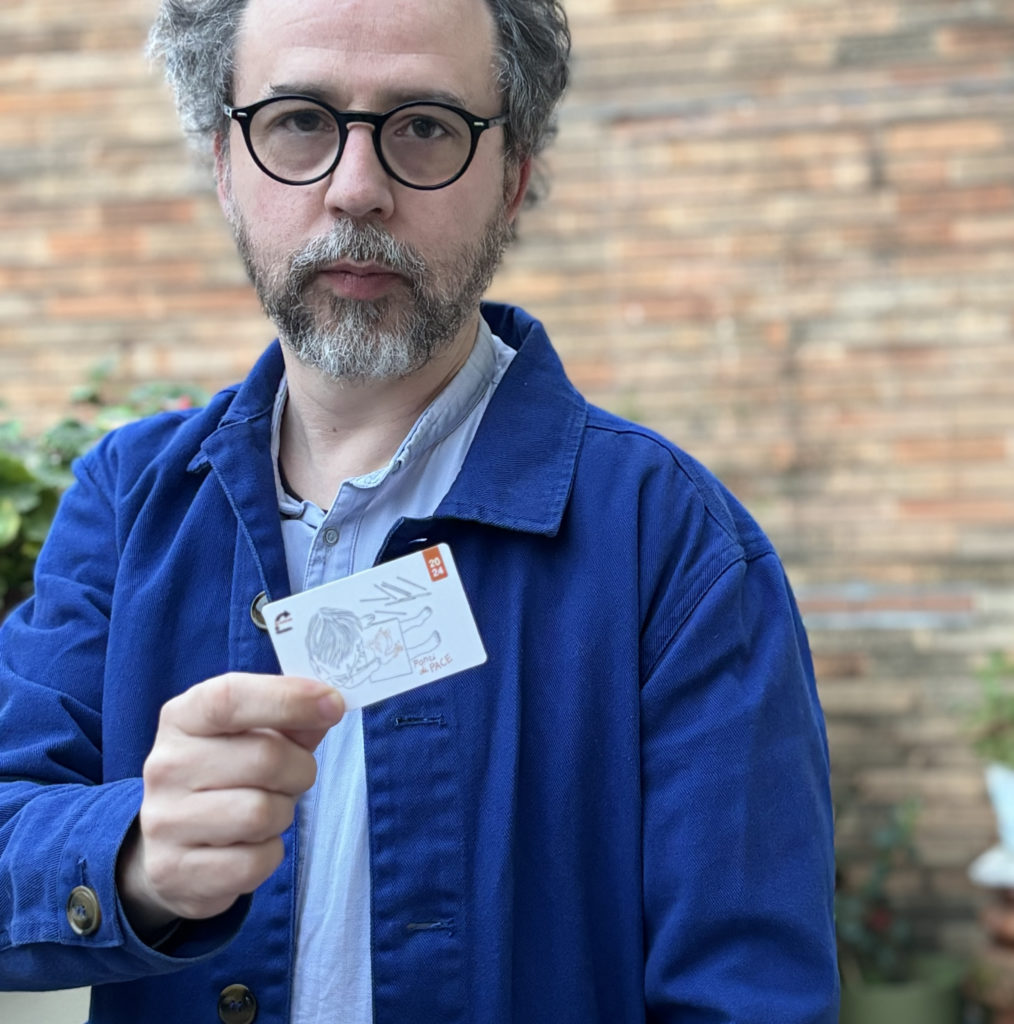
Long hair hides a little girl's face. The small pencil is clenched between her tiny fingers as she draws a dove. This is the subject chosen by Gianluca Costantini, artist and illustrator, for the new Un Ponte Per card he donated to us.
A dreamlike subject that portrays a peaceful future restored by the hands of the new generations. 'Maybe it's just a dream, as the world is heading towards a state of semi-permanent war, with a constant narrowing of human rights,' Gianluca tells us the morning we meet him. Genocide is taking place in Palestine and it is difficult to talk about anything else. "But let's start at the beginning. In 1993, Joe Sacco's graphic novel 'Palestine, an Occupied Nation' came out and immediately became a classic. It was a work that undoubtedly influenced Costantini's artistic career, which began that very year, at the end of the Academy. "I was inspired by the power of those things there, the big collective stories like the Palestinian one. I loved Joe Sacco very much. I even organised an exhibition dedicated to him in our country'. Over the years, Gianluca chose to use his art to side with the last people and those fighting for human rights. He became what is known as an artist-activist, "a definition that suits me because, as Gramsci said, 'every manifestation of art is political' and I come from the art of collectives, from self-production for a militant public". Over time, Gianluca moves from large community narratives to personal stories, which become emblematic of larger causes. The graphic stroke becomes essential, the texts reduced to short evocative captions, and the power of the message certainly gains. His works make viral the faces of activism that resists regimes and the deprivation of rights and freedoms. He draws, among others, Giulio Regeni, Patrick Zaki, Julian Assange, becoming very popular on social media and often ending up in the eye of the storm. He will be accused of anti-Semitism by the American right for a cartoon on Netanyahu and of terrorism by the Turkish government.
Gianluca Costantini holding the new Un Ponte Per card
'Obviously I regret not being able to travel to some countries any more,' he says, 'but I guess that's part of the game somehow. The accusations of anti-Semitism hurt the most: they are one of the worst things for human rights activists. However, I believe that in a world ruled by a committee of businessmen and warmongers, art has a duty to try to break through the hypocrisy of the powerful,' he explains. Thus, Gramsci's curls and glasses become the distinctive features of the face of Zaki, an Egyptian activist symbol of resistance to repression, who was only freed at the end of a major global campaign. "I am happy that Patrick is OK. My work ended the day he was freed and he was able to return to Italy. Unfortunately, I don't think a similar fate will befall Assange". Assange, Wikileaks and the western wars on Iraq, one of the reasons why Gianluca is siding with Un Ponte Per: "I knew your 30 years of work in Iraq, alongside its people who have paid a heavy price for the madness of war. It is incredible that those who committed these atrocities never ended up on trial, while those like Assange who revealed their crimes are imprisoned and considered a public enemy,' he adds. Turning his thoughts back to Gaza, today Gianluca is dedicating a series of portraits to Palestinian journalists killed after 7 October (at the time of the interview there were about 80, ed.). "A disaster for the truth. They were brave people, direct witnesses, brutally silenced so that they would not tell what they had seen. They will not be able to contribute to building a shared truth. A truth that will be missing in Gaza," he concludes.
Creating a safe place to meet and discuss, to learn more about one's rights, to discuss. It is with this aim that we have imagined our 'Conversation Clubs', which we have recently activated in Jordan as part of our 'Masahat Amina' (Safe Spaces) project, dedicated to vulnerable women and girls. Funded by the Italian Agency for Development Cooperation (AICS), the work we carry out targets particularly vulnerable people between the refugee community in the country and the host community.
In the country, we at Un Ponte Per have been working for many years. We have always focused on supporting the Syrian refugee community, but also the host community, in an attempt to create harmony and social cohesion, targeting in particular women, girls and people with disabilities.
The aim of our work in the country has always been to encourage the social inclusion and participation of the most vulnerable people: over the years, we have achieved wonderful results, such as the opening of an Italian pizzeria run by refugees, or a café run by people with disabilities. Our aim has always been to fight the stigmatisation of people with disabilities, and in particular of women, to support them on their path to self-determination and independence.
With the same objective in mind, we imagined the 'Conversation Clubs': spaces dedicated to them for a serene, safe, protected confrontation.
Last February, Huda Nijem, a psychologist and our long-time collaborator, together with the local organisations we have been working with for many years, started to organise 'Conversation Clubs' for 160 women and girls with disabilities from different areas of Jordan: Amman, Russeyfah, Dhleyl and Irbid. Each week, for a total of 8 meetings in each area, the Clubs offer women and girls with different types of disabilities the opportunity to learn about their rights and discuss protection-related topics, such as stigma, discrimination, violence and mental health, in a safe and prejudice-free space.
Together with them, the people who care for these women and girls also participate, thus helping to create a network that feeds on shared experiences and stories.
The clubs create a network of solidarity for the participants who can confront their opinions, discuss their feelings and share their personal experiences, thus building a protected environment.So far, the meetings have been a success: the participants have enjoyed sharing activities and have shown a greater awareness of their rights and their role in society.
Thirteen years have passed since the beginning of the Syrian crisis. What has long been considered the region's main humanitarian emergency is now seeing a crisis in funding and international support from humanitarian actors, who remain on the ground amidst many difficulties in addressing the needs of a population that remains in need of support, healthcare, and development.
This is also the case in the north-east area of Syria, where Un Ponte Per has been working tirelessly since 2015, thanks to the support of international donors such as the European Civil Protection and Humanitarian Aid Operations (ECHO), and thanks to the work of its local partners, including the Kurdish Red Crescent (KRC). Here, there are still numerous camps housing people who have been displaced since the beginning of the fighting in the country, and due to repeated offensives launched by Turkey over the years. Often established as informal settlements in remote areas of the country, difficult to reach and far from the main cities, over time they have become camps that are now supported by non-governmental organisations to ensure access to health, education and protection for the displaced population.
These include the Abo Khashab camp, established in 2017 in the Deir Ez-Zor area, which now houses more than 10,000 people who have fled both the Syrian conflict and Turkish incursions into the area. Established as an informal settlement, it was soon joined by humanitarian actors, including Un Ponte Per, in an attempt to build a system of basic humanitarian support and assistance. Here, the majority of the people sheltered are women, and 70% are minors.
Thanks to ECHO's support, Un Ponte Per and KRC were able to build a stable clinic in the camp, which is now able to handle emergencies 7 days a week, 24 hours a day, and is equipped with an ambulance system capable of reaching the nearest hospitals. Equipped with all the necessary equipment, and stocked with medicines that are distributed free of charge, the clinic provides care for chronic diseases and internal medicine services, but has also focused on women and children: gynaecology and paediatrics services (including child malnutrition screening) are provided free of charge, and emergency cases such as recurring outbreaks of leishmaniasis are handled.
"In these years of work in Abo Khashab camp, we have met so many stories and so many people," says Maria Toran Carpio, Project Manager of the project "Life-saving and life-sustaining health assistance to the war-affected population in NES", supported by ECHO and now in its seventh year. "Like Yazi, a very courageous displaced woman who has been a great inspiration to us all.A year ago, she faced serious health problems," says Maria. "Although her condition was really very complex, the KRC team managed to support her in an extraordinary way. Recognising the seriousness of the situation early on, the team managed to direct her to the most appropriate specialist medical facility, where she was accompanied towards recovery.Today, her condition has improved a lot, she continues to refer to our clinic and staff in the camp where she is monitored weekly," he explains.
A happy ending is also what we managed to secure for Yassin, a 10-year-old girl who suffered very severe burns on 75 per cent of her body from an accident. In this case too, it was the KRC team, together with Un Ponte Per, that tried to find the best solution to ensure she received the specialist care she needed. "Yassin underwent several surgeries," Toran Carpio recalls, "and the dedication of the medical team in Abo Khashab, in cooperation with the local hospitals, was unparalleled. A month ago, she was finally able to return to school, resuming her path of study and growth.Her story reminds us how crucial it is to continue to stand by the Syrian people and not forget them'.
******
Music video by Bensound.com/royalty-free-music
License code: LEGVDR3JB5M8HQOF
Photo credits: Pierluigi Giorgi; www.facebook.com/wchan.org
Who we are
Menu
close
What we do
Menu
close
Join
Menu
close
Support us
Menu
close
News
Menu
close
Subscribe
Join our newsletter to stay up to date on our projects.
To provide the best experiences, we use technologies like cookies to store and/or access device information. Consenting to these technologies will allow us to process data such as browsing behavior or unique IDs on this site. Not consenting or withdrawing consent, may adversely affect certain features and functions.
Functional
Always active
The technical storage or access is strictly necessary for the legitimate purpose of enabling the use of a specific service explicitly requested by the subscriber or user, or for the sole purpose of carrying out the transmission of a communication over an electronic communications network.
Preferences
The technical storage or access is necessary for the legitimate purpose of storing preferences that are not requested by the subscriber or user.
Statistics
The technical storage or access that is used exclusively for statistical purposes.The technical storage or access that is used exclusively for anonymous statistical purposes. Without a subpoena, voluntary compliance on the part of your Internet Service Provider, or additional records from a third party, information stored or retrieved for this purpose alone cannot usually be used to identify you.
Marketing
The technical storage or access is required to create user profiles to send advertising, or to track the user on a website or across several websites for similar marketing purposes.