We wanted to share iftar together on the first day of Ramadan, but she refused completely, all because of that black mask on her face. It wasn’t illness that made her refuse, but something deeper than exhaustion, harsher than hunger.
The story begins with Hamdi’s family, which consisted of nine people including him. Before the war, he was a successful trader in the markets. Money was never a worry — he owned property and several businesses that allowed him and his family to live comfortably.
But when the genocide began, day by day, life started changing for Hamdi and his family. Things that were once easy to get became almost impossible. On the first day of May 2024, Hamdi received news that his property and everything he owned had been destroyed by occupation missiles. He couldn’t bear it, and in that moment, his heart stopped, leaving behind a whole family struggling to provide the basics of life on their own. They lived in southern Gaza, in Rafah.
A week later, news came of the invasion of Rafah. More than a million people, including the displaced from Rafah, were forced to flee into the unknown. I was Hamdi’s neighbor. That day, during the displacement, Um Youssef — Hamdi’s wife — didn’t know how to leave the house or what to do. I managed to contact a transport vehicle to take her few belongings. She planned to go temporarily to her sister’s house in central Gaza.
After that day, I didn’t see Um Youssef and her family until November,2025 almost two years into the genocide, after the fragile ceasefire. My mother got a call saying that Um Youssef was looking for a place to set up her tent because she couldn’t find anywhere. We tried to find her a small space on our land, enough for her, her two young children, and her daughters.
A few hours later, Um Youssef and her family arrived. I could barely recognize them except through one of her daughters, who was my age and whom I knew from before. Their faces had changed so much. They came with a small cart carrying their belongings, including a little child who seemed older than his years, having seen too much in life. Youssef, who was nine, tried to carry and unload the items by himself.
Um Youssef wore a mask, at first, I thought it was because of the flu or something like that.
I helped them arrange their belongings, set up the only tent they had, built a temporary bathroom, and organized everything. It was mid-winter, and every day a new storm arrived. The storm wasn’t just weather; it was another test of whether the fragile tent could withstand a world collapsing over it.
Through all this, I watched little Nour Al-Din, her shy child who kept looking away from me. When he laughed for the first time, his innocent smile, when I played with him, I would say, “Kiss me, and I’ll buy you a biscuit?” And that was the end of that day.
A week later, I was sitting with my mother and asked her about Um Youssef. Why, in the cold winter, did she live in a tent? She told me, tears welling in her eyes, that Um Youssef had been living in a tent for over a year, after the area where her sister lived in central Gaza was threatened. She found a place in a shelter center.
Then she moved to southern Gaza called Asdaa to set her tent. She lived there alone with her family in a displacement camp. Her sister’s house had been partially destroyed, making it impossible for her to return, experiencing multiple displacements herself and with her family.
My mother told me that in mid-2025, the Israeli occupation suddenly entered the area where they lived, forcing most families to leave without any belongings. When Um Youssef returned, many of her few possessions had been destroyed. She endured some of the hardest days of hunger, sometimes surviving on just one meal every two days.
During that period, aid entered sporadically and didn’t reach everyone. Prices in small markets doubled every week. A bag of flour became a dream, and a can of sardines had to be divided among several children. The question was no longer, “What will we eat?” but, “Will we eat today?”
I couldn’t stop thinking about this. Even in my own family, with my father and my brother Mohammad, we barely managed to get by. How did others manage? How did they cope with the struggle for the simplest foods, the basics of life, sometimes almost impossible to obtain?
I remembered seeing little Youssef on the first day he arrived. His sharp expression made sense, he carried worries beyond his age, having seen so much despite being only ten. And the mask Um Youssef always wore, what was its story? Why did she wear it all the time?
I asked because in December and January 2026, I went to check on them during harsh winds and heavy reins. I tried to help them tie down anything the wind tore or dig channels in the sand so water wouldn’t flood their tent. Even in those conditions, she kept her mask on.
My mother told me the reason. Before the war, when life was good, Um Youssef jokingly told my mother she wanted a gold tooth. Today, she wears the mask because of her circumstances — she has been robbed of the ability to smile, even at a young age.
I didn’t understand at first. I asked my mother what she meant. She explained: due to hunger, stress, headaches, and the pressures of life, she lost many essential vitamins, and her upper teeth fell out. She tried visiting several dentists to fix them, but the cost — about $4,000 — was impossible. She had to accept reality and wear the mask indefinitely.
The mask didn’t just cover her mouth.
It hid the effects of hunger on her body and her embarrassment in a world that didn’t even leave her the right to smile.
I couldn’t stand that moment. I remembered Hamdi Abu Youssef, always praised for his generosity. I once asked him for a ring as a child, and he brought it the next day. Now, I write for more than ten international platforms, translated into seven languages, and yet I couldn’t help her. I felt helpless, frustrated, and heartbroken. I went to the sea for fresh air, but even that day, the breeze that usually calmed me had no effect.
Ramadan began on February 18. A day before, I wanted to bring them some joy. I tried inviting them to share iftar with us. They refused at first, saying she was sick. In truth, she couldn’t remove her mask to eat in front of anyone.
In Ramadan, families gather around food. She feared the eyes watching her instead.
I saved some money from my writing to provide them with Ramadan necessities, to share small moments of happiness and let them know we were thinking of them. This Ramadan, though lacking its usual signs and traditions, we try to make it through, carrying memories with us every day.
When I look at Um Youssef, I don’t see her alone. I see all of Gaza, trying to hide its cracks beneath a thin layer of patience.
Her story is not unique. There are 57, 000 stories like hers, reflecting the harsh reality of life in Gaza today, under a fragile ceasefire and empty peace slogans that mean nothing.

Hassan Herzallah - Correspondent from Gaza
In a global context marked by conflicts, polarisations and crises, supporting culture means firmly believing in the ability of societies to imagine alternative futures. This is why we at Un Ponte Per have always flanked humanitarian and emergency interventions in the countries where we operate with the protection of local cultural heritage, developing an integrated approach that links peace, human rights, social justice and culture as an essential dimension of human development.
Within this framework, culture is not conceived as an ancillary or purely symbolic domain, but as a social and political infrastructure.
For us, heritage protection, cultural production and the right to self-representation are fundamental tools of community resistance, reconstruction of the social fabric and conflict prevention.
In doing so, we are also attempting to deconstruct Western hegemonic narratives and to return power and expertise to the local communities we have been walking alongside for years.
We have been doing this for decades in Iraq, working on the reconstruction and restoration of the immense book heritage of the National Library in Baghdad, which was destroyed during the war, with the programme 'Knowledge that Resists'. Or by supporting lə young activists in projects to protect and build sustainable tourism routes around places of fundamental importance, such as the Mesopotamian Marshes or the archaeological site of Ur, both of which are UNESCO World Heritage Sites.
Today, we continue to do so in Jordan, through the promotion of cultural, responsible and sustainable tourism in decentralised areas that are rich in history and community heritage.
This is the case with the archaeological area of Jerash, a site of enormous cultural importance but which pays the price for its decentralised geographical location.
Today, the local community benefits only marginally from the positive impact that sustainable and responsible tourism could have in Jerash. In fact, tourists visit the site briefly, then move on to other much better known destinations in the country, without getting to know or stay in the urban area and building very limited interactions with its rich and vibrant local community.
This is why, thanks to the valuable support of the Italian Agency for Development Cooperation (AICS) and together with ARCS, the project leader, we designed and launched 'Sustainable Jerash', a two-year intervention that aims to protect and enhance the city's cultural heritage, to promote inclusive and sustainable local development, creating economic opportunities for the community.
In particular, we will work on the restoration of the Eastern Roman Baths, located in the modern city of Jerash, to enhance them as a connecting point between the urban and archaeological areas.
In doing so, the thermal baths will not only be studied for the first time, but will finally be opened to the public and made accessible, thus encouraging a circular economy and enhancing their heritage.
To do this, we will work together with the Municipality of Jerash, the Ministry of Tourism, and the Department of Antiquities, which will take over the direct management of the site upon completion. But also with organisations such as Monumenta Orientalia and the University of Roma Tre, with whom we will also restore the precious mosaic inside.
For us, as always, the aim is also to make the entire local tourist area more accessible, through the involvement of people with disabilities and local organisations we have been working with for years.
Over the next few months we will be spending time with the Jerash community - citizens, traders, local craftsmen - to gather their impressions of the work we are doing. Follow us for new updates.
For eighteen hours, I stayed outside the tent. Rain fell on my friends and me during the night, and during the day we stood under the sun. All of this just to activate a bank account that, two years ago, I could have opened in less than thirty minutes.
In Gaza, accessing money has become a journey in itself. Every number on the screen tells a story of endurance and struggle, and every step toward reaching it teaches you what life means under the hardest conditions.
It all began when I heard that banks in central Gaza City had started allowing people to access their accounts again after being closed for more than two years.
I decided I had to go, no matter what, because we no longer know what tomorrow might bring. Three friends agreed to come with me. We arrived at 10 p.m., thinking we would be among the first. Instead, dozens of people were already there. My number was 50. Some people were sleeping at the bank’s entrance.
We waited in the street. One of my friends said, “Maybe we should come back tomorrow. This is too exhausting.” But I had made up my mind not to leave without activating my account. We all held our IDs in our hands, looking for anything we could lean on. There were no seats, no shade from the sun, and no clear system to know when our turn would come.
In the first hours, we talked to pass the time. Around 2 a.m., the cold became unbearable. Each of us tried to find a corner to shield ourselves from the wind. Our bones ached from the cold. At sunrise, the street grew even more crowded. Some people slept directly on the ground, covered with thin blanckets or pieces of cloth. Others searched for a small space to sit, resting slightly on the sidewalk. Conversations were quiet, mixed with the sound of cars arriving from time to time. Every minute felt heavy. Every hour increased our exhaustion. But we had no choice except to wait.
As time passed, I felt the weight of waiting on my body and spirit. My hands stiffened from holding my ID and water bottle. My feet swelled from standing so long. My eyes stayed fixed on the closed door that felt like a gate to another world.
Ahmad, one of my friends, whispered, “Do you think we’ll be able to activate our accounts?”
“I don’t know,” I replied, “but I’m not leaving without mine.”
As morning approached, my anxiety grew. Would I get my turn before the bank’s working hours ended? Would number 50 still count? Moments like these reveal a part of daily life in Gaza, where something as simple as accessing a bank account requires enormous effort.
At 8 a.m., the bank gates opened. By then, more than 200 people stood behind me. Two hours after the bank opened, I finally stood at the door, waiting for someone inside to come out so I could go in. It felt like a small victory, and a clear sign of the crisis we live in.
Inside, activating my account took less than 29 minutes. But that did not make the situation any less severe. For years, banks have not regularly paid out salaries or transfers. Accessing cash has become a daily struggle, even for those with bank accounts.
The money exists on the screen. The numbers are clear. But turning those numbers into physical cash is a daily battle.
For the past two years, and even now after the ceasefire on paper, many people have been forced to rely on liquidity seller. They sit in small places or narrow corners with their phones, offering one service: turning your bank balance into cash for a high commission. Sometimes this commission reached 40% or more. People lost a large portion of their own money just to access what was rightfully theirs, while prices of goods continued to rise dramatically.
The challenge did not stop there. Small change and worn-out banknotes had become another daily problem. Coins were nearly nonexistent. I had a nearly worn bill, so I took it to a place we call the "Money Clinic" to get it fixed. Later, I tried to buy bread with it. The seller looked at the bill carefully, and in the end, he refused to take it, and I walked away hungry, unable to buy bread. In moments like these, money itself feels unstable.

As a result, the salary or balance shown in the banking app becomes more of an idea than a reliable amount you can plan your month around. The number shrinks at every stage: during transfer, during withdrawal, and during purchase because of high prices and shortages. What reaches your hand is not what you actually earned. Turning digital money into tangible goods becomes an exhausting, mentally draining process.
What makes this even more complex is that this daily financial crisis is not just about numbers. It creates constant social and psychological pressure. Thinking about money is no longer about saving or planning for the future, but about how to access it quickly to cover basic needs: bread, water, charging electricity, and perhaps a little gas for cooking.
And here lies the strangest contradiction of all: our dependence on an advanced digital financial system while living an extremely primitive life in tents.
Money arrives through phone apps. Transfers happen in seconds. Balances update instantly. The process feels as if we are living in a smart, modern city with advanced infrastructure. But the physical reality around us is far from that.
We live in tents without stable electricity, without running water, and without many daily necessities. No refrigerators to preserve food. No stoves that work consistently. No reliable lighting. Yet there is a digital wallet on the phone, a banking app, and constant transfer notifications. Financial technology arrived long before many of the basic elements humans need to survive.
When I received my first payment for an article I wrote, I felt relief for a moment. The number on the screen gave me a sense of financial security. But I quickly realized that this number meant nothing if I could not turn it into bread, water, electricity, or gas.
First, I had to find a broker who would accept the transfer. Then accept the commission deducted from the money. Then find a shop that would sell what I needed and accept the worn-out cash. All of these steps just to secure basic necessities.
At the end of the day, survival in Gaza does not depend only on how much money you have, but on your ability to access it and use it under harsh conditions. Digital money exists, but physical life is extremely fragile. Modern technology advances quickly, while the basic elements of survival are completely absent.
This contradiction between the digital and the primitive, between money on a screen and fragile life in tents, summarizes the experience of living in Gaza today.
It is a difficult experience filled with challenges, but it also reveals the resilience and daily creativity people rely on to survive despite everything.
Hassan Herzallah - Correspondent from Gaza
In the emergency department of the National Hospital in Hassakeh, Syria, generators hum, medical teams are at work, ambulances arrive non-stop. For hundreds of thousands of people, this public hospital is the only point of reference for specialised care and life-saving interventions. It is here that Un Ponte Per, together with local partners, has built a bridge between those most in need and a health system brought to its knees by years of crisis and sudden cuts in humanitarian funding.
By mid-2025, the situation in north-east Syria was dramatic: 68 health facilities were at risk of closure and only 1 out of 16 public hospitals remained fully operational. The consequences fell mainly on pregnant women, children and people with chronic illnesses, who were suddenly forced to forego essential examinations, medicines and operations. In the camps for displaced people, overcrowding and precarious water and sanitation infrastructure have multiplied the risks of epidemics.
The suspension of international humanitarian support to the National Hospital in Hassakeh, due to cuts imposed on USAID, had left over 333,000 people without access to public, free and specialist care.

'BRIDGE': AN ALLIANCE TO KEEP THE HEALTH SYSTEM ALIVE
Thanks to the solidarity of donors, we were able to supply the hospital with drugs, equipment and basic medical supplies, but the demands were growing daily. With the 'BRIDGE' programme, carried out together with ACTED and thanks to the invaluable support of the Syrian Humanitarian Fund (SHF), we were able to respond promptly to this emergency.
In 6 months of intervention, between Hassakeh, Deir-ez-Zor and Raqqa, we provided free integrated healthcare to over 137,000 people, supporting 7 facilities:
We have provided drugs and medical devices, trained health personnel, strengthened maternal and child care and emergency services, and enhanced pathways for taking charge of and transferring patients to specialist care when necessary.

We have done this by strengthening local public structures: because the self-determination of a community also passes through the right to a free public health system.
THE HASSAKEH NATIONAL HOSPITAL AT THE CENTRE: THE 'BRIDGE' THAT CANNOT BE BROKEN
At Hassakeh Hospital, we were able to break down the economic barriers that prevented the most vulnerable people from accessing diagnostic tests, surgery and treatment. When a service was not available in-house, we provided transfers and reimbursements to external referral facilities.
To do this, we created the Health Equity Fund (HEF): a health equity fund that covers, on a case-by-case basis, the primary and life-saving care costs of displaced persons and refugees. The fund enables displaced persons to access specialist care that would otherwise be out of their reach. Most of them, in fact, are unable to afford even the capped fees of the public health system, let alone the much higher costs of private facilities.

"I cannot thank you enough for all the efforts you made to save my life. The cost of the surgery would have been impossiblefor me and my family tobear," said Amira, a 40-year-old woman who arrived at Hassake Hospital with angina and was promptly identified by health workers at our clinic in Washokani camp. Urgently stabilised, she underwent surgery and was able to return to her family.
But 'BRIDGE' was also able to provide long-term, non-emergency care, as in the case of Saleh, a 35-year-old man suffering from chronic pain due to hip joint problems.
"I was not able to bear the costs of the procedure nor the transport costs from the camp to the hospital. This operation gave me a new life, without pain," he told us after the surgery he was able to access thanks to the orthopaedic team at the Hassakeh National Hospital.

CONTINUE, TOGETHER
These months of work in Syria have allowed us to continue a long journey, undertaken alongside local communities more than 15 years ago, with the aim of supporting them in their efforts to build a quality, public and accessible health system, in defiance of the ongoing crises in the country.
As Dr Salar, medical coordinator of the Hassakeh National Hospital, recalled, "this intervention was instrumental in saving lives. We are proud of what we have built together, and I want to express my deep gratitude to the entire UPP team. Our hospital has become a landmark, strengthening the entire community.The legacy of what we have done will continue for a long time, and we hope to continue this journey together".
Leonardo spa ends up in the crosshairs of legal action: Italian and international laws on arms exports would render contracts with Israel null and void.
A group of important Italian associations joined with a Palestinian citizen to ask the Civil Court of Rome to declare null and void the contracts signed by Leonardo spa and its subsidiaries with the State of Israel for the sale and supply of arms. This initiative should be seen in the context of what has been going on for over two years in the Gaza Strip. And which many authoritative voices, including the UN Independent International Commission of Inquiry on the Occupied Palestinian Territories, claim is a genocide.
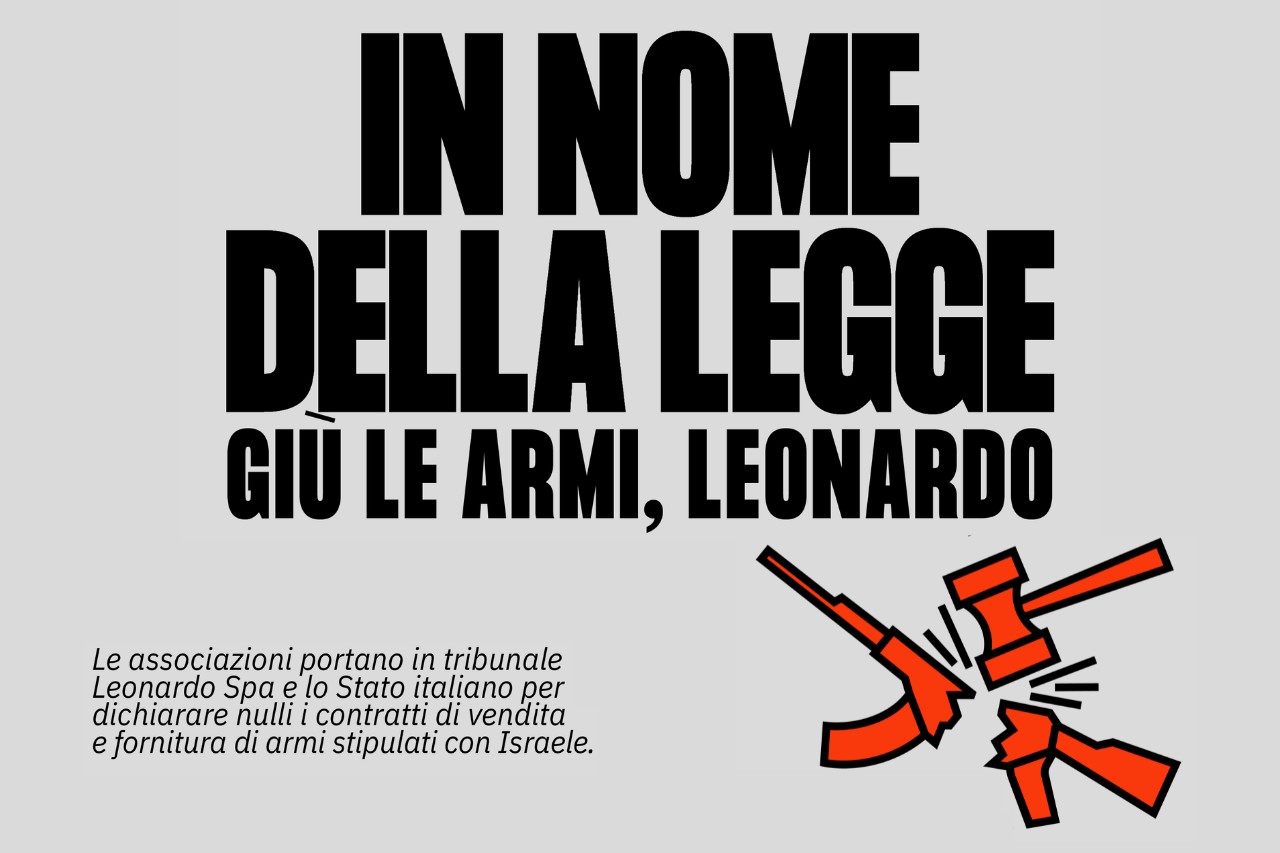
"IN THE NAME OF THE LAW LAY DOWN YOUR ARMS, LEONARDO"
'In the name of the law, lay down your arms, Leonardo' is the name given to the lawsuit filed in the Civil Court of Rome. A number of NGOs joined the complaint by Hala Abulebdeh, a Gazawi pharmacist whose entire family was exterminated by Israel: Assopace Palestina, A Buon Diritto, ATTAC Italia, ARCI, ACLI, Pax Christi, Un Ponte Per. The legal action also involves the Italian State, which with the Ministry of Economy and Finance is Leonardo's majority shareholder.
This is the second legal initiative in a short time targeting Leonardo in connection with what is happening in Gaza. In October, in fact, Leonardo's CEO Roberto Cingolani had been reported to the International Criminal Court, together with the heads of the Italian government, for 'alleged complicity in Israeli crimes'.
THE COMMITMENT OF A BRIDGE AGAINST WAR
Un Ponte Per (UPP) has been working for over 30 years in countries that are the scene of armed conflicts, such as Iraq and Syria. Or the Lebanon, 'where Israeli attacks have never stopped,' explains Giulia Torrini, president of UPP.
"We see the effects of war every day. To think that in some way Italy could favour the extermination of the civilian population does not sit well with us. Suing Leonardo is not an everyday occurrence for associations like us. But it seemed important to us to do so, especially in this historical period'.
The purpose of the legal action, Torrini emphasises, is not to attack Leonardo. But to ask for verification of whether the law is actually being applied. 'The questions we are asking are those that our members and the vast majority of Italian citizens are asking. If Italy repudiates war, as Article 11 of our Constitution states, why does it sell weapons to countries at war? Our aim is for the cause to be talked about as much as possible'.
Above all, Torrini is keen to distinguish the workers of Leonardo from the company.
"In Leonardo Square I have never seen it, the workers have. Like all the workers in the war industry, or the dockworkers forced to load weapons into ships, they are blameless because they are subject to labour blackmail and have no alternative'.
Representing the plaintiffs, together with his colleague Veronica Dini, is lawyer Luca Saltalamacchia, one of the lawyers who months ago sent a notice to the Italian government demanding the revocation of the Italy-Israel Memorandum on military matters. "The 2013 International Arms Trade Treaty signed by Italy, and Italian Law 185/1990, prohibit the export of arms to countries at war and countries that systematically violate human rights," Saltalamacchia explains.
"Italian law prohibits exports to countries whose policies conflict with the principles of Article 11 of the Constitution. International law prohibits the export of arms if at the time of authorisation it is known that the arms or goods may be used in the commission of genocide, crimes against humanity, serious violations of the Geneva Conventions of 1949. Attacks directed against targets or civilian subjects protected as such or other war crimes defined as such by international agreements to which the state is a party'.
The plaintiffs therefore turned to the court to ask whether the precise constraints of national and international laws were being respected. That is, whether it is legitimate for the Italian state to have allowed the export of arms to Israel, 'recognised for years as a state that systematically violates human rights and whose policy is certainly not in line with Article 11 of the Constitution. After 7 October 2023, with a genocide taking place, we wonder how it is possible that the State has not suspended the licences already granted and has not prevented Leonardo from selling arms, including through its subsidiaries or affiliates, to the State of Israel. Moreover, such a transfer is also contrary to Leonardo's Code of Ethics,' Saltalamacchia concludes.
THE NGOS AND LEONARDO WAITING FOR THE FIRST HEARING
In mid-May, Un Ponte Per was part of the solidarity caravan organised by AOI (Association of Italian NGOs), with numerous politicians in tow, which arrived at the Rafah crossing. But it was not allowed in. "We saw the trucks with aid stopped, the warehouses full of food and medicine. We heard the bombs falling only a kilometre away, killing people: it was terrible,' says Torrini.
The first hearing of the case is expected to take place early this year. "We will see what the judge decides and go from there," Torrini concludes. 'If he decides as we hope, it will become interesting. Italy and the world are moving towards rearmament and a passion for warfare, we are intransigent on this and we appeal to all Italian citizens and workers. We absolutely do not want public spending to go towards rearmament. Against war we are and always will be in the squares'.
Article originally published on Valori.it. Cover photo is by Massimo Lupo/UPP.
Our'Sahati' (My Health) intervention, financed by Otto per Mille funds from the Waldensian Church, was successfully concluded. It has been active since May 2025 in Jordan to improve the autonomy, mobility and social inclusion of adults and minors with disabilities in Syrian refugee and host communities in the governorates of Amman, Zarqa and Irbid.
Despite significant legal progress in Jordan for persons with disabilities, women, men, boys and girls continue to face obstacles in meeting their needs and exercising their rights due to both an underfunded public system and socio-cultural and economic barriers. The demand for health services has increased over the years for the Syrian refugee community, putting pressure on the national health system, and costs remain very high.
In this context, the provision of specialised services for people with disabilities therefore remains a major concern.
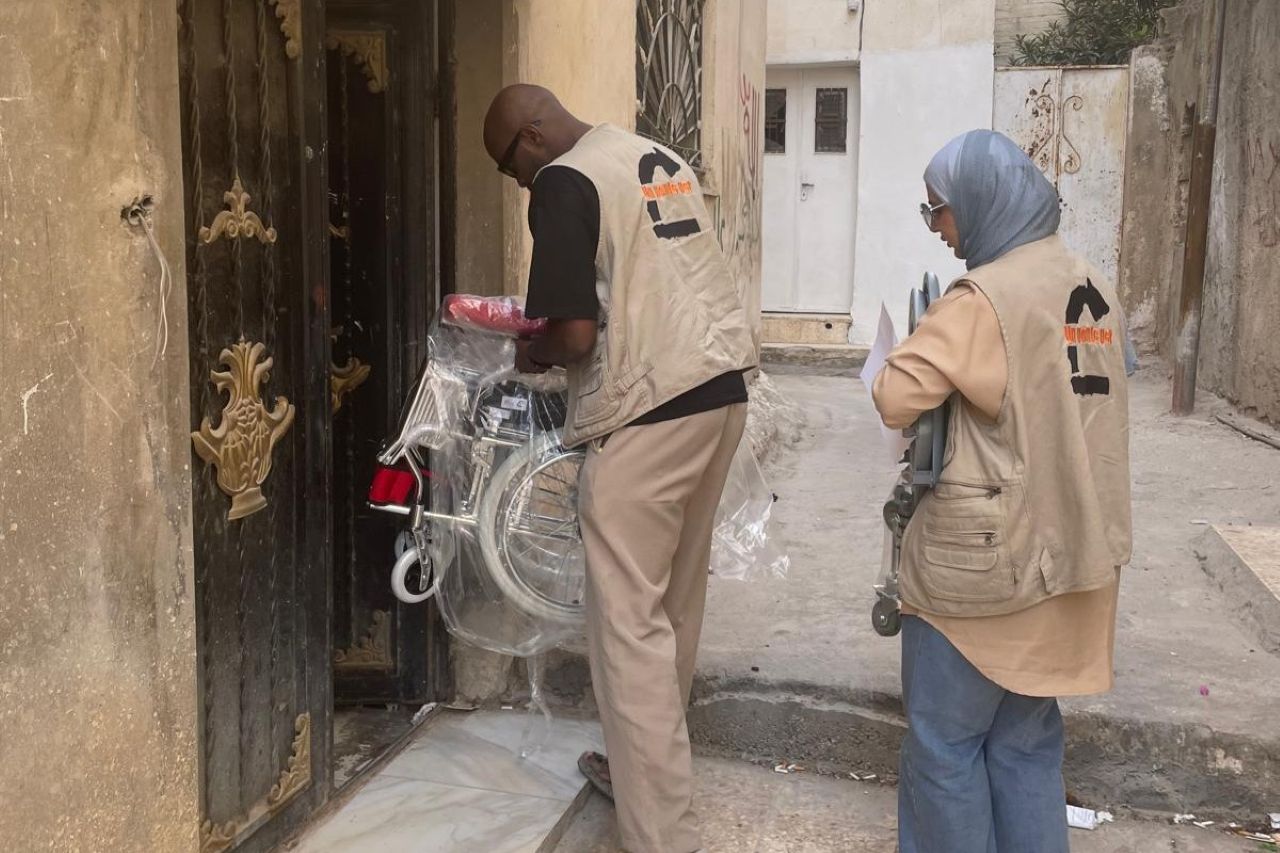
This is why we are particularly happy to have managed to reach 322 people in just a few months, exceeding by 120% the target that 'Sahati' initially set itself, thanks to home rehabilitation services, the provision of mobility aids and prostheses, and training sessions for people with disabilities and caregivers.
Un Ponte Per has been present in Jordan with projects aimed at people with disabilities for many years, and our activities include the deployment of a mobile unit composed of occupational therapists, physiotherapists and social workers, who again ensured regular interventions by reaching particularly vulnerable areas and maintaining continuity with the activities started in the previous project, "Masahat Aamina II".
In six months, 229 people - including a majority of women and girls - had access to specialised rehabilitation sessions (35 occupational therapy and 194 physiotherapy).

In coordination with the Ministry of Social Development, Un Ponte Per also updated and implemented the mobility aids distribution plan, delivering 114 devices to 100 people at the Zarqa rehabilitation centre. In parallel, the Mobile Unit conducted 229 training sessions on home rehabilitation exercises, use and maintenance of the aids, involving 159 people with disabilities and 70 caregivers, and was able to distribute another 208 mobility aids to a total of 112 people.
"Sahati" also enabled us to strengthen cooperation with national and international organisations through our participation in coordination groups for protection work in the country. Co-operation with the Ministry of Social Development enabled a targeted distribution of aids.

All our staff in Jordan have also received specific training on PSEAH(Protection from Sexual Exploitation, Abuse and Harassment) policies to prevent all forms of sexual harassment and abuse, confirming our organisation's commitment to protecting the people we work with.
By significantly exceeding the expected results, the 'Sahati' project confirms the importance of ensuring access to free, comprehensive and culturally sensitive rehabilitation services in improving the well-being, functional autonomy and social inclusion of persons with disabilities in refugee and host communities in Jordan.
Thanks to our long-standing collaboration with the Waldensian Church, and the support provided by Otto per Mille funds, it was possible for us to carry out this additional intervention, guaranteeing continuity in access to services for the communities we have been working with for years in the country.
Hassan Herzallah is a translator, writer and storyteller from Gaza. He collaborates with several international newspapers. For the "Water for Gaza" campaign, he chose to share with Un Ponte Per his direct testimonydocumenting his life under siege and displacement. She is in her third year of studies in English translation at the Islamic University of Gaza and continued her education online after the university was bombed.
Gaza, 21 January 2026
Only days had passed since we entered the new year.
I wasn’t counting the seconds, I didn’t check my phone, and I wasn’t expecting any greetings. I sat quietly, staring at the cup of tea I had prepared, no lights, no music, no familiar sounds around me.
Outside, the world was celebrating, but here, silence weighed heavier than ever.
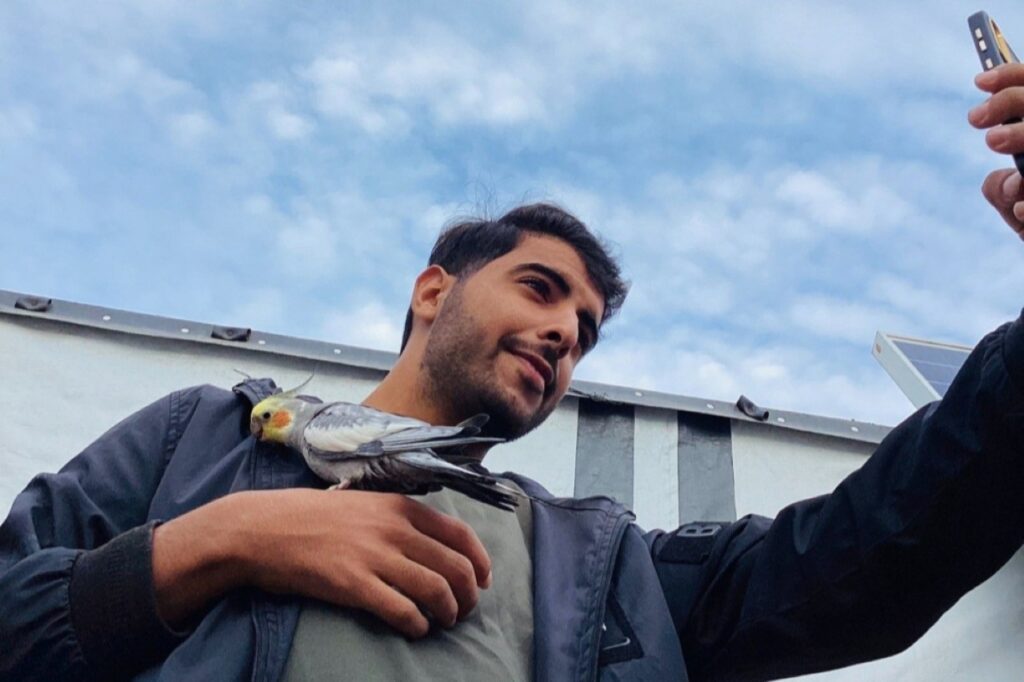
The first moments of 2026 arrived, and with them, danger returned to our camp. The distant rumble of explosions from areas where the army still stationed, and occasional flashes of fire in the night sky, reminded me that our lives are still measured by survival, not by seconds. I wasn’t completely alone that night; Simsim, my little bird, sat silently beside me, my only companion in days filled with loss.
The nights of January began with sleeplessness, each one haunted by the random gunfire we endure almost every night.
I remember one night this week around two in the morning, when a hail of random shots rained down on the camps from occupation tanks and naval patrols. In that moment, my siblings and I stayed flat on the floor of our tent, unable to move at all for fear of being hit. I could hear bullets whizzing over our fragile tent, which offered no protection, and I even heard the sound of cups breaking from the gunfire.
The next morning, when we woke up, we learned that there had been more than seventeen injuries that very night in our camp and the surrounding camps. All of this still creates a constant feeling of instability, a sense that accompanies us every day here, even after the ceasefire exists “on paper.” From here, the truce does not appear to stop the danger; instead, it takes the form of a daily threat that the world does not see.
Beyond the immediate danger, there is the silent genocide we endure during the winter months.
This is the second winter for my family and me, and we are living under a fabric tent. The rain began early this year, and the force of the wind tore through everything in its path. Just two days ago, the storms ripped part of the tent where my siblings and I sleep, forcing us to quickly move our belongings into my parents’ tent. Some of my personal items, like my laptop, which belongs to a friend, were damaged that day. Even those who live in houses have seen parts of their homes collapse under the force of this winter’s storms.
We began to witness homes collapsing on their resident almost every day, and some even dying as a result. While I was talking to my friend Mahmoud, he told me how the house next to theirs had suddenly collapsed, turning every new day into another challenge in a life that never stops testing us.
The cold this winter is not just a normal drop in temperature, it is a constant, looming fear.
Every day we hear about elderly people or young people dying from the cold. Since the beginning of the year, seven people have died from the cold, including one infant, the child of the barber I go to, which keeps me constantly worried for the children around me and my younger siblings.
In the middle of this month, my family lost someone very close to us, my father’s neighbor, Mohammed. He was a close friend of my father when we still lived in our homes in Rafah. Whenever he spoke to my father, he would say he would come visit us in Al-Mawasi, always adding, “We will meet soon, once we return to our areas.”
But we have not returned, and that visit never happened.
In the middle of this month, Mohammed and his daughter were martyred while walking in the street, victims of Israeli shelling. When my father received the news, he kept repeating one sentence:
“We didn’t lose Mohammed during two years of genocide, and yet we lost him in the midst of a fragile ceasefire, while the world believes we are living under a truce.”
That moment was enough for me to understand that the danger had never left us, and that death here does not require an open war; sometimes, simply stepping outside is enough.
With prices unstable in the markets due to the irregular opening of the crossings, life feels heavier with each passing day. I look at my family, especially my mother, whose health has deteriorated severely as a result of the war. At times, she cannot even walk due to the pain in her head that extends down her back. We are still waiting for the crossings to open, which were supposed to be accessible months ago, yet the occupation continues to violate the terms of the ceasefire. Each time we try to contact institutions in Italy and other countries to enable my mother to travel and receive proper treatment, we are met with the same harsh reality.
The medications available are insufficient for her condition, and the specialized drugs she needs are not accessible in Gaza, as the occupation continues to obstruct the entry of essential medicines.
Amid all this, we are not searching for a new beginning as much as I am yearning for an ordinary day: a day when we can sleep without fear, when my mother wakes up without pain, and when people can walk the streets without risk.
We did not celebrate this year, yet I hold on to a small, stubborn hope, that the coming year will be less harsh, and that it will return to us what has long been take away.
By now, only a few days into the new year, the same quiet that marked its beginning still lingered around me. Life continued with its daily threats and uncertainties, yet amid all this, my little bird, Simsim, looked at me silently. He made no sound, nor sang as he usually does, as if he sensed the weight of everything we are enduring. In that moment, the silence between us felt like a shared language, a small anchor of presence and comfort in a world where even ordinary days are fragile.
Hassan Herzallah - Correspondent from Gaza
Hassan Herzallah is a translator, writer and storyteller from Gaza. He collaborates with several international newspapers. For the "Water for Gaza" campaign, he chose to share with Un Ponte Per his direct testimonydocumenting his life under siege and displacement. She is in her third year of studies in English translation at the Islamic University of Gaza and continued her education online after the university was bombed.
Gaza, 30 December 2025
It was midnight, and it was raining heavily. Strong winds threatened to tear apart the tent that shelters my family and me. I was exhausted and unwell, feeling the weight of every step and a cold that seemed to sink into my hands and feet, as if winter had entered every part of me.
I tried to sleep, but who could sleep in a camp during such rain? Every drop made the situation feel heavier, as if we were trapped with nowhere to hide. I stepped outside and could only see people dreaming of rights that had become so hard to reach. At the same time, messages from my friends appeared on my phone, talking about the approaching end of the year and plans for the next one. I remembered myself here in Gaza, where even holding onto basic rights feels like chasing impossible dreams.
By morning, around ten o’clock, it felt more like five, as thick clouds blocked any sunlight. I was waiting for the day to begin so I could buy a plastic canopy for our tent, which had become weak and no longer protected us from the rain that had fallen in the past days. My whole family was still asleep. I wanted to make myself a cup of tea while waiting for my friend Hamouda, whose tent had completely flooded the night before, and who needed to buy some wood, plastic sheets, or even a new tent.
There was no news about the cooking gas cylinder we had filled at the end of October, which was supposed to be refilled monthly. So, we were forced to use the last of it for absolute necessities, relying entirely on fire. I tried to light a fire using any paper or wood I could find, but the intense cold and the wet wood made it almost impossible.
I heard Hamouda calling, so we decided to get something to drink on the way from any nearby supermarket—juice or anything else. I asked him if his phone had any charge so we could pay through the banking app, since I hadn’t been able to charge my phone the night before due to the lack of sunlight, and his phone was dead too. I had six dollars in cash, so I bought juice and a biscuit for two dollars, but the shopkeeper didn’t have change. We returned the items, still frustrated by dealing with worn-out money, even after the ceasefire had been declared.
We arrived at the place selling tents. My friend bought a small tent for $500, while I bought plastic canopy at $40. Since we needed two, we quickly headed back using the available transportation, especially the donkey cart in Khan Younis. On the way, the weather suddenly changed, and the sky became heavily overcast, while Hamouda’s belongings were left outside, and his family was waiting for him to set up the new tent and arrange the rest of their things.
We arrived at the camp, and I first went with him to help set up the tent, since he couldn’t do it alone. I stayed until we finished, then hurried back to our own tent to cover it with the canopy. As soon as I got inside, I asked my mother to check the weather forecast - during winter in Gaza, the first thing we do every day is follow the weather. She said, “A strong wind is coming this time, but the rain isn’t too heavy.” The morning passed, and I managed, with difficulty, to charge my phone just enough for studying or writing this diary.
By midnight, there was no sound from anyone, and no light in the camp except the faint glow of my phone. I began to hear the rain and very strong winds. After a few minutes, voices came from outside - from neighbors. When I stepped out into the rain, I saw that some tents had been torn apart by the force of the wind, and people didn’t know what to do. I felt a deep pain inside from everything we were going through in the camp. Minutes later, the plastic canopy I had bought to protect our tent were ripped away - the wind was stronger than anything I could do.
I couldn’t sleep all night, trying to hold onto the canopy and tie them to anything I could find, but the wind kept tearing them away every time. My body was completely exhausted, and I felt sick from repeatedly going out into the rain to protect my family’s tent.
When I finally had a moment, I checked my phone to see what was happening in the rest of the world.
I saw people celebrating their achievements as the year came to an end - greetings being exchanged, brightly lit streets, people gathered together, continuing their lives as if everything were normal. Here in Gaza, however, we recognize the end of the year only through winter, a season we cannot withstand no matter how much we try to prepare for it.
What hurts most again is that all our dreams for the new year here in Gaza are simply basic rights that already exist elsewhere.
Hassan Herzallah - Correspondent from Gaza
Un Ponte Per responds to the criminalisation of activism in Italy and around the world with two protection programmes for human rights defenders. Protecting democracy.
A worrying phenomenon is growing in Italy and Europe: the criminalisation of protests and dissent is eroding civic and democratic space. In recent years, new regulations have significantly restricted civil liberties and fundamental rights guaranteed by the Constitution. And these are not isolated incidents, but a structural process: from the Security Law, which affects all popular movements across the board through the introduction of new crimes and harsher punishments; to mass surveillance, such as the use of spyware installed on activists' phones that violates privacy, to gag lawsuits, which directly affect freedom of expression, and SLAPPs, intimidation lawsuits aimed at silencing activists, journalists and organisations. Finally, the recent 'anti-Semitic decree' which, if passed, risks becoming a further tool of repression, hitting those who demonstrate solidarity with the Palestinian population and fight against the ongoing genocide.

According to CIVICUS Monitor Watchlist (December 2025), Italy is among the countries where civic space is under serious threat (classification: "obstructed"). This is no longer just a perception: even non-violent protest actions are punished with disproportionate penalties. For a peaceful roadblock, for example, one can now risk up to two years in prison. The aim seems to be to limit political action from below, on the one hand by turning certain administrative offences into criminal offences, and on the other hand by abusing administrative measures, such as heavy fines, urban daspo, travel bans and participation bans, which do not require a trial but significantly affect freedom of movement and public participation. All this has a deterrent effect: many activists give up mobilising for fear of the legal consequences. Less protest, less dissent, less democracy. It is a process of authoritarian acceleration that threatens the very heart of European democratic life.
In this scenario, consistent with our commitment to the protection of human rights, we have chosen not to limit ourselves to political solidarity and denunciation, but to build concrete instruments of protection for those who defend human rights. "Shelter City Roma" and the "Protection Hub" embody our human, civil and social rights-based approach, putting justice, dignity and freedom at the centre of our work.
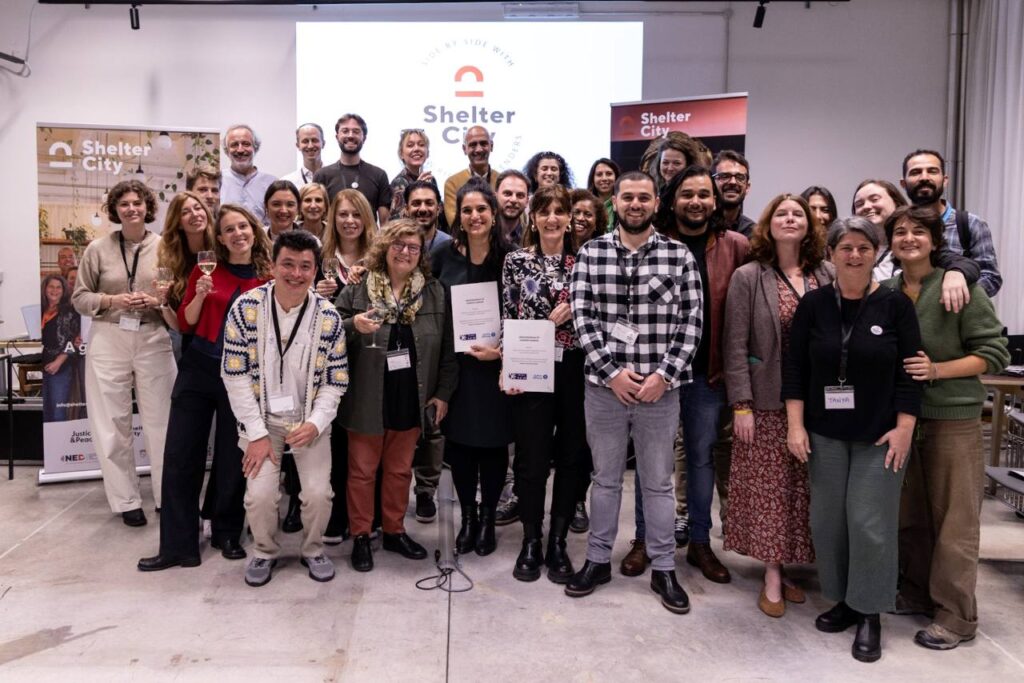
"SHELTER CITY: ROME BECOMES SHELTER CITY
The 'Shelter City' programme was born in the Netherlands in 2011, in response to the repression of human rights defenders outside Europe. In many regions of the world, defending fundamental rights is considered a crime: activists, journalists and members of civil society are exposed to threats, persecution, arbitrary arrests and systematic violence. 'Shelter City' offers them a period of protection and rest in cities perceived as safer. In just a few years, the programme has grown into an international network of 26 cities, spread across Europe, Latin America and Africa, with a simple but powerful idea: to make cities bastions of democracy, local spaces capable of guaranteeing global protection. In 2023, Rome officially joined the international network through the collaboration between Un Ponte Per and the In Difesa Di network, with the support of the 8th Municipality. Roma Capitale and Roma Città Metropolitana also signed a motion. Rome is officially a city of refuge, with the aim of developing a replicable model that can also become a reference point for other Italian cities.

The programme fully embodies our values of participatory democracy, decolonising international cooperation, and enhancing the aspirations of the activistə accoltə. It provides temporary shelter for human rights defenders at risk, offering a period of mental and physical rest from political activity. The first objective of the project is to guarantee protection, understood in a holistic sense, combining physical, medical, psychological, legal, social and digital support. Providing protection is not enough, but it is essential to avoid isolation and promote integration into daily life. Rome thus becomes part of a transnational network that builds social cohesion and defends democracy from below, fostering encounters between different cultures, languages, religions and traditions, in line with our vision of peaceful and equitable coexistence between peoples.
THE 'PROTECTION HUB': WHEN THE THREAT IS HERE
When 'Shelter City' was born, Europe and Italy were considered 'safe and democratic harbours'. Today the situation is different. What coherence would our commitment have if we only defended those who are at risk abroad without protecting those who are criminalised at home?
Out of this awareness came the 'Protecion Hub', a nationwide programme designed to support those who defend human rights in Italy and find themselves under attack. The Hub represents an evolution of our work: from an international cooperation organisation to a civic entity that protects those who defend rights in Italy as well. Createdas a reaction to the Security Decree, the Hub offers legal, psychological and digital protection to activists, organisations and movements under pressure, connecting existing networks without replacing them. The Hub is not a mere service provider, but a social laboratory to create exchange of expertise and experiment with new forms of concrete solidarity.
CONCRETE PROTECTION: THE CASE OF ROBERTO MALINI AND LISETTA SPERINDEI
An emblematic example of the Hub's intervention is the case of Roberto Malini and Lisetta Sperindei, activists affected by a EUR 2 million SLAPP (Strategic Lawsuit Against Public Participation) lawsuit brought by Fox Petroli, a world record for compensation demanded from individuals. SLAPP lawsuits exploit the disparity of resources between whistleblowers and large economic or political actors. It is the classic 'David versus Goliath' effect: for a company losing a case is irrelevant, but for activistsə or a small NGO it can mean years of stress, unsustainable legal costs and the end of a public engagement. The 'Protection Hub' intervened by offering legal support, but did not stop at the individual case: it initiated the creation of a dataset of repression cases followed, useful to monitor trends, document violations and produce reports for advocacy. The dataset is linked to a document database to share good legal practices, winning strategies and useful materials for advocacy.
TWO SIDES OF THE SAME FIGHT
"Shelter City" and "Protection Hub" are therefore not isolated initiatives, but parts of a common design embodying a strong principle: activists protecting activists . Building ever stronger links between local protection and transnational solidarity means concretely realising our mission: to prevent violent conflicts by building networks for social justice, fostering encounters between cultures and building cohesion. Because defending those who defend rights means, everywhere, defending democracy and promoting a vision of peaceful and equitable coexistence between peoples.

Lorenza Fiaschetti – Shelter City Rome Coordinator for Un Ponte Per
Hassan Herzallah is a translator, writer and storyteller from Gaza. He collaborates with several international newspapers. For the "Water for Gaza" campaign, he chose to share with Un Ponte Per his direct testimony, documenting his life under siege and displacement. He is in his third year of studies in English translation at the Islamic University of Gaza and continued his education online after the university was bombed.
Gaza, 24 November 2025
I was eager to dive into the sea with my fisherman friends, the same people I had come to know during the harshest days of famine. Suddenly, a large boat approached quickly, and before I could even comprehend what was happening, gunfire erupted. Israeli naval boats. Water surrounded me on all sides, and my heart pounded wildly, as if every second could be my last. I couldn’t move, and all I could think about was staying alive, trapped in the immediate danger of death or capture at any moment.
After the ceasefire was declared in Gaza on October 9, the genocide had officially stopped on paper, but the daily struggles continued, and securing even the most basic necessities of life remained an ongoing challenge.
It was six in the morning, and the weather was as unpredictable as ever these days.
I left our tent in the camp, heading out with my friend Abood to buy a bag of bread. My mother was ill, and I didn’t want to tire her out by having her knead the dough so early in the morning. I wanted to call Abood to let him know I was waiting, but his phone was dead, and there was no electricity at this early hour anyway. So, I went straight to his tent, and as soon as I called his name, he came out, smiling wearily:
“Is there any sleep left in this camp? I’ve been awake since dawn.”
We walked together to the place where bread was sold, and when we arrived, we were shocked to see a long line of people. Abood turned to me and said,
“The war is over… but when will these queues end?”
We waited until nine o’clock. When there were only about fifteen people left ahead of us, the baker called out,
“The bread is finished, everyone!”
It was a small morning defeat, but a bitter one. We returned to the tents empty-handed.
My little sister Malak and I kneaded the dough ourselves, and then I went to bake it. It was around half past ten, the usual time when water trucks pass by. I heard its horn in the distance, but I couldn’t go -the distance was too far while I was at the bakery. When I returned to the tent, I found that my brother Mohammad had already filled the water gallons.
After that long morning, I felt the need to catch my breath, so I went to the sea - the only place where I truly felt I could breathe. That moment on the shore reminded me of my relationship with the sea before the war, when I used to go there every Thursday with my friends, staying until sunset before returning to our warm homes. I never imagined that the place where I spent my happiest times would later become my last refuge.
After we were displaced from Rafah, we found ourselves living on the beach in a thin fabric tent, offering no protection from the cold or the wind. From that day on, our lives took on a new form unlike anything I had ever known. Even the simplest tasks became daily battles: charging our phones at crowded stations, running after water trucks every morning, and lighting firewood after the gas ran out - a task that could take an entire day just to prepare the simplest meal… if food was even available.
Amid all this weight, the sea remained the only place where I truly felt I could breathe. After every long day chasing the essentials for survival, I would carry a cup of hot mint tea - which took a full hour to prepare - and sit on the sand, watching the waves, as if stealing a small moment of respite from time itself.
By mid-July 2025, my relationship with the sea had completely changed. It was no longer just a temporary escape; it had become my only way to secure food for my starved family. I searched for flour in the markets, sometimes barely finding a single kilogram, and often returned empty-handed, risking my life to reach dangerous places.
I remember the day I went to the U.S. aid trap points, where I ate nothing but a small bowl of soup. The sun was harsh, bullets whizzed overhead, and I lost the ability to run until I lost my balance and everything went dark. When I opened my eyes, the people had returned from the distribution point, and my legs carried me alone toward the sea - the only refuge left for me to breathe.
From that day on, I began helping the fishermen every morning, taking a portion of what we caught for my family. I spent longer hours with them, risking the waters despite the merciless gunfire. One of them was a university student, his entire family in Egypt, dreaming of hugging his father after the ceasefire. The other two were waiting for the crossings to open to take their sick relatives for treatment. We were all there for the same reason: to keep our families alive.
As the days passed, news of the ceasefire on October 9 reached us. For me, it was not just a political announcement; it was a small window toward a postponed dream: continuing my studies in a proper environment. Even though I had studied online for a full year, my passion for the university life I had dreamed of since school remained alive.
Several weeks after the ceasefire was announced, I went to the sea to meet my fisherman friends after a period of separation due to the scarcity of food in the markets. I was eager to dive with them again for the first time since the ceasefire. Suddenly, a large boat approached, and before we could understand what was happening, gunfire erupted. They were Israeli naval boats.
At that moment, surrounded by water and with my heart racing, we realized the immediate danger. We all dived underwater, each of us on our own, trying to escape the bullets and gunfire. After long minutes swimming beneath the surface, we miraculously reached the shore safely, exhausted but alive. I felt then that our daily lives were no longer secure, and that even after the ceasefire, our existence remained fraught with danger.
Even after the ceasefire was declared in Gaza, daily suffering continues unabated. Securing the most basic necessities of life remains an ongoing struggle: there is no stable electricity, water is not consistently available, and our lives depend on queuing for even the simplest items. The crossings remain closed to students and patients, and as winter approaches, our tattered tents grow cold and damp. Life in Gaza continues to be a struggle, with daily survival - finding bread, water, and electricity - never guaranteed.
Amid all this, I’ve been accepted to universities in the UK and Finland, though travel and funding remain uncertain. I still hope to one day study at the University of Trento in Italy, holding onto the possibility that my education abroad can finally become a reality.
Hassan Herzallah - Correspondent from Gaza