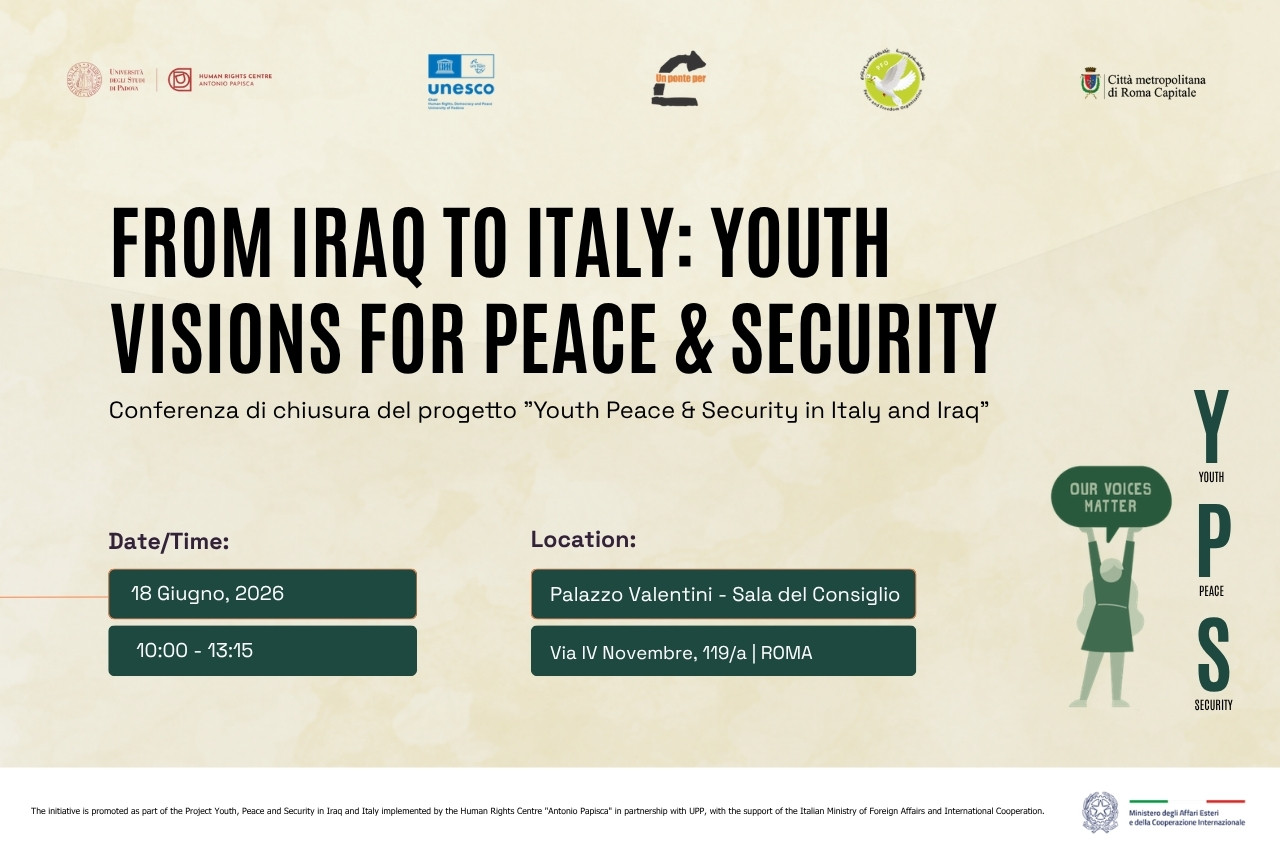
23.06.2026 | YPS and WPS agendas: synergies and perspectives (online)

Meeting with activists and institutions Thursday 17 October, h 16:30 at Villa Altieri - Viale Manzoni 47, Rome.
In 2023, worldwide, at least 300 Human Rights Defenders were killed for their activism.
Thousands have suffered arbitrary arrests, persecution, death threats and violence. Because in a world adrift, amidst wars, humanitarian and environmental disasters, there are still thousands of people who believe that another world is possible and fight every day for freedom, justice and peace, facing repression and violence.
Since 2016, Un Ponte Per, an NGO that has been active for over 30 years in the Middle East, and In Difesa Di, a network of Italian civil society organisations, have been working to promote the 'sanctuary city' model in Italy as well, with the aim of raising awareness among local administrations on the need to implement actions in defence of Human Rights Defenders.
In 2022 they intensified their joint efforts with the idea of promoting a similar model also in the capital: Rome as an open city for Human Right Defenders.
n outcome ofUn Ponte Per's experience supporting HRDs in the countries where it operates, andIn Difesa Di's commitment to promoting joint actions among Italian civil society organisations to supportHRDs.
A commitment that has achieved important milestones over the past year:
Thanks to "Shelter City Rome", Rome becomes a "shelter city", offering those who fight for human rights a protected space of rest and "respite" from their daily commitment. The city of Rome is the first Italian city to join the Shelter City network (21 cities and 400 defenders supported in 2022) founded by Justice & Peace Netherlands.
To find out more, we look forward to seeing you on Thursday 17 October, 16:30 at Villa Altieri - Viale Manzoni 47, Rome.
"Everyone has the right, individually and in association with others, to promote and fight for the protection and realisation of human rights and fundamental freedoms at the national and international level."
Art. 1 of the UN Declaration on Human Rights Defenders, adopted by the UN General Assembly Resolution 53/144, 8 March 1999.