We wanted to share iftar together on the first day of Ramadan, but she refused completely, all because of that black mask on her face. It wasn’t illness that made her refuse, but something deeper than exhaustion, harsher than hunger.
The story begins with Hamdi’s family, which consisted of nine people including him. Before the war, he was a successful trader in the markets. Money was never a worry — he owned property and several businesses that allowed him and his family to live comfortably.
But when the genocide began, day by day, life started changing for Hamdi and his family. Things that were once easy to get became almost impossible. On the first day of May 2024, Hamdi received news that his property and everything he owned had been destroyed by occupation missiles. He couldn’t bear it, and in that moment, his heart stopped, leaving behind a whole family struggling to provide the basics of life on their own. They lived in southern Gaza, in Rafah.
A week later, news came of the invasion of Rafah. More than a million people, including the displaced from Rafah, were forced to flee into the unknown. I was Hamdi’s neighbor. That day, during the displacement, Um Youssef — Hamdi’s wife — didn’t know how to leave the house or what to do. I managed to contact a transport vehicle to take her few belongings. She planned to go temporarily to her sister’s house in central Gaza.
After that day, I didn’t see Um Youssef and her family until November,2025 almost two years into the genocide, after the fragile ceasefire. My mother got a call saying that Um Youssef was looking for a place to set up her tent because she couldn’t find anywhere. We tried to find her a small space on our land, enough for her, her two young children, and her daughters.
A few hours later, Um Youssef and her family arrived. I could barely recognize them except through one of her daughters, who was my age and whom I knew from before. Their faces had changed so much. They came with a small cart carrying their belongings, including a little child who seemed older than his years, having seen too much in life. Youssef, who was nine, tried to carry and unload the items by himself.
Um Youssef wore a mask, at first, I thought it was because of the flu or something like that.
I helped them arrange their belongings, set up the only tent they had, built a temporary bathroom, and organized everything. It was mid-winter, and every day a new storm arrived. The storm wasn’t just weather; it was another test of whether the fragile tent could withstand a world collapsing over it.
Through all this, I watched little Nour Al-Din, her shy child who kept looking away from me. When he laughed for the first time, his innocent smile, when I played with him, I would say, “Kiss me, and I’ll buy you a biscuit?” And that was the end of that day.
A week later, I was sitting with my mother and asked her about Um Youssef. Why, in the cold winter, did she live in a tent? She told me, tears welling in her eyes, that Um Youssef had been living in a tent for over a year, after the area where her sister lived in central Gaza was threatened. She found a place in a shelter center.
Then she moved to southern Gaza called Asdaa to set her tent. She lived there alone with her family in a displacement camp. Her sister’s house had been partially destroyed, making it impossible for her to return, experiencing multiple displacements herself and with her family.
My mother told me that in mid-2025, the Israeli occupation suddenly entered the area where they lived, forcing most families to leave without any belongings. When Um Youssef returned, many of her few possessions had been destroyed. She endured some of the hardest days of hunger, sometimes surviving on just one meal every two days.
During that period, aid entered sporadically and didn’t reach everyone. Prices in small markets doubled every week. A bag of flour became a dream, and a can of sardines had to be divided among several children. The question was no longer, “What will we eat?” but, “Will we eat today?”
I couldn’t stop thinking about this. Even in my own family, with my father and my brother Mohammad, we barely managed to get by. How did others manage? How did they cope with the struggle for the simplest foods, the basics of life, sometimes almost impossible to obtain?
I remembered seeing little Youssef on the first day he arrived. His sharp expression made sense, he carried worries beyond his age, having seen so much despite being only ten. And the mask Um Youssef always wore, what was its story? Why did she wear it all the time?
I asked because in December and January 2026, I went to check on them during harsh winds and heavy reins. I tried to help them tie down anything the wind tore or dig channels in the sand so water wouldn’t flood their tent. Even in those conditions, she kept her mask on.
My mother told me the reason. Before the war, when life was good, Um Youssef jokingly told my mother she wanted a gold tooth. Today, she wears the mask because of her circumstances — she has been robbed of the ability to smile, even at a young age.
I didn’t understand at first. I asked my mother what she meant. She explained: due to hunger, stress, headaches, and the pressures of life, she lost many essential vitamins, and her upper teeth fell out. She tried visiting several dentists to fix them, but the cost — about $4,000 — was impossible. She had to accept reality and wear the mask indefinitely.
The mask didn’t just cover her mouth.
It hid the effects of hunger on her body and her embarrassment in a world that didn’t even leave her the right to smile.
I couldn’t stand that moment. I remembered Hamdi Abu Youssef, always praised for his generosity. I once asked him for a ring as a child, and he brought it the next day. Now, I write for more than ten international platforms, translated into seven languages, and yet I couldn’t help her. I felt helpless, frustrated, and heartbroken. I went to the sea for fresh air, but even that day, the breeze that usually calmed me had no effect.
Ramadan began on February 18. A day before, I wanted to bring them some joy. I tried inviting them to share iftar with us. They refused at first, saying she was sick. In truth, she couldn’t remove her mask to eat in front of anyone.
In Ramadan, families gather around food. She feared the eyes watching her instead.
I saved some money from my writing to provide them with Ramadan necessities, to share small moments of happiness and let them know we were thinking of them. This Ramadan, though lacking its usual signs and traditions, we try to make it through, carrying memories with us every day.
When I look at Um Youssef, I don’t see her alone. I see all of Gaza, trying to hide its cracks beneath a thin layer of patience.
Her story is not unique. There are 57, 000 stories like hers, reflecting the harsh reality of life in Gaza today, under a fragile ceasefire and empty peace slogans that mean nothing.

Hassan Herzallah - Correspondent from Gaza
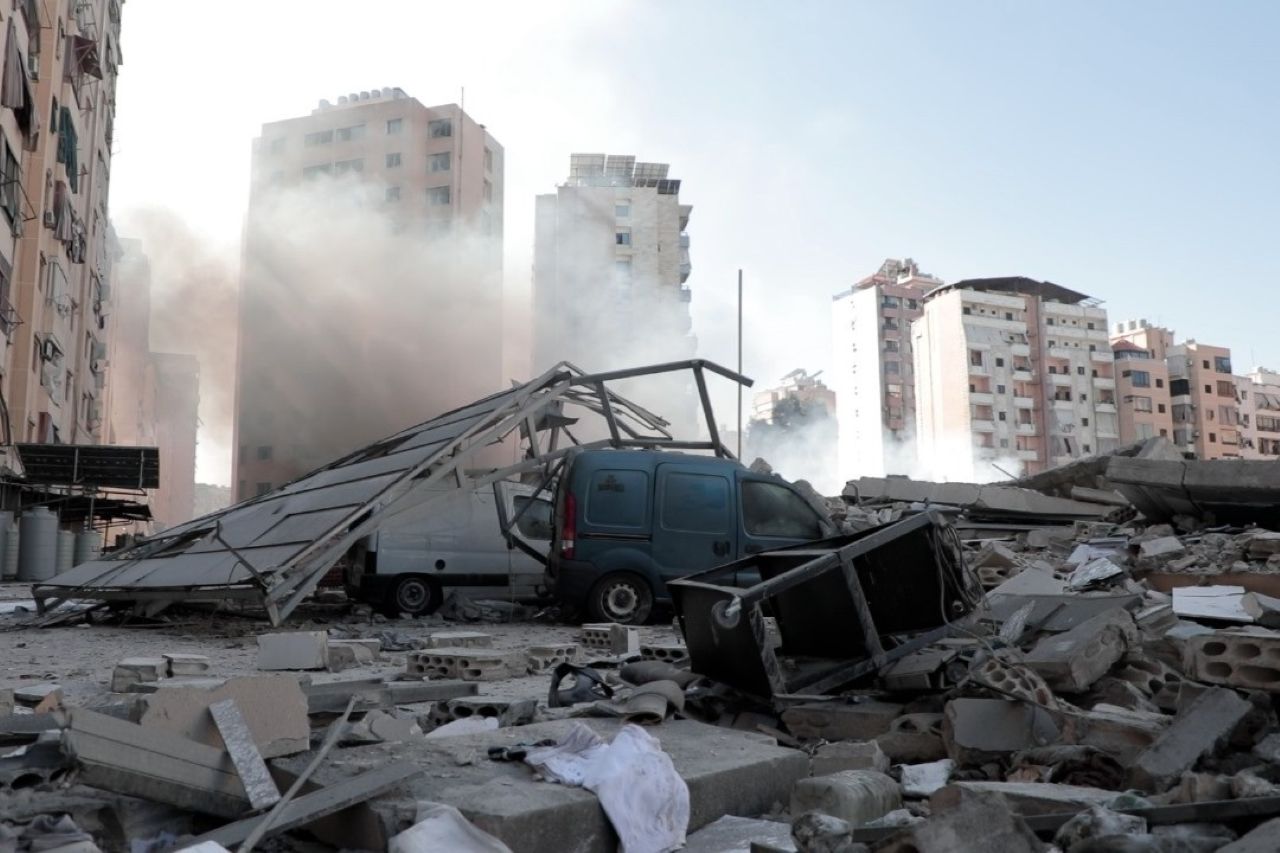
A Bridge For is responding to the new escalation of violence in Lebanon, where hundreds of thousands of people have been forced to flee their homes after Israeli bombings on 2 March 2026 that hit the southern suburbs of Beirut, the south of the country and the Bekaa Valley.
In a matter of hours, entire communities have left their homes to seek refuge in public schools and collective facilities turned into temporary shelters. Many of these spaces are not equipped to accommodate such large numbers of people and conditions are rapidly deteriorating.
"The population most affected by the attacks is in southern Lebanon. This military action represents yet another operation against Lebanon, and it is mainly the civilian population that is paying the price,' our Head of Mission in Beirut, David Ruggini, tells us.
A WAVE OF FORCED DISPLACEMENT
The Israeli army has ordered the immediate evacuation of the entire south of Lebanon, forcing thousands of people to move within hours. Among the areas included in the evacuation order is the Palestinian camp of Shatila, where Un Ponte Per supports a community sports centre and dozens of families with its Distance Support programme.
An evacuation order of this magnitude not only represents a serious violation of international law, but also leaves the most vulnerable people - the elderly, the sick, people with disabilities and families without the means to travel - unprotected, exacerbating an already acute humanitarian crisis.
This new escalation is part of an extremely unstable regional context, marked by growing tensions between Israel, Iran and Hezbollah, and risks further escalating the conflict.
Since 2023, Israeli military operations in Lebanon have had devastating consequences for the civilian population and for the country's infrastructure, which has faced a series of crises in recent years, from the Beirut port explosion of 2020, to UNRWA cuts, to the economic crisis with the subsequent collapse of essential services for the population.
OUR INTERVENTION IN THE FIELD
Un Ponte Per is present in Lebanon and is working with local partners to support displaced people who have found refuge in schools and community centres, where needs are growing rapidly.
Emergency activities include the distribution of essential goods such as family hygiene kits, nappies, water, food and sleeping materials such as mattresses and blankets, to improve living conditions in shelters and support families forced to flee.
A BRIDGE TO LEBANON
Un Ponte Per has been present in Lebanon since 1997, when it started working in the Palestinian refugee camps to guarantee the right to education and health to Palestinian children and refugees from Syria. In the wake of the humanitarian emergencies that have swept through the country, UPP has supported the local organisations with which it has been working for years in strengthening the response and distributing essential aid. Alongside local movements and realities, UPP works to support the difficult process of rebuilding social cohesion following the civil war that bloodied the country for 15 years, promoting the participation of young people and women in peace-building processes.
In a global context marked by conflicts, polarisations and crises, supporting culture means firmly believing in the ability of societies to imagine alternative futures. This is why we at Un Ponte Per have always flanked humanitarian and emergency interventions in the countries where we operate with the protection of local cultural heritage, developing an integrated approach that links peace, human rights, social justice and culture as an essential dimension of human development.
Within this framework, culture is not conceived as an ancillary or purely symbolic domain, but as a social and political infrastructure.
For us, heritage protection, cultural production and the right to self-representation are fundamental tools of community resistance, reconstruction of the social fabric and conflict prevention.
In doing so, we are also attempting to deconstruct Western hegemonic narratives and to return power and expertise to the local communities we have been walking alongside for years.
We have been doing this for decades in Iraq, working on the reconstruction and restoration of the immense book heritage of the National Library in Baghdad, which was destroyed during the war, with the programme 'Knowledge that Resists'. Or by supporting lə young activists in projects to protect and build sustainable tourism routes around places of fundamental importance, such as the Mesopotamian Marshes or the archaeological site of Ur, both of which are UNESCO World Heritage Sites.
Today, we continue to do so in Jordan, through the promotion of cultural, responsible and sustainable tourism in decentralised areas that are rich in history and community heritage.
This is the case with the archaeological area of Jerash, a site of enormous cultural importance but which pays the price for its decentralised geographical location.
Today, the local community benefits only marginally from the positive impact that sustainable and responsible tourism could have in Jerash. In fact, tourists visit the site briefly, then move on to other much better known destinations in the country, without getting to know or stay in the urban area and building very limited interactions with its rich and vibrant local community.
This is why, thanks to the valuable support of the Italian Agency for Development Cooperation (AICS) and together with ARCS, the project leader, we designed and launched 'Sustainable Jerash', a two-year intervention that aims to protect and enhance the city's cultural heritage, to promote inclusive and sustainable local development, creating economic opportunities for the community.
In particular, we will work on the restoration of the Eastern Roman Baths, located in the modern city of Jerash, to enhance them as a connecting point between the urban and archaeological areas.
In doing so, the thermal baths will not only be studied for the first time, but will finally be opened to the public and made accessible, thus encouraging a circular economy and enhancing their heritage.
To do this, we will work together with the Municipality of Jerash, the Ministry of Tourism, and the Department of Antiquities, which will take over the direct management of the site upon completion. But also with organisations such as Monumenta Orientalia and the University of Roma Tre, with whom we will also restore the precious mosaic inside.
For us, as always, the aim is also to make the entire local tourist area more accessible, through the involvement of people with disabilities and local organisations we have been working with for years.
Over the next few months we will be spending time with the Jerash community - citizens, traders, local craftsmen - to gather their impressions of the work we are doing. Follow us for new updates.
The military escalation of these hours between Iran, Israel and the United States reopens a wound we know all too well. The parallel with 2003 and the invasion of Iraq is not just rhetoric. Once again there is talk of a 'pre-emptive strike', once again regime change is evoked - more or less explicitly - as a solution. And once again a spiral is set in motion that threatens to ignite an entire region.
Regional war is not a fatality, it is a political choice. A choice rooted in a vision of power and domination that, in the name of security (whose?) produces permanent instability. We have already seen this in Iraq, Syria, Libya, Afghanistan. External interventions that have destroyed entire countries and populations, weakened civil processes, and stifled transformations from below.
Today we are witnessing dramatic contradictions: in Iran and in the diasporas, there are those who rejoice at the death of the Supreme Guide, those who mourn her, and those who are astonished. But eliminating leading figures does not mean dismantling a pervasive political system that has lasted almost 50 years. It means exposing millions of people to unforeseeable suffering as well as completely denying their self-determination.
As an organisation that has been working in the region for over 30 years, we strongly condemn this new military adventure promoted by the US-Israel axis. It is a choice that dramatically weakens the paths of emancipation and change from below, the same ones that in 2011 and 2019 had animated the Arab springs against authoritarianism and injustice. Rights are not exported by bombing. Democracies are not born from rubble.
At the same time, we stigmatise the dominant media narrative, which uncritically repeats the formula of the 'preventive attack' and struggles to pronounce simple and necessary words: girls, civilians, families. In these hours, there is general talk of 'victims' in a girls' school hit in Iran, but the terrible toll tells of over one hundred girls killed. Words count.
We also denounce Italy's political irrelevance in this scenario, reduced to a logistical tool of a war that has not been publicly discussed or deliberated. Bases on Italian territory, such as Sigonella, cannot and must not be used to fuel regional conflict.
Our concern is greatest for the countries in which we operate and with which we work every day: in addition to Iran and the Gulf monarchies, the crisis is already affecting Lebanon and Iraq. And while international attention is focused on this new front, violence by Israeli settlers and military operations are intensifying in Gaza and the West Bank. The risk is that one war will overshadow the other, multiplying impunity.
We share some testimonies collected in these hours.
IRAN. VOICE FROM THE DIASPORA
One of our Iranian diaspora activists, who has always been critical of the regime in Tehran, tells us about the complexity of these hours
"I am experiencing mixed feelings. Iranian society is much more complex than how it is described in the West. There are those who celebrate, those who mourn, those who are afraid. But it is not by 'eliminating' senior religious and military officials that one dismantles a system rooted in 50 years. The risk is to plunge into a scenario of endless instability, as in Iraq or Syria. And in the meantime, the victims are civilians. There are already so many. They are children."
IRAQ. 'WE DO NOT WANT ANOTHER WAR'.
One of our Iraqi colleagues recounts:
"I was sitting in a bar when two rockets went over our heads. Everyone panicked. My wife called me, terrified. The war will only bring death and collapse. We absolutely do not want another conflict in Iraq. What is happening is a violation of international law: destruction of infrastructure, intimidation of civilians. To all parties involved: stop the bombing immediately. We must learn from the wars we have already endured. Iraq and its people deserve peace."
LEBANON. ESCAPE IN THE NIGHT
Dramatic news comes to us from Lebanon. After rockets were launched from the south towards Israel, the Israeli army's response hit the south of the country and the southern districts of Beirut. Dozens of civilians were killed along with Hezbollah exponents.
The highways were immediately stormed by fleeing families. Our colleague Zaynab, who lives in the south, fled in the night in shock, taking hours to reach a safer area in Mount Lebanon. Local partners, such as the organisation Amel, have some staff stranded in the south awaiting evacuation. An Israeli communiqué called for the total evacuation of 53 villages (!) in the south, while the shelling continues. Shelters have been reopened in Beirut and other areas of the country to accommodate displaced families. The scenario evokes that of 2024, with the fear of an Israeli ground operation. One of the schools supported by our Qalam project has been declared a shelter for displaced people. We are conducting rapid assessments to respond to the emergency.
Un Ponte Per strongly condemns the ongoing military escalation and any war strategy aimed at redrawing political balances by force.
We also condemn the total disregard for international law, now reduced to waste paper. We had built the legal instruments to avoid the omnipotence of the law of the strongest and today these instruments are trampled underfoot.
We demand an end to the instrumental use of territories and populations as theatres of war for imperialist and colonial interests. The people we work with - activists, teachers, health workers, local communities - ask for one simple thing: to live in peace, without being pawns in conflicts they did not choose.
We have already seen where this road leads. We cannot accept history repeating itself, yet again.
For eighteen hours, I stayed outside the tent. Rain fell on my friends and me during the night, and during the day we stood under the sun. All of this just to activate a bank account that, two years ago, I could have opened in less than thirty minutes.
In Gaza, accessing money has become a journey in itself. Every number on the screen tells a story of endurance and struggle, and every step toward reaching it teaches you what life means under the hardest conditions.
It all began when I heard that banks in central Gaza City had started allowing people to access their accounts again after being closed for more than two years.
I decided I had to go, no matter what, because we no longer know what tomorrow might bring. Three friends agreed to come with me. We arrived at 10 p.m., thinking we would be among the first. Instead, dozens of people were already there. My number was 50. Some people were sleeping at the bank’s entrance.
We waited in the street. One of my friends said, “Maybe we should come back tomorrow. This is too exhausting.” But I had made up my mind not to leave without activating my account. We all held our IDs in our hands, looking for anything we could lean on. There were no seats, no shade from the sun, and no clear system to know when our turn would come.
In the first hours, we talked to pass the time. Around 2 a.m., the cold became unbearable. Each of us tried to find a corner to shield ourselves from the wind. Our bones ached from the cold. At sunrise, the street grew even more crowded. Some people slept directly on the ground, covered with thin blanckets or pieces of cloth. Others searched for a small space to sit, resting slightly on the sidewalk. Conversations were quiet, mixed with the sound of cars arriving from time to time. Every minute felt heavy. Every hour increased our exhaustion. But we had no choice except to wait.
As time passed, I felt the weight of waiting on my body and spirit. My hands stiffened from holding my ID and water bottle. My feet swelled from standing so long. My eyes stayed fixed on the closed door that felt like a gate to another world.
Ahmad, one of my friends, whispered, “Do you think we’ll be able to activate our accounts?”
“I don’t know,” I replied, “but I’m not leaving without mine.”
As morning approached, my anxiety grew. Would I get my turn before the bank’s working hours ended? Would number 50 still count? Moments like these reveal a part of daily life in Gaza, where something as simple as accessing a bank account requires enormous effort.
At 8 a.m., the bank gates opened. By then, more than 200 people stood behind me. Two hours after the bank opened, I finally stood at the door, waiting for someone inside to come out so I could go in. It felt like a small victory, and a clear sign of the crisis we live in.
Inside, activating my account took less than 29 minutes. But that did not make the situation any less severe. For years, banks have not regularly paid out salaries or transfers. Accessing cash has become a daily struggle, even for those with bank accounts.
The money exists on the screen. The numbers are clear. But turning those numbers into physical cash is a daily battle.
For the past two years, and even now after the ceasefire on paper, many people have been forced to rely on liquidity seller. They sit in small places or narrow corners with their phones, offering one service: turning your bank balance into cash for a high commission. Sometimes this commission reached 40% or more. People lost a large portion of their own money just to access what was rightfully theirs, while prices of goods continued to rise dramatically.
The challenge did not stop there. Small change and worn-out banknotes had become another daily problem. Coins were nearly nonexistent. I had a nearly worn bill, so I took it to a place we call the "Money Clinic" to get it fixed. Later, I tried to buy bread with it. The seller looked at the bill carefully, and in the end, he refused to take it, and I walked away hungry, unable to buy bread. In moments like these, money itself feels unstable.

As a result, the salary or balance shown in the banking app becomes more of an idea than a reliable amount you can plan your month around. The number shrinks at every stage: during transfer, during withdrawal, and during purchase because of high prices and shortages. What reaches your hand is not what you actually earned. Turning digital money into tangible goods becomes an exhausting, mentally draining process.
What makes this even more complex is that this daily financial crisis is not just about numbers. It creates constant social and psychological pressure. Thinking about money is no longer about saving or planning for the future, but about how to access it quickly to cover basic needs: bread, water, charging electricity, and perhaps a little gas for cooking.
And here lies the strangest contradiction of all: our dependence on an advanced digital financial system while living an extremely primitive life in tents.
Money arrives through phone apps. Transfers happen in seconds. Balances update instantly. The process feels as if we are living in a smart, modern city with advanced infrastructure. But the physical reality around us is far from that.
We live in tents without stable electricity, without running water, and without many daily necessities. No refrigerators to preserve food. No stoves that work consistently. No reliable lighting. Yet there is a digital wallet on the phone, a banking app, and constant transfer notifications. Financial technology arrived long before many of the basic elements humans need to survive.
When I received my first payment for an article I wrote, I felt relief for a moment. The number on the screen gave me a sense of financial security. But I quickly realized that this number meant nothing if I could not turn it into bread, water, electricity, or gas.
First, I had to find a broker who would accept the transfer. Then accept the commission deducted from the money. Then find a shop that would sell what I needed and accept the worn-out cash. All of these steps just to secure basic necessities.
At the end of the day, survival in Gaza does not depend only on how much money you have, but on your ability to access it and use it under harsh conditions. Digital money exists, but physical life is extremely fragile. Modern technology advances quickly, while the basic elements of survival are completely absent.
This contradiction between the digital and the primitive, between money on a screen and fragile life in tents, summarizes the experience of living in Gaza today.
It is a difficult experience filled with challenges, but it also reveals the resilience and daily creativity people rely on to survive despite everything.
Hassan Herzallah - Correspondent from Gaza
In Gaza, the crisis has not stopped. Despite the announcement of a ceasefire, violations numbered in the hundreds and the entry of humanitarian aid remained grossly insufficient, irregular and unfair. The war continued to affect people's bodies and living conditions, while hunger, displacement and the destruction of infrastructure made survival a daily struggle.
In this context, thousands of families continued to live without stable access to food, without functioning markets, without income, without cash. Malnutrition rates - especially among childrenə, pregnant women, the elderlyə and persons with disabilities - remained dramatically high.
And then winter came.
Heavy rains flooded tents and makeshift shelters, destroying what little the families had. Living under an impervious tarp, in the cold and mud, has meant exposing oneself to enormous health risks, especially for the most fragile. In Gaza, even the weather has become a threat.
It is within this emergency within the emergency that Un Ponte Per, together with local partners UAWC and Al-Ard, and also thanks to donations that arrived at Christmas 2025, started the new distributions.
FOOD FOR 350 FAMILIES
The first objective was to respond to an immediate emergency: access to food.
To recently displaced families - often excluded from even the small amount of aid available - we delivered 350 parcels of fresh vegetables, reaching a total of 1,925 people throughout the Gaza Strip.
"The first thing I thought when I saw them was: they finally weigh the right amount," commented Sharif Hamad, Communication Officer of the Water for Gaza Campaign. "The food parcels distributed today weigh more. There is more food inside. And, finally, there are eggs. A simple, essential food, often absent for months. It is not a symbol of abundance, but of regained minimal dignity. It is the difference between surviving and feeding. Between enduring and still being able to take care of your children'.

WATER: A LIFE-SAVING ANSWER
Next to food, access to water remains one of the most serious emergencies. Bombardments have extensively damaged water systems , sewage networks, civil and agricultural wells, almost completely disrupting the water supply. In many areas, water only exists if it is transported by truck, often at great expense and with no possibility of storing it safely.
In response to this emergency, thanks also to donations received in recent months, we have distributed 200 500-litre tanks to 200 displaced families in the areas most affected by the conflict - Rafah, Khan Younis, Deir al-Balah and Nuseirat - where homes and infrastructure have been destroyed and access to essential services is extremely limited.
The tanks allow families to safely store water received through distribution or transport by truck, reducing dependence on unsafe sources and the need to travel long distances, in a context where every journey involves serious risks to people's safety. To ensure the effective use of the tanks, each family will receive drinking water for three months, with two refills per month.
Marwa is a young mother, displaced from the north of the Gaza Strip. Her words tell what it means not to have access to water:
"I have a five-month-old baby girl. I couldn't find a single drop of water. I went from tent to tent, morning, afternoon and evening, trying to fill a bottle.
I had been displaced from the north, on foot, and I had nothing with me. When this tank arrived, I was overjoyed, because now I always have water available. God bless all those who supported this project and gave us these water tanks."

Fadi also recounts a continuous fatigue of repeated and insufficient gestures:
"We suffered from a lack of water. We carried it in pots and buckets: I had three, but they were never enough. Water was scarce, my throat was always dry. Carrying it was a struggle, as was everything else, because we had nothing to store it in. Thanks to this tank, I no longer have any difficulties and I don't have to worry about water like before.
WINTER-PROOFING SHELTERS
But eating and drinking are not enough if you do not have a dry place to sleep.
Therefore, a major part of the donations was earmarked for making the makeshift shelters safer. Between November and December 2025, tendering and procurement procedures were started for materials and equipment needed to waterproof the tents.
The delivery of the materials took place in the last week of December 2025 and about 200 families benefited from these interventions.
TOGETHER WE CONTINUE TO ENSURE DIGNITY
Operating in Gaza means facing enormous obstacles: arbitrary restrictions on the entry of aid, collapsed markets, lack of functioning banking systems, constant forced displacement and security risks for staff.
Ensuring protection, equity and dignity is a constant challenge.
Water, fresh food, safer shelters: these are partial but fundamental responses. They keep a space of life, dignity and resistance open.
In Gaza today, nothing is taken for granted. Not even being able to drink, feed oneself or the winter that passes without losing everything.
Thank you for choosing to be there.


In the emergency department of the National Hospital in Hassakeh, Syria, generators hum, medical teams are at work, ambulances arrive non-stop. For hundreds of thousands of people, this public hospital is the only point of reference for specialised care and life-saving interventions. It is here that Un Ponte Per, together with local partners, has built a bridge between those most in need and a health system brought to its knees by years of crisis and sudden cuts in humanitarian funding.
By mid-2025, the situation in north-east Syria was dramatic: 68 health facilities were at risk of closure and only 1 out of 16 public hospitals remained fully operational. The consequences fell mainly on pregnant women, children and people with chronic illnesses, who were suddenly forced to forego essential examinations, medicines and operations. In the camps for displaced people, overcrowding and precarious water and sanitation infrastructure have multiplied the risks of epidemics.
The suspension of international humanitarian support to the National Hospital in Hassakeh, due to cuts imposed on USAID, had left over 333,000 people without access to public, free and specialist care.

'BRIDGE': AN ALLIANCE TO KEEP THE HEALTH SYSTEM ALIVE
Thanks to the solidarity of donors, we were able to supply the hospital with drugs, equipment and basic medical supplies, but the demands were growing daily. With the 'BRIDGE' programme, carried out together with ACTED and thanks to the invaluable support of the Syrian Humanitarian Fund (SHF), we were able to respond promptly to this emergency.
In 6 months of intervention, between Hassakeh, Deir-ez-Zor and Raqqa, we provided free integrated healthcare to over 137,000 people, supporting 7 facilities:
We have provided drugs and medical devices, trained health personnel, strengthened maternal and child care and emergency services, and enhanced pathways for taking charge of and transferring patients to specialist care when necessary.

We have done this by strengthening local public structures: because the self-determination of a community also passes through the right to a free public health system.
THE HASSAKEH NATIONAL HOSPITAL AT THE CENTRE: THE 'BRIDGE' THAT CANNOT BE BROKEN
At Hassakeh Hospital, we were able to break down the economic barriers that prevented the most vulnerable people from accessing diagnostic tests, surgery and treatment. When a service was not available in-house, we provided transfers and reimbursements to external referral facilities.
To do this, we created the Health Equity Fund (HEF): a health equity fund that covers, on a case-by-case basis, the primary and life-saving care costs of displaced persons and refugees. The fund enables displaced persons to access specialist care that would otherwise be out of their reach. Most of them, in fact, are unable to afford even the capped fees of the public health system, let alone the much higher costs of private facilities.

"I cannot thank you enough for all the efforts you made to save my life. The cost of the surgery would have been impossiblefor me and my family tobear," said Amira, a 40-year-old woman who arrived at Hassake Hospital with angina and was promptly identified by health workers at our clinic in Washokani camp. Urgently stabilised, she underwent surgery and was able to return to her family.
But 'BRIDGE' was also able to provide long-term, non-emergency care, as in the case of Saleh, a 35-year-old man suffering from chronic pain due to hip joint problems.
"I was not able to bear the costs of the procedure nor the transport costs from the camp to the hospital. This operation gave me a new life, without pain," he told us after the surgery he was able to access thanks to the orthopaedic team at the Hassakeh National Hospital.

CONTINUE, TOGETHER
These months of work in Syria have allowed us to continue a long journey, undertaken alongside local communities more than 15 years ago, with the aim of supporting them in their efforts to build a quality, public and accessible health system, in defiance of the ongoing crises in the country.
As Dr Salar, medical coordinator of the Hassakeh National Hospital, recalled, "this intervention was instrumental in saving lives. We are proud of what we have built together, and I want to express my deep gratitude to the entire UPP team. Our hospital has become a landmark, strengthening the entire community.The legacy of what we have done will continue for a long time, and we hope to continue this journey together".
Leonardo spa ends up in the crosshairs of legal action: Italian and international laws on arms exports would render contracts with Israel null and void.
A group of important Italian associations joined with a Palestinian citizen to ask the Civil Court of Rome to declare null and void the contracts signed by Leonardo spa and its subsidiaries with the State of Israel for the sale and supply of arms. This initiative should be seen in the context of what has been going on for over two years in the Gaza Strip. And which many authoritative voices, including the UN Independent International Commission of Inquiry on the Occupied Palestinian Territories, claim is a genocide.
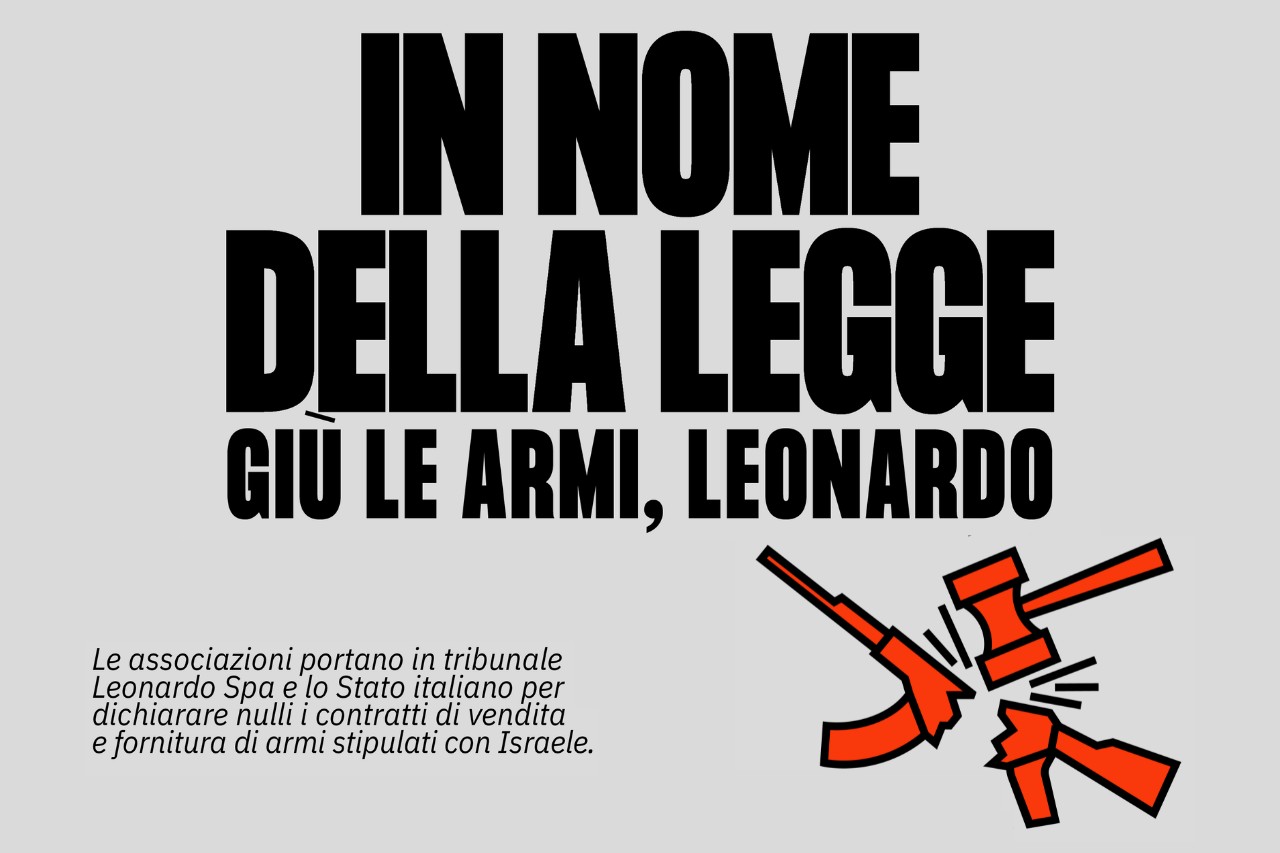
"IN THE NAME OF THE LAW LAY DOWN YOUR ARMS, LEONARDO"
'In the name of the law, lay down your arms, Leonardo' is the name given to the lawsuit filed in the Civil Court of Rome. A number of NGOs joined the complaint by Hala Abulebdeh, a Gazawi pharmacist whose entire family was exterminated by Israel: Assopace Palestina, A Buon Diritto, ATTAC Italia, ARCI, ACLI, Pax Christi, Un Ponte Per. The legal action also involves the Italian State, which with the Ministry of Economy and Finance is Leonardo's majority shareholder.
This is the second legal initiative in a short time targeting Leonardo in connection with what is happening in Gaza. In October, in fact, Leonardo's CEO Roberto Cingolani had been reported to the International Criminal Court, together with the heads of the Italian government, for 'alleged complicity in Israeli crimes'.
THE COMMITMENT OF A BRIDGE AGAINST WAR
Un Ponte Per (UPP) has been working for over 30 years in countries that are the scene of armed conflicts, such as Iraq and Syria. Or the Lebanon, 'where Israeli attacks have never stopped,' explains Giulia Torrini, president of UPP.
"We see the effects of war every day. To think that in some way Italy could favour the extermination of the civilian population does not sit well with us. Suing Leonardo is not an everyday occurrence for associations like us. But it seemed important to us to do so, especially in this historical period'.
The purpose of the legal action, Torrini emphasises, is not to attack Leonardo. But to ask for verification of whether the law is actually being applied. 'The questions we are asking are those that our members and the vast majority of Italian citizens are asking. If Italy repudiates war, as Article 11 of our Constitution states, why does it sell weapons to countries at war? Our aim is for the cause to be talked about as much as possible'.
Above all, Torrini is keen to distinguish the workers of Leonardo from the company.
"In Leonardo Square I have never seen it, the workers have. Like all the workers in the war industry, or the dockworkers forced to load weapons into ships, they are blameless because they are subject to labour blackmail and have no alternative'.
Representing the plaintiffs, together with his colleague Veronica Dini, is lawyer Luca Saltalamacchia, one of the lawyers who months ago sent a notice to the Italian government demanding the revocation of the Italy-Israel Memorandum on military matters. "The 2013 International Arms Trade Treaty signed by Italy, and Italian Law 185/1990, prohibit the export of arms to countries at war and countries that systematically violate human rights," Saltalamacchia explains.
"Italian law prohibits exports to countries whose policies conflict with the principles of Article 11 of the Constitution. International law prohibits the export of arms if at the time of authorisation it is known that the arms or goods may be used in the commission of genocide, crimes against humanity, serious violations of the Geneva Conventions of 1949. Attacks directed against targets or civilian subjects protected as such or other war crimes defined as such by international agreements to which the state is a party'.
The plaintiffs therefore turned to the court to ask whether the precise constraints of national and international laws were being respected. That is, whether it is legitimate for the Italian state to have allowed the export of arms to Israel, 'recognised for years as a state that systematically violates human rights and whose policy is certainly not in line with Article 11 of the Constitution. After 7 October 2023, with a genocide taking place, we wonder how it is possible that the State has not suspended the licences already granted and has not prevented Leonardo from selling arms, including through its subsidiaries or affiliates, to the State of Israel. Moreover, such a transfer is also contrary to Leonardo's Code of Ethics,' Saltalamacchia concludes.
THE NGOS AND LEONARDO WAITING FOR THE FIRST HEARING
In mid-May, Un Ponte Per was part of the solidarity caravan organised by AOI (Association of Italian NGOs), with numerous politicians in tow, which arrived at the Rafah crossing. But it was not allowed in. "We saw the trucks with aid stopped, the warehouses full of food and medicine. We heard the bombs falling only a kilometre away, killing people: it was terrible,' says Torrini.
The first hearing of the case is expected to take place early this year. "We will see what the judge decides and go from there," Torrini concludes. 'If he decides as we hope, it will become interesting. Italy and the world are moving towards rearmament and a passion for warfare, we are intransigent on this and we appeal to all Italian citizens and workers. We absolutely do not want public spending to go towards rearmament. Against war we are and always will be in the squares'.
Article originally published on Valori.it. Cover photo is by Massimo Lupo/UPP.
Our'Sahati' (My Health) intervention, financed by Otto per Mille funds from the Waldensian Church, was successfully concluded. It has been active since May 2025 in Jordan to improve the autonomy, mobility and social inclusion of adults and minors with disabilities in Syrian refugee and host communities in the governorates of Amman, Zarqa and Irbid.
Despite significant legal progress in Jordan for persons with disabilities, women, men, boys and girls continue to face obstacles in meeting their needs and exercising their rights due to both an underfunded public system and socio-cultural and economic barriers. The demand for health services has increased over the years for the Syrian refugee community, putting pressure on the national health system, and costs remain very high.
In this context, the provision of specialised services for people with disabilities therefore remains a major concern.
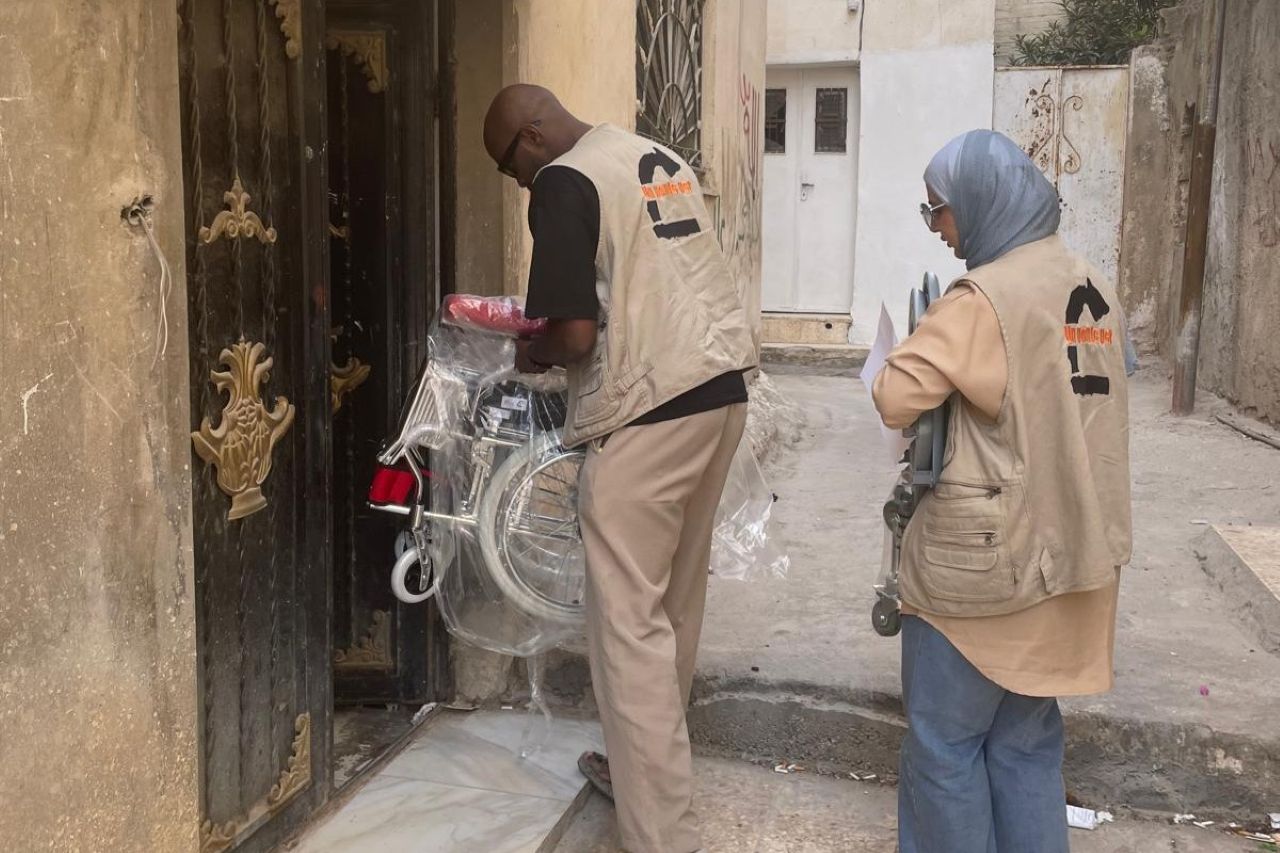
This is why we are particularly happy to have managed to reach 322 people in just a few months, exceeding by 120% the target that 'Sahati' initially set itself, thanks to home rehabilitation services, the provision of mobility aids and prostheses, and training sessions for people with disabilities and caregivers.
Un Ponte Per has been present in Jordan with projects aimed at people with disabilities for many years, and our activities include the deployment of a mobile unit composed of occupational therapists, physiotherapists and social workers, who again ensured regular interventions by reaching particularly vulnerable areas and maintaining continuity with the activities started in the previous project, "Masahat Aamina II".
In six months, 229 people - including a majority of women and girls - had access to specialised rehabilitation sessions (35 occupational therapy and 194 physiotherapy).

In coordination with the Ministry of Social Development, Un Ponte Per also updated and implemented the mobility aids distribution plan, delivering 114 devices to 100 people at the Zarqa rehabilitation centre. In parallel, the Mobile Unit conducted 229 training sessions on home rehabilitation exercises, use and maintenance of the aids, involving 159 people with disabilities and 70 caregivers, and was able to distribute another 208 mobility aids to a total of 112 people.
"Sahati" also enabled us to strengthen cooperation with national and international organisations through our participation in coordination groups for protection work in the country. Co-operation with the Ministry of Social Development enabled a targeted distribution of aids.

All our staff in Jordan have also received specific training on PSEAH(Protection from Sexual Exploitation, Abuse and Harassment) policies to prevent all forms of sexual harassment and abuse, confirming our organisation's commitment to protecting the people we work with.
By significantly exceeding the expected results, the 'Sahati' project confirms the importance of ensuring access to free, comprehensive and culturally sensitive rehabilitation services in improving the well-being, functional autonomy and social inclusion of persons with disabilities in refugee and host communities in Jordan.
Thanks to our long-standing collaboration with the Waldensian Church, and the support provided by Otto per Mille funds, it was possible for us to carry out this additional intervention, guaranteeing continuity in access to services for the communities we have been working with for years in the country.
Hassan Herzallah is a translator, writer and storyteller from Gaza. He collaborates with several international newspapers. For the "Water for Gaza" campaign, he chose to share with Un Ponte Per his direct testimonydocumenting his life under siege and displacement. She is in her third year of studies in English translation at the Islamic University of Gaza and continued her education online after the university was bombed.
Gaza, 21 January 2026
Only days had passed since we entered the new year.
I wasn’t counting the seconds, I didn’t check my phone, and I wasn’t expecting any greetings. I sat quietly, staring at the cup of tea I had prepared, no lights, no music, no familiar sounds around me.
Outside, the world was celebrating, but here, silence weighed heavier than ever.
The first moments of 2026 arrived, and with them, danger returned to our camp. The distant rumble of explosions from areas where the army still stationed, and occasional flashes of fire in the night sky, reminded me that our lives are still measured by survival, not by seconds. I wasn’t completely alone that night; Simsim, my little bird, sat silently beside me, my only companion in days filled with loss.
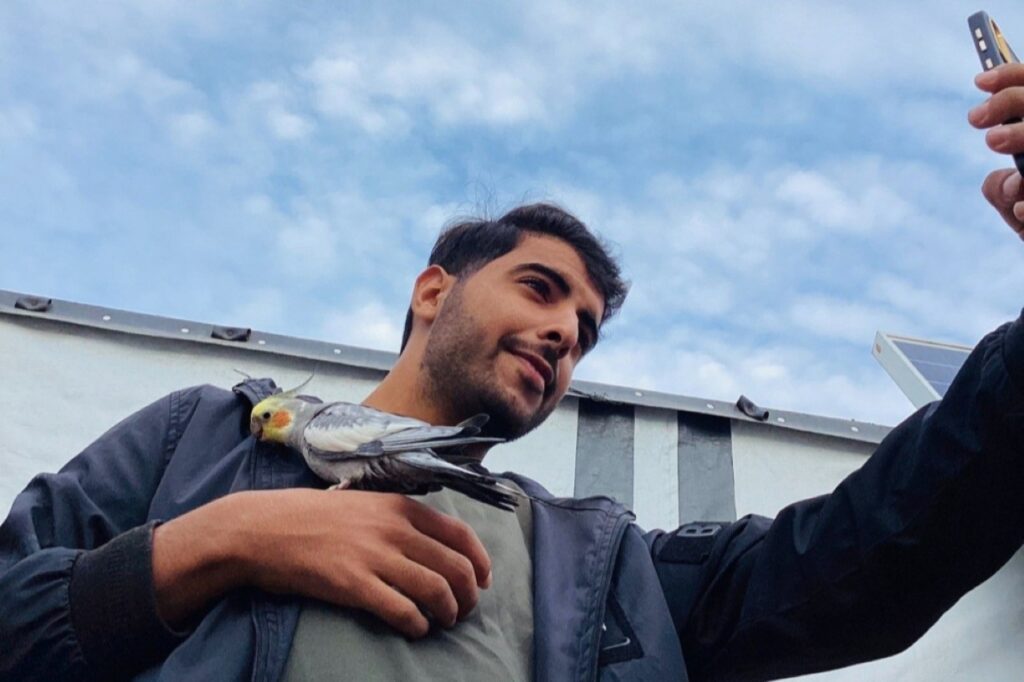
The nights of January began with sleeplessness, each one haunted by the random gunfire we endure almost every night.
I remember one night this week around two in the morning, when a hail of random shots rained down on the camps from occupation tanks and naval patrols. In that moment, my siblings and I stayed flat on the floor of our tent, unable to move at all for fear of being hit. I could hear bullets whizzing over our fragile tent, which offered no protection, and I even heard the sound of cups breaking from the gunfire.
The next morning, when we woke up, we learned that there had been more than seventeen injuries that very night in our camp and the surrounding camps. All of this still creates a constant feeling of instability, a sense that accompanies us every day here, even after the ceasefire exists “on paper.” From here, the truce does not appear to stop the danger; instead, it takes the form of a daily threat that the world does not see.
Beyond the immediate danger, there is the silent genocide we endure during the winter months.
This is the second winter for my family and me, and we are living under a fabric tent. The rain began early this year, and the force of the wind tore through everything in its path. Just two days ago, the storms ripped part of the tent where my siblings and I sleep, forcing us to quickly move our belongings into my parents’ tent. Some of my personal items, like my laptop, which belongs to a friend, were damaged that day. Even those who live in houses have seen parts of their homes collapse under the force of this winter’s storms.
We began to witness homes collapsing on their resident almost every day, and some even dying as a result. While I was talking to my friend Mahmoud, he told me how the house next to theirs had suddenly collapsed, turning every new day into another challenge in a life that never stops testing us.
The cold this winter is not just a normal drop in temperature, it is a constant, looming fear.
Every day we hear about elderly people or young people dying from the cold. Since the beginning of the year, seven people have died from the cold, including one infant, the child of the barber I go to, which keeps me constantly worried for the children around me and my younger siblings.
In the middle of this month, my family lost someone very close to us, my father’s neighbor, Mohammed. He was a close friend of my father when we still lived in our homes in Rafah. Whenever he spoke to my father, he would say he would come visit us in Al-Mawasi, always adding, “We will meet soon, once we return to our areas.”
But we have not returned, and that visit never happened.
In the middle of this month, Mohammed and his daughter were martyred while walking in the street, victims of Israeli shelling. When my father received the news, he kept repeating one sentence:
“We didn’t lose Mohammed during two years of genocide, and yet we lost him in the midst of a fragile ceasefire, while the world believes we are living under a truce.”
That moment was enough for me to understand that the danger had never left us, and that death here does not require an open war; sometimes, simply stepping outside is enough.
With prices unstable in the markets due to the irregular opening of the crossings, life feels heavier with each passing day. I look at my family, especially my mother, whose health has deteriorated severely as a result of the war. At times, she cannot even walk due to the pain in her head that extends down her back. We are still waiting for the crossings to open, which were supposed to be accessible months ago, yet the occupation continues to violate the terms of the ceasefire. Each time we try to contact institutions in Italy and other countries to enable my mother to travel and receive proper treatment, we are met with the same harsh reality.
The medications available are insufficient for her condition, and the specialized drugs she needs are not accessible in Gaza, as the occupation continues to obstruct the entry of essential medicines.
Amid all this, we are not searching for a new beginning as much as I am yearning for an ordinary day: a day when we can sleep without fear, when my mother wakes up without pain, and when people can walk the streets without risk.
We did not celebrate this year, yet I hold on to a small, stubborn hope, that the coming year will be less harsh, and that it will return to us what has long been take away.
By now, only a few days into the new year, the same quiet that marked its beginning still lingered around me. Life continued with its daily threats and uncertainties, yet amid all this, my little bird, Simsim, looked at me silently. He made no sound, nor sang as he usually does, as if he sensed the weight of everything we are enduring. In that moment, the silence between us felt like a shared language, a small anchor of presence and comfort in a world where even ordinary days are fragile.
Hassan Herzallah - Correspondent from Gaza