An interview with Gulistan Issa, Project Manager of Un Ponte Per, outlines the ecological crisis in North-East Syria and the response of the Autonomous Administration, which is tackling the environmental challenges with sustainable initiatives, community management of resources and reforestation projects.
By Daniela Galié for DinamoPress*
In Northeast Syria, water has become a strategic resource and a matter of survival. The water crisis affecting Rojava is not only the result of an increasingly arid climate or old infrastructure, but the fruit of a systematic encirclement that aims to economically and socially strangle this political experience. Turkey's control of water sources and forced reduction of water flows have amplified an already dramatic shortage, exacerbated by war and international sanctions.
Once-vital rivers, such as the Xabur and Çaxçax, only flow for a few months of the year, while towns such as Hesekê survive on rationing and reservoirs. Agriculture, the mainstay of regional self-sufficiency, is in crisis. At the same time, groundwater pollution and the lack of efficient purification systems are turning drinking water into an increasingly rare commodity.
The water problem is part of a broader ecological crisis. Waste disposal, for example, is often entrusted to unregulated landfills located close to water sources. Air pollution, due to rudimentary oil refining and the massive use of diesel generators, contributes to a further deterioration of environmental quality.
Despite this, Rojava is responding strongly. The model of Democratic Confederalism has placed ecology at the centre of its politics, promoting bottom-up initiatives to counter the difficult environmental and geopolitical conditions.
Through reforestation projects, the reduction of the use of chemical fertilisers and the development of community water management strategies, efforts are made to ensure that water remains a right for all and not a weapon in the hands of external powers.
To better understand this emergency and the strategies adopted on the ground, we interviewed Gulistan Issa, Project Manager and Campaigner of the humanitarian organisation Un Ponte Per. Born in Hesekê in 1994, she lived and studied in Syria, graduating in pharmaceutical sciences from Homs University in 2017. Soon after, she started working with humanitarian organisations and now works on the ground, in Rojava, to help tackle an environmental crisis with deep political roots.
ECOLOGY AND SELF-MANAGEMENT: A MODEL OF ENVIRONMENTAL RESISTANCE
In Rojava, the Democratic Confederalism model is proposed as a project that integrates ecological principles into social organisation. The administrative autonomy of North-East Syria is based on a balanced relationship between community and nature, tackling with determination the limits imposed by available resources. The commitment to a political ecology is not only theoretical, but is translated into concrete initiatives. "A significant example is the existence at the University of Rojava of a Jinology faculty that deals with ecology and ecofeminism. This facility works to integrate ecological principles into everyday life, with a focus on the role of women in environmental management,' Issa explains.
The role of women in this transformation is crucial. Among the most active figures in this field is Berivan Omar, deputy co-chairwoman of the Local Government Department. "She and her team are doing important work, addressing environmental challenges and integrating ecological solutions into the self-government system," Issa points out.
In Rojava, sustainability is not an abstract concept, but a necessity for survival. "Ecology is considered a fundamental pillar," says Issa. "If you look at the self-management model and the social structure of the region, it becomes clear that the relationship between ecosystem and community is essential for sustainable living in Rojava."
WASTE MANAGEMENT AND HEALTH
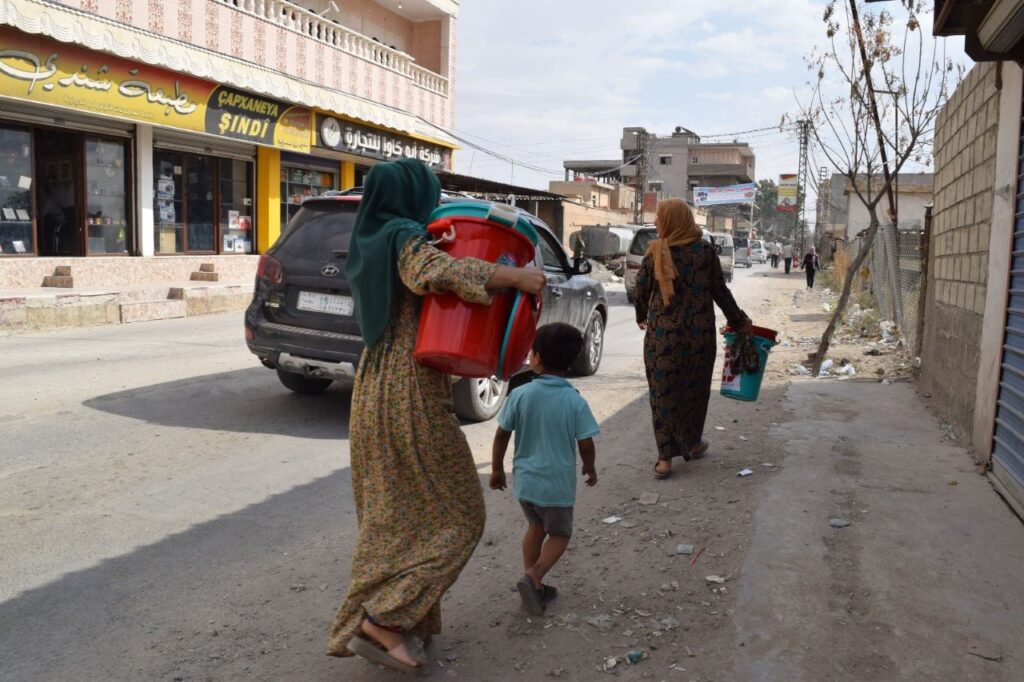
In the context of a Syrian North-East in continuous emergency, waste management represents one of the most complex challenges for the Autonomous Administration. For decades, there has been no real waste collection and disposal system, let alone a structured recycling programme, throughout Syria. In recent years, a number of experimental projects have been launched that aim to radically transform this sector, although they come up against limited budgets and insufficient infrastructure.
"With Un Ponte Per we started a solid waste management and recycling project, which was implemented in cooperation with the municipal environment department and has been going on for about two years. The initiative has introduced composting areas for organic waste, with material collected from fruit and vegetable markets and restaurants. However, the available resources do not allow us to cover the entire region due to an extremely limited budget. We cannot intervene in all of Hasakê, Qamişlo or the rest of Rojava'.
The role of local administrations has been decisive. "The municipalities have made a great effort to equip themselves with waste collection vehicles and to provide dedicated composting spaces," Issa continues.
Today, the pilot project initiated in Hasakê has made it possible to separate waste into categories - paper, plastic and organic waste - and to link this process to local economic cooperatives. "Through cooperatives linked to self-government, recyclable materials are sold to one of the few recycling companies in the region. The proceeds are reinvested in social projects. One of the most concrete examples of this initiative is the creation of a space for women: with the funds from the sale of cardboard and plastic, some cooperatives opened a small gymnasium and sports club. Next to the gymnasium a space for children was set up, allowing women to have time for themselves'.
In addition to solid waste, Rojava also faces the problem of medical waste disposal. Without adequate infrastructure, hospitals and clinics risk turning into hotbeds of infection, making an effective management system essential. "For the past five years, we have been running a specific medical waste management project in cooperation with the Kurdish Red Crescent," explains Issa. "We have involved more than 60 health facilities throughout the region, from Qamişlo to Dêrik, from Tabqa to Manbij."
One of the main objectives was to introduce the separation of waste by categories directly within the healthcare facilities. "We trained medical staff on how to deal with hazardous waste," says Issa. "We then built sanitary disposal areas outside the cities to avoid contamination."
Today, there are more than 15 dedicated medical waste disposal areas in Rojava. The process involves several steps: 'The waste is collected daily by municipal staff and transported to the dedicated areas. Here they are disposed of through a system that includes glass shatterers, volume reducers for needles and syringes, and incinerators for contaminated materials such as masks, gauze and gloves'. The project was then handed over to the local authorities. "The municipality and the health department, together with the Kurdish Red Crescent, now manage this system, carrying out the separation and disposal procedures".
Nevertheless, the difficulties remain enormous. "Unfortunately, in the current context, projects like these are considered secondary to the humanitarian emergency and security. Yet without effective waste management, the region's environmental crisis is only likely to worsen'. The work carried out in recent years shows, however, that change is possible, even under the most difficult conditions.
DEMILITARISING WATER
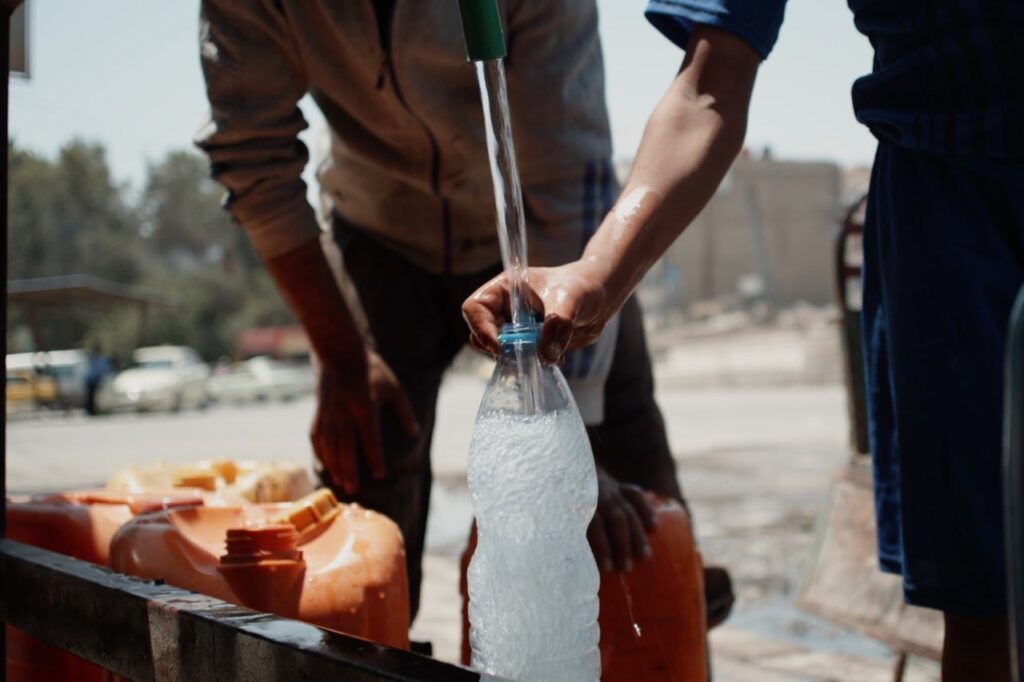
In Rojava, water management has become a political and humanitarian battle. The construction of large dams on the Tigris and Euphrates rivers by Turkey, despite international agreements, has drastically reduced the water flow to Syria and Iraq. But the problem is not limited to drought: water is now an instrument of geopolitical pressure, used to suffocate the Syrian North-East.
"From the beginning, Turkey has not respected agreements on water management," explains Gulistan Issa. "But the situation worsened with the occupation of some strategic areas, such as the Alok water station, the main source of water for 1.5 million people between Hasakê, Tel Tamer and Al-Hol."
The Turkish invasion of Serekaniye in 2019 marked a turning point. "Since then, the Alok station has been under the control of the pro-Turkish Syrian army, which has stopped its operations, depriving not only Kurds but also Arabs, Yazidis and Christians of water," Issa points out. 'Hasakê now depends on private wells, with water of dubious quality, while in the Al-Hol camp, the largest and most unstable in the region, the lack of water has aggravated sanitary conditions, increasing the risk of epidemics such as cholera and COVID-19'.
The use of water as a tool of war has had devastating consequences on the population. "The people who fled Afrin were forced to move several times: first to Tell Rifaat and Shahba, then to Raqqa and finally to Hasakê, where they now live in schools that have been turned into emergency shelters".
In order to solve the water crisis, the Rojava self-government sought an agreement with pro-Turkish forces to reactivate the Alok station: in exchange for the supply of electricity, the water flow was supposed to be restored. "But while the self-government respected the terms, water only came intermittently, once a week for a few hours," Issa complains.
To further complicate the situation, Turkey has intensified the bombing of energy infrastructure, hitting strategic plants in Derik and Derbasiya. 'On the one hand they demand electricity, on the other hand they bomb the power plants,' Issa explains.
Turkey did not only control drinking water, but also targeted hydropower production. 'The Tishreen dam, which fed Kobane, Raqqa and even Hasakê, was hit repeatedly,' Issa recounts. "The goal is clear: to create an energy collapse that would make life impossible in the region."
In response, the population organised protests at the dam, resisting even in the cold of winter. In the face of this emergency, the international community has remained silent. 'Water has become a weapon of war, yet no one intervenes'.
UPP and other organisations continue to lobby for the demilitarisation of water.
POLLUTION AND WAR
In Rojava, air pollution and environmental degradation are not only the result of chaotic industrialisation, but also a direct consequence of war.
'Oil extraction and refining in north-east Syria pose a serious health risk,' Issa explains. "Many people suffer from respiratory problems and cancers. Most cancer patients in the region are forced to travel to Damascus to receive treatment, because the necessary facilities are lacking here'. Living conditions are so poor that problems such as toxic emissions take a back seat. "People do not have access to drinking water every day, so air quality becomes a secondary problem," says Issa. "Raw diesel is used for heating in homes, often in rudimentary stoves that fill the room with toxic fumes."
The war has prevented the development of more sustainable infrastructure. "There are no advanced processing facilities and oil is refined using primitive methods outside the population centres," Issa explains. 'The situation is aggravated by the fact that Rojava is constantly under attack. Without security, no long-term project can be realised'. Dependence on oil is therefore inevitable. 'Building a new Syria would require a stable economy, safe water and a development plan'.
In addition to oil refining, the Turkish bombardment has had a devastating environmental impact. "Drone attacks and air raids are contaminating underground water reserves," Issa complains. "Due to a toxic leak, one of the lakes in Arisha has been poisoned, killing all the fish. It is an ecological catastrophe'.
The long-term consequences of this environmental degradation are incalculable. "We are not just talking about air pollution, but a systematic poisoning of the ecosystem," Issa explains.
BUILDING A SUSTAINABLE FUTURE
Despite technical limitations and reduced resources, Rojava continues to seek new solutions. "Democratic Confederalism actively involves local communities in resource management," Issa explains. Ecological transition, although hampered by war, remains a shared goal. "Courses on water quality are organised in Kobane and the water department has always participated enthusiastically," says Issa. "We provide modern tools for monitoring, but the real driver for change is the commitment of the population."
Training of health and technical staff is also a priority. "Local authorities are always looking to expand their competencies," explains Issa.
International restrictions have aggravated the situation. "After the USAID funding freeze, many essential services have been affected," Issa complains. "Despite some exceptions for life-saving programmes, many facilities have been left without support."
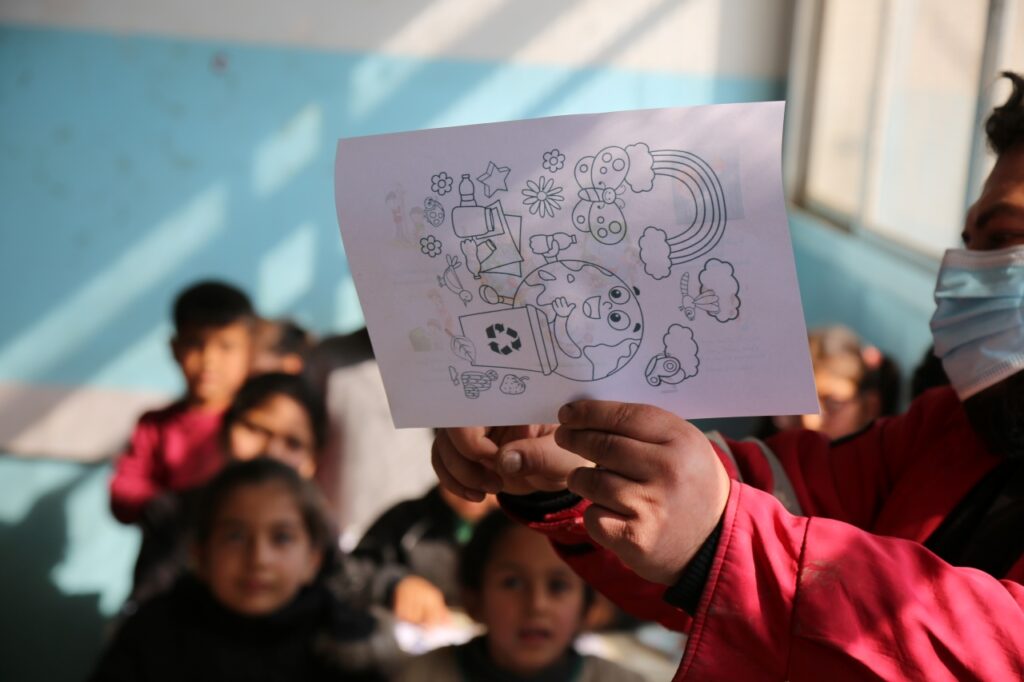
Alongside local institutions, numerous civil associations are contributing to environmental awareness. "Organisations such as Green Tress and Green NES are promoting reforestation and care for the land," says Issa. "They have even started educational programmes in schools, where every student has planted a tree in the courtyard to learn how to take care of it.
Rojava's vision is one of a future based on sustainability and self-sufficiency. "We want a green Syria, a Rojava full of water and vegetation," Issa states with determination. "Once this region was called Al-Jazeera, the island surrounded by the Euphrates, Khabur and Tigris rivers. Now the Khabur has almost disappeared, the Euphrates is drying up and the Tigris is constantly threatened'.
The obstacles are enormous: bombings, border restrictions, reduced budgets and an unstable political situation. Despite everything, hope is not lost. "We are fighting for a Rojava that can live without war, without water shortages, without pollution," Issa concludes. "And even if everything seems difficult today, we know that another future is possible.
*This article was originally published on DinamoPress and is available at this link: https://www.dinamopress.it/news/ambiente-e-assedio-la-battaglia-ecologica-in-siria-del-nord-est/
After 15 months of genocide and an unprecedented level of destruction and death caused by Israel, the ceasefire agreement took effect on 19 January. The Gaza population that survived the genocide thus entered the first of three phases of a ceasefire process, each lasting 42 days.
The main objective is to secure the return of hundreds of thousands of forcibly displaced people to their home areas, and in particular to the almost completely destroyed northern Gaza Strip, - as well as the entry of humanitarian aid, the withdrawal of Israeli troops from urban areas, and the exchange of prisoners.
People have been walking back to their cities for days now. What they find, however, is often just a pile of rubble. A destruction that is not only material.
"This is the most difficult phase for the surviving population," our colleague Sharif Hamad, who has lived through many Israeli offensives, most recently in 2014, which destroyed his own home, tells us. 'It is the moment when the joy of surviving soon gives way to anguish: you find your homes in rubble, you realise who is no longer there. If you no longer have to fight to stay alive, you give way to trauma. And it is often devastating,' he says.
As explained by our colleagues at UAWC - Union of Agricultural Work Committees, with whom we have worked tirelessly over the past 15 months to bring concrete aid to the Palestinian population, the terms of the ceasefire agreement have been internationally monitored since early February, although the aid entering Gaza has not reached the necessary levels. Fuel, medicines and safe havens for the displaced population who have seen their homes destroyed are still severely insufficient. In parallel, statements by the new US administration have generated enormous concern:
"These are extraordinary and unbelievable statements about the intention to carry out ethnic cleansing against the people of Gaza and to reconstruct the Strip for the purpose of building speculation," the UAWC explained. At the same time, newly-appointed President Trump signed executive orders to sanction the International Criminal Court and those working to implement international laws with respect to holding Israel accountable for its heinous crimes. "These are actions that Isarele is supporting and that seriously jeopardise the possibility of implementing the second phase of the truce agreement," our colleagues insist.
And on the other hand, the situation in Gaza remains dramatic. Over 500,000 people have returned to the areas to the north of the 'Netzarim corridor ' - created by Israel in the course of its offensive to control the Strip and separate the northern area from the centre and the south - finding their property and homes destroyed, the land strewn with unexploded ordnance and severely polluted, posing a real risk to the population.
Health and psycho-social services remain grossly inadequate to the needs: there is still a major shortage of fuel, clean water, sanitation materials and safe shelters, UAWC explain. To this must be added the destruction of all civilian infrastructure and of the main arteries linking the cities of the Strip, making the transportation of aid and the movement of trucks, which are rarely able to reach the areas where the needs are greatest, even more complex.
In this situation, the plight of families living from fishing and farming remains very serious. According to UAWC data, at least80 per cent of Gaza's agricultural land has been destroyed, severely damaged or rendered unusable, particularly greenhouses and fruit and vegetable crops. Sea water remains largely, and equipment needed for fishing, storage sites and warehouses have been almost totally destroyed. In addition to this, cisterns, water plants and water desalination sources have been permanently contaminated, damaged or destroyed, making the sources of drinking water supply extremely unsafe, and now almost inaccessible to the population.
An overall situation that, as always, weighs doubly on women, those who pay the highest price for the lack of sanitation, but also severely affected socially and economically. As explained by UAWC, women's participation in social and economic life has not returned to pre-7 October 2023 levels.
This is why 'it is necessary to keep our attention high and continue to support the population of the Gaza Strip as much as possible,' Sharif recalls. At the same time, he denounced the extremely serious violations committed daily in the occupied territories of the West Bank, where the heart of Israeli military operations has shifted with continuous arrests, demolitions, raids and attacks by soldiers and settlers against the occupied population.
The immediate needs identified by our UAWC colleagues in the coming weeks include the provision of fuel and clean water; the reconstruction of roads to allow for the delivery of humanitarian aid; the rehabilitation of farmland so that it can be cultivated again, and the provision of seeds and fertilisers to return to minimum levels of economic subsistence and self-production; the rehabilitation of agricultural infrastructure; direct financial support to ensure the survival of families; the distribution of hygiene kits and medicines; and support for women with social and economic empowerment actions to return to the levels of women's participation prior to the genocide committed by Israel.
"Your closeness is needed now more than ever," Sharif emphasised. "The people need to feel that we are there, that we are not abandoning them, that we will continue to fight alongside them in the demands of this moment: justice and reconstruction. Those who have supported us have shown great courage in these months: thanks to the generosity of so many people, we have been able to bring Gaza water, food, toilets, tents to shelter from the rain and cold. But we must go on and continue. Because only with your support can we Palestinians look up to the sky again and see a new dawn'.
To find out what we have done so far with UAWC, click here.
On the night of 2 to 3 February, a Turkish bombing raid in the north-east of Syria hit and destroyed the 'Kobane Water Station', a vital water station for the population, which had already been damaged during the terrible earthquake in the winter of 2023. The power station consisted of two pumping stations, one of which was involved in a rehabilitation project of Un Ponte Per.
The pumping station that was hit by the Turkish bombardment drew water from the Euphrates River and then transmitted it to the second unit, where water purification took place, and where we would soon start an intervention to rehabilitate the facility, improve its efficiency and train its staff to ensure access to drinking water for more than 60,000 displaced people living in the entire Kobane area. The functioning of the entire water plant is currently totally compromised. Finally, a new borehole was drilled to extract water in the village of Al-Adhath, in the Shahba area, Tell Rifaat district, making water more accessible to the local population.
"The attacks on Kobane, and in particular against the civil water and electricity infrastructure, are unacceptable and constitute a crime against humanity. Daily life is becoming more and more difficult and in this way they want to force us to leave our land," says Yasser, a resident of Kobane.
The city, which recently celebrated the tenth anniversary of its liberation from the Islamic State, continues to experience precarious security conditions due to continuous Turkish bombardment and threats from Turkish-backed Islamist militias, which have already attacked and taken control of the Shahba and Membij areas in recent months, resulting in thousands of newly displaced people.
The impact of the Turkish bombardment over the past few days now affects more than 100,000 people in the entire Kobane area, which is already in a very precarious condition also due to the terrible earthquake that devastated the region in February 2023, also affecting and damaging the waterworks.
At the time, the already critical conditions of the displaced population had been severely aggravated by tremors reaching a magnitude of 7.7, causing 5,900 casualties and the destruction of over 2,000 civilian buildings. Since then, the more than 43,000 displaced people have been living in precarious conditions, without the possibility of returning to their homes and in the absence of safe shelters, food, medicine and clean water. For this reason, the Kobane Water Directorate had appealed for immediate support to increase its technical capacity. In response to this appeal, our intervention was planned, which would fit into a broader framework of activities we have been carrying out for years in north-east Syria to ensure environmental justice and work on proper waste disposal.
"Two years after the terrible earthquake that wreaked havoc across northern Syria, the inhabitants of Kobane are once again being affected by continuous Turkish attacks, which are targeting civilian infrastructure without distinction," explains Roberta, our programme desk officer for environmental justice interventions in the area. "The joy at the start of the work we were going to do to rehabilitate one of the most important water pumping stations in Kobane has been dissipated by the smoke of new rubble: tomorrow it will be even more difficult and expensive to rebuild," Roberta explains.
We strongly condemn the deliberate and indiscriminate attacks by the Turkish side against the civilian population in Syria, and in particular against civilian infrastructure necessary for survival: actions contrary to international law that must be stopped immediately.
After 13 years of uninterrupted conflict and war, Syria - forgotten by the international community and out of the media headlines - is back in the news for yet another crisis affecting its population. What has been happening since the end of November is a direct consequence of turning our eyes away from that context, forgetting a conflict that continues uninterrupted with a devastating impact on the lives of hundreds of thousands of people.
From Aleppo to Idlib to Hama, the situation is serious and is affecting the population and the possibility of action by humanitarian actors.
We at Un Ponte Per have been present in the North East of Syria since 2015, working side by side with a number of long-standing local partners - including the Kurdish Red Crescent (Heyva Sor a Kurd - KRC) and Doz International, with interventions aimed at ensuring free access to healthcare, rebuilding the local health system, creating Safe Spaces to support women and children survivors of war and gender-based violence with psychological support and education.
Today, we can only observe what is happening with deep concern and anguish for our colleagues, friends and the entire population. With our ambulances and Mobile Medical Units we are preparing to receive new flows of people fleeing, restless, seeking shelter, moving to where they are most needed to provide first aid and guidance. In the coming hours, we expect at least 120,000 people to arrive.
In the city of Raqqa, still in rubble and far from overcoming the page of war that has engulfed it, we have set up a first aid point in the city stadium together with KRC to receive people fleeing. These are mainly Kurdish people, previously displaced from Afrin, who are now leaving Aleppo moving eastwards.
In the meantime, we are reconverting our work in Raqqa into first aid interventions: the Safe Spaces that usually support women and children survivors of gender-based violence, operational thanks to our local partner Doz International, are providing first reception, orientation and psychological support to the people arriving, who have joined those fleeing Lebanon in recent weeks. And it was precisely with our colleague Dilbrin, from Doz, that we had spoken a few days before this new crisis erupted, while another one was already unfolding on the ground: that of the Syrian people who had fled the war in Lebanon in recent years, forced to retrace their path in reverse, to escape this time the Israeli offensive on Beirut.
"The situation is very complicated, because Raqqa remains a city deeply wounded by the war, still partially in rubble, lacking schools, health facilities, normal living spaces for people," Dilbirin told us, explaining how the Safe Spaces for women and children opened together had become an important reference point for the population over the years. Both for those in Raqqa, who had finally found a place where they could be supported psychologically, and who had recently also started to provide remedial classes for children forced to drop out of school; and for the Syrian population arriving from Lebanon. "They already knew us because we had helped them in the past. When people came back, they knew they could count on us like you count on long-time friends. In Safe Spaces, we were able to direct them to services provided by other organisations, to give them a hand in putting conflict-torn lives back together again," Dilbrin said. Now, they will be joined by new flows of internal migration generated by this umpteenth emergency.
Since 27 November, in fact, the fighting front has been volatile, changing from day to day and making it extremely difficult to predict future scenarios. At the moment, the cities of Aleppo, Idlib and Hama are suffering the worst conditions, where heavy bombardment is reported, hitting key facilities such as water plants, schools, hospitals and clinics, making it very difficult to provide treatment and first aid.
Therefore, thanks to the valuable work of our colleagues and local partners, we will continue to do our utmost to support the population as we have always done, and as long as necessary.
Civil society is considered a key actor in the democratisation and development process of countries. Covering a range of fields, civil society acts as a bridge between local communities and the authorities, facilitating citizens' participation in public life and providing basic services. Iraqi civil society is no exception. In Iraq, the origins of civil society date back to the 1920s. Despite its early emergence, long years of authoritarian rule and several conflicts affected the effectiveness and involvement of civil society in the life of the country. It was only after the military ouster of Saddam Hussein in 2003 that civil society was finally able to flourish again. More than two decades after the US military invasion, Iraqi civil society is an important actor on the public stage, where it plays significant roles, including providing humanitarian aid to victims of war and violence, offering legal support to vulnerable and marginalised groups, promoting and consolidating the principles of peace, peaceful coexistence, human rights and justice, supporting women's rights, fighting corruption, monitoring parliamentary and provincial elections, and many more.
The role of civil society in Iraq is recognised by law, thanks to international treaties signed by Iraq and a series of national and regional laws adopted over the past two decades. In addition to these, a number of operational measures regulate civil society in the country.
After a first part on the origins of civil society and its role, the study presents an overview of the legal and operational framework governing civil society in central and southern Iraq, as well as in the Iraqi Kurdistan region. The study suggests a number of recommendations to local authorities to promote cooperation between civil society actors and institutions.
The research was carried out in the framework of the EU-funded project Mubadara - Fostering an Enabling Environment for Civil Society in Iraq, in partnership with Peace and Freedom Organisation and Ufuq Organisation for Human Development.
To download the full study:
Today, for us at Un Ponte Per, is an important day. In fact, Flai CGIL has chosen to give concrete support to our fundraising campaign 'Water for Gaza', with which we are distributing drinking water, food and hygiene kits to Palestinian families affected by the Israeli offensive, thanks to the valuable work of our local partner, the Union of Agricultural Work Comittees (UAWC).
The Union of Palestinian Agricultural Work Committees is an NGO that has been active for over 30 years in Palestine, supporting Palestinian farmers, workers and fishermen, protecting land and distributing seeds.
On 5 November 2024, Flai and Un Ponte Per signed an agreement that will allow the funds collected by the union from the payments made by Flai national workers in the general strikes of the last two years to be allocated to Gaza.
'We are proud to be able to stand by the martyred Palestinian people , ' explained Flai CGIL Secretary General Giovanni Mininni at the signing of the agreement . 'More than forty thousand deaths in one year is an intolerable reality. We want to actively promote in all areas of the organisation the spirit of militancy and solidarity necessary to build a permanent mobilisation against the war, for the implementation of a just transition that puts work, economic, environmental and social sustainability, democracy, freedom and Peace back at the centre'.
"At a time of unprecedented regional humanitarian crisis, any help can make a difference, as can forging solidarity links between European and Palestinian workers for the protection of land," said our President, Giulia Torrini, and our Director, Martina Pignatti . "All the more so because Flai's support will not only be limited to the humanitarian response to the emergency, but aims to promote initiatives of economic and technical support to small farmers and fishermen, often organised in cooperatives, to enable them to resume their activities as soon as possible once the humanitarian crisis is over. While denouncing the war crimes and grave violations of international law committed by the Israeli army, we are jointly committed to giving a horizon of hope to those in Palestine who refuse to abandon their land and surrender to despair'.
All of us at Un Ponte Per thank Flai for being able to build together another piece of the solidarity needed by the Palestinian population, particularly in the Gaza Strip, so that they can have decent access to water and food, and protect what remains of their farmland.